What RNC-MNN certification means in nursing
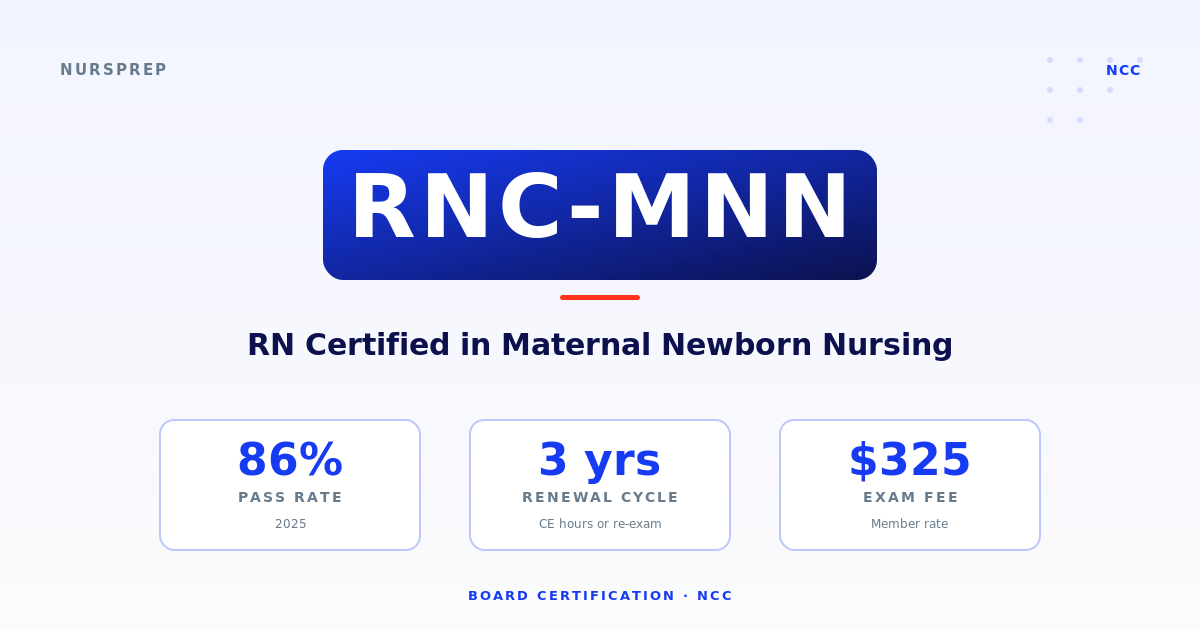
RNC-MNN stands for Registered Nurse Certified – Maternal Newborn Nursing, and it is the credential NCC awards to RNs who pass the Maternal Newborn Nursing core exam. The National Certification Corporation (NCC) — a Chicago-based certifier whose core and subspecialty programs are accredited by the National Commission for Certifying Agencies (NCCA) — also issues RNC-OB, RNC-NIC, RNC-LRN, WHNP-BC, and the obstetric and neonatal subspecialty exams.
The scope is what separates this credential from its neighbours. NCC defines the MNN exam as testing care of the childbearing family from birth to six weeks, in hospital and outpatient settings. Mother and baby are graded on the same exam: maternal postpartum content carries 51% of the items and newborn content carries 42%.
Certification is voluntary and separate from licensure. NCC says so directly — its certification carries no licensing authority, and the right to practise is regulated by state boards of nursing such as the California Board of Registered Nursing and the Florida Board of Nursing. Employers, not regulators, are what give RNC-MNN its weight.
Am I eligible for the RNC-MNN exam?
You are eligible if you hold a current, active, unencumbered RN license in the U.S. or Canada, and you have 24 months of specialty experience in maternal newborn nursing built on a minimum of 2,000 specialty hours. NCC is explicit that both criteria must be met — this is not an either/or rule.
Two details trip candidates up. The 2,000 hours may have been accumulated at any point in your career, so early mother-baby years still count. But you must also have been employed in the specialty sometime in the last 24 months, so a nurse who left postpartum practice five years ago no longer qualifies on career hours alone. Specialty experience may be direct patient care, education, administration, or research.
There is no degree requirement beyond RN licensure, no minimum GPA, and no employer sign-off gate. NCC verifies licensure from documentation you upload with the application, and an incomplete application costs $30 to reprocess.
You are a strong candidate if…
- You have at least 24 months in postpartum, mother-baby, couplet care, or newborn nursery practice, with 2,000 or more specialty hours logged and recent employment in the specialty.
- You assess fundus, lochia, perineum, and bladder as a single sequence and can tell atony from a full bladder before you reach for a uterotonic.
- You can grade a latch, troubleshoot engorgement and nipple trauma, and name the contraindications to breastfeeding without looking them up.
- You are comfortable with newborn transition — thermoregulation, glucose screening in the infant of a diabetic mother, bilirubin risk plotting, and the CCHD and metabolic screens your unit runs before discharge.
- You hold current Neonatal Resuscitation Program (NRP) provider status and have run the first minutes of a delivery-room or couplet-room resuscitation.
- You teach post-birth warning signs at discharge and can recognise postpartum preeclampsia, endometritis, and a perinatal mood or anxiety disorder in a patient who is already home.
What does the RNC-MNN exam cover?
The 2026 blueprint is five content categories. Maternal Postpartum Assessment, Management, and Education (26%) and Maternal Postpartum Complications (25%) together carry just over half the exam; Newborn Complications (22%) and Newborn Assessment and Management (20%) carry another 42%. Pregnancy, Birth Risk Factors and Complications is the smallest category at 7%.
- Maternal Postpartum Assessment, Management, and Education (physiologic changes, nursing care, psychosocial and ethical issues, lactation and feeding) 26%
- Maternal Postpartum Complications (hematologic, cardiopulmonary, infection, diabetes, psychological conditions and substance use) 25%
- Newborn Complications (cardiorespiratory, neuro and GI, hematologic, infectious disease, genetic/metabolic/endocrine) 22%
- Newborn Assessment and Management (transition, gestational age and physical assessment, care and family education, resuscitation) 20%
- Pregnancy, Birth Risk Factors and Complications (antenatal and intrapartum factors) 7%
That 7% is the section candidates misread. It is not a labour-and-delivery domain — it asks how antenatal and intrapartum events (gestational diabetes, preeclampsia, shoulder dystocia, chorioamnionitis, operative delivery, meconium) shape the couplet you receive afterwards. If you are studying fetal monitoring strips for this exam, you are studying for RNC-OB.
Lactation sits inside the largest category rather than standing alone, which understates how much of it appears. NCC's outline puts anatomy and physiology of lactation, latch, feeding cues, milk supply, mastitis, storage, and formula composition under Maternal Postpartum Assessment, Management, and Education alongside physiologic changes, medications, and psychosocial and ethical issues.
NCC notes that the percentages represent a range of items per area and may total slightly more or less than 100. The sample score report merges the 7% and 25% categories into one 32% feedback line, so your results letter shows four content rows, not five.
What does RNC-MNN cost, and when can I test?
The exam costs $325 — a $50 non-refundable application fee plus a $275 testing fee — at the same price whether you sit at an AMP/PSI test center or take the exam through Live Remote Proctoring (LRP) from home. There are no application deadlines and no fixed testing windows: apply whenever you are ready, and NCC takes 1 to 14 days to review.
Once NCC confirms eligibility you are placed in the next available 90-day window, and you must book your appointment inside the first 30 days of it. Test-center seats run Monday through Saturday at 9:00 am and 1:30 pm across more than 100 AMP assessment centers; LRP appointments are available around the clock. Scheduling requires at least four business days of lead time.
Nothing is scored at the test site. Pass/fail lands in your NCC account within 15 business days, with the content-area score report a day later — longer when NCC is running a new exam form.
| Fee item | Cost (USD) |
|---|---|
| Total exam fee (Test Center or LRP) | $325 |
| → Non-refundable application fee | $50 |
| → Testing fee | $275 |
| Incomplete application reprocessing | $30 |
| Change request (window, method, or category) | $125 |
| Withdrawal partial refund | $160 returned of $325 |
| Retake fee | Full $325 — no discount |
| Hand-score request | $55 |
| Maintenance fee (CCA pathway) | $100 — as low as $60 with NCC CE |
| Maintenance fee (alternative pathway) | $175 |
Renewal
RNC-MNN is awarded for three years, and NCC's maintenance program is competency-driven rather than a flat CE tally. At the start of each cycle you complete the Continuing Competency Assessment (CCA): 125 items mirroring the current MNN exam content, free, on demand, no pass/fail, 2 hours 15 minutes in one session, and worth 5 NCC CE hours.
The CCA produces a specialty index from 1 to 10 in each of four MNN competency areas — Pregnancy, Birth Risk Factors and Complications (5 hours); Postpartum Assessment, Management and Complications (20 hours); Newborn Assessment, Management and Complications (20 hours); Professional Practice (5 hours). Score 7.5 or higher in an area and you owe no CE there. Score below it and that area's hours land on your Education Plan.
A 15-hour baseline sits under the plan, so even a certificant who clears 7.5 everywhere owes 15 hours — less the 5 CE hours the CCA itself awards, which is 10 hours in the best case and 45 in the worst. Only CE earned after the CCA and matching the plan counts, which is why taking the assessment late in a cycle is the most common self-inflicted renewal problem.
You then submit a maintenance application with the $100 fee before your due date; using 15, 30, or 45 hours of NCC CE modules drops that to $80, $70, or $60. Applications are randomly audited, so keep certificates and course descriptions for outside CE — NCC module records are already on file. Opting out of the CCA is possible through alternative maintenance: 50 CE hours across every core content area, no discounts, no preceptorship or presentation substitutions, and a $175 fee. A certification that is not maintained lapses, and reinstatement is a one-year window with a fee.
How hard is the RNC-MNN exam?
The RNC-MNN pass rate has stayed between 84% and 94% in every year NCC has published since 2016, and landed at 86% on 1,656 candidates in 2025. That makes it the highest-scoring of NCC's core RNC exams and one of the more approachable specialty certifications in women's and infant health.
The number reflects who sits for it. NCC gates the exam behind 24 months and 2,000 specialty hours, so the candidate pool is experienced mother-baby nurses testing on work they do daily. The roughly one candidate in seven who does not pass usually loses ground in the two complications categories — maternal postpartum and newborn complications total 47% of scored items and cover conditions many couplet-care nurses see a handful of times a year.
There is no percentage cutoff to aim at. NCC scores criterion-referenced with item response theory (Rasch analysis), equating forms to a common scale, so a candidate on a harder form needs fewer correct answers than one on an easier form. Your report returns word descriptors — very weak through very strong — by content area, never a raw or scaled score.
An 8-week RNC-MNN study plan
Eight weeks suits most mother-baby RNs who already meet the 24-month eligibility bar, with question volume ramping from week 2 and a full-length timed run in week 7. Weight your calendar the way NCC weights the exam: about half the time on maternal postpartum content, a little over 40% on newborn content, and a single focused block on antenatal and intrapartum risk factors.
NCC neither sponsors nor endorses any review course, and it does not release retired items. Anything marketed as an RNC-MNN review course is independent of NCC. The Candidate Guide's own reference list is the closest thing to an official syllabus — it names 20 texts, including the Core Curriculum for Maternal-Newborn Nursing, AWHONN's Perinatal Nursing, Breastfeeding and Human Lactation, and the Textbook of Neonatal Resuscitation.
-
1 WeekRead the 2026 NCC MNN Candidate Guide outline end to end + baseline diagnostic
-
2 WeekPostpartum physiology and assessment — involution, lochia, REEDA, bladder, cardiopulmonary and hematologic shifts
-
3 WeekPostpartum nursing care and medications — analgesia, antihypertensives, uterotonics, RhIG, vaccines, patient education
-
4 WeekLactation and feeding — latch, supply, mastitis, contraindications, storage, formula composition, newborn fluid and caloric needs
-
5 WeekMaternal postpartum complications — hemorrhage and TXA, DVT and PE, endometritis and sepsis, postpartum preeclampsia, PMADs, substance use
-
6 WeekNewborn assessment and care — transition, thermoregulation, gestational age, screening, NRP, cord and skin care, safe sleep
-
7 WeekNewborn complications + full-length timed practice (175 items in 3 hours) and error-log review
-
8 WeekAntenatal and intrapartum risk factors, psychosocial and ethical issues, targeted weak-area review, logistics, test day
How RNC-MNN candidates actually fail — and how to avoid it
Sample RNC-MNN question
This item mirrors NCC's published three-option format: a short stem and three answer choices — one correct, two distractors, alphabetised by first word. NCC's own sample items are deliberately simpler than the real exam, so this one is pitched closer to test-day difficulty. Try it before reading the rationale.
The findings describe uterine atony with a contributing distended bladder — a boggy, high, right-deviated fundus with heavy bleeding after macrosomia and prolonged oxytocin exposure, both atony risk factors. Fundal massage is the immediate intervention because it restores tone and slows blood loss within seconds, and it can be performed while assessing the bladder in the same sequence. Emptying the bladder is the correct second step, not the first, because it takes minutes the patient is actively bleeding through. Escalating uterotonics is appropriate if massage and bladder emptying do not firm the fundus, but medication follows the mechanical intervention rather than replacing it.
Key RNC-MNN terms every candidate should know
These terms recur across MNN items. Review them until recall is automatic — three-option stems often turn on whether you can name which framework or finding applies before you compare the choices.
| Term | Definition | Domain |
|---|---|---|
| Involution | Return of the uterus to pre-pregnancy size, descending roughly one fingerbreadth per day after birth. A fundus that is high, boggy, or deviated points to atony, retained products, or a full bladder. | Postpartum |
| Lochia progression | Rubra (days 1–3), serosa (days 4–10), alba (up to about six weeks). A return to bright red bleeding after serosa suggests retained placental fragments or subinvolution. | Postpartum |
| REEDA | Redness, Edema, Ecchymosis, Discharge, Approximation — the structured perineal or cesarean incision assessment used to distinguish normal healing from infection or hematoma. | Postpartum |
| Post-birth warning signs | Discharge-teaching content named in NCC's outline; AWHONN publishes the version most U.S. units use. Covers the symptoms — chest pain, obstructed breathing, seizure, heavy bleeding, severe headache, fever — that send a postpartum patient back for care. | Postpartum |
| Postpartum preeclampsia | New or persistent hypertension with severe features after birth, including presentations that first appear days after discharge. Magnesium sulfate seizure prophylaxis and antihypertensive thresholds are testable. | PP Complications |
| Endometritis | Uterine infection presenting with fever, uterine tenderness, and foul-smelling lochia, most often after cesarean, prolonged rupture, or chorioamnionitis (Triple I). | PP Complications |
| PMADs | Perinatal Mood and Anxiety Disorders — postpartum depression, anxiety, OCD, and postpartum psychosis. Psychosis is the emergency: onset is typically early, and it carries acute risk to parent and infant. | PP Complications |
| Ballard score | New Ballard Score — neuromuscular and physical maturity assessment used to assign gestational age, and the tool that identifies the late preterm infant whose feeding, glucose, and bilirubin risks differ from a term newborn's. | Newborn |
| Transition to extrauterine life | NCC scopes this as birth to four hours: initial physiologic adaptation and thermoregulation, including heat loss by convection, conduction, radiation, and evaporation. | Newborn |
| IDM hypoglycemia | The infant of a diabetic mother is hyperinsulinemic at birth and prone to early hypoglycemia, along with macrosomia, birth injury, polycythemia, and hypocalcemia. Screening timing and feeding response are commonly tested. | Newborn |
| Hyperbilirubinemia risk | Bilirubin assessed by transcutaneous or serum measurement and plotted against hour-specific thresholds. ABO and Rh incompatibility, G6PD deficiency, bruising, and poor feeding all raise risk. | NB Complications |
| TTN | Transient Tachypnea of the Newborn — retained fetal lung fluid causing tachypnea and mild distress in the first hours, more common after cesarean without labour. Usually resolves within 24 to 72 hours. | NB Complications |
| NRP | Neonatal Resuscitation Program — the AAP and AHA algorithm behind the exam's resuscitation and stabilisation items, covering initial steps, positive-pressure ventilation, and evaluation of intervention effectiveness. | Newborn |
| Delayed cord clamping | Deferring cord clamping after birth to improve neonatal iron stores and transitional circulation. Listed in NCC's intrapartum factors alongside method of delivery and TOLAC. | Pregnancy/Birth |
| CCA specialty index | The 1-to-10 rating the Continuing Competency Assessment returns per competency area at renewal. A 7.5 or higher clears that area's CE requirement; anything lower generates hours on your Education Plan. | Renewal |
RNC-MNN vs. RNC-OB, RNC-NIC, RNC-LRN, C-EFM, IBCLC
RNC-MNN sits among several credentials that cover neighbouring patients, and the wrong choice costs $325 plus a 90-day window. Match the credential to where your hours actually are, not to the unit name on your badge.
| Credential | Body | Scope | Best fit |
|---|---|---|---|
| RNC-MNN | NCC | Childbearing family from birth to six weeks — postpartum patient and newborn on one exam | Postpartum, mother-baby, couplet care, and newborn nursery RNs |
| RNC-OB | NCC | Inpatient obstetric care after 20 weeks of gestation through discharge, including labour and birth and fetal assessment | L&D, antepartum, and OB triage RNs |
| RNC-NIC | NCC | Acutely and critically ill neonates within an intensive care environment | Level III and IV NICU RNs |
| RNC-LRN | NCC | Low-risk neonatal intensive care — newborn only, no maternal content | Level I and II nursery RNs who want a newborn-only credential |
| C-EFM | NCC | Electronic fetal monitoring subspecialty — an add-on, not a standalone core credential | Intrapartum RNs, providers, perinatal educators |
| C-OBE | NCC | Obstetric emergencies subspecialty, first reported in NCC’s 2025 statistics | OB rapid-response and emergency-team RNs |
| IBCLC | IBLCE | Lactation consulting — a separate certifier with its own clinical-hour and education pathways, open beyond nursing | Nurses and non-nurses practising as lactation consultants |
Take RNC-MNN if your day is the couplet — postpartum assessment, feeding support, newborn care, and discharge teaching. Choose RNC-OB instead if you spend most shifts at a labour bedside, and RNC-NIC if your patients are intubated. RNC-LRN is the newborn-only alternative when maternal content is not part of your assignment. If lactation is the whole job rather than a shift task, IBCLC through IBLCE is the credential that matches, and it can sit alongside RNC-MNN rather than replacing it.
Frequently asked questions about RNC-MNN certification
RNC-MNN stands for Registered Nurse Certified – Maternal Newborn Nursing. It is a core board certification from the National Certification Corporation (NCC) covering care of the childbearing family from birth to six weeks — the postpartum patient and the newborn on the same exam.
You need a current, active, unencumbered RN license in the U.S. or Canada, 24 months of maternal newborn specialty experience, and a minimum of 2,000 specialty hours. Both must be met, the hours can come from any point in your career, and you must have worked in the specialty sometime in the last 24 months.
Apply online at the NCC website — mail, fax, and email applications are not accepted — and upload your licensure documentation with the $325 fee. NCC reviews in 1 to 14 days, then places you in a 90-day testing window. Schedule your AMP/PSI test-center seat or Live Remote Proctoring slot within the first 30 days of that window.
Five categories: Maternal Postpartum Assessment, Management, and Education (26%), Maternal Postpartum Complications (25%), Newborn Complications (22%), Newborn Assessment and Management (20%), and Pregnancy, Birth Risk Factors and Complications (7%). There is no labour and birth or fetal monitoring domain.
NCC charges $325 total — a $50 non-refundable application fee plus a $275 testing fee — at the same rate for test-center and Live Remote Proctoring formats. Retakes pay the full $325 again, and an incomplete application adds a $30 reprocessing fee.
Three hours for 175 multiple-choice items — 150 scored plus 25 unscored pretest items — in a single block. Each item has a stem and three answer options: one correct answer and two distractors, alphabetised by first word.
NCC reported an 86% pass rate in 2025 on 1,656 candidates. The rate has run between 84% and 94% in every year NCC has published since 2016, which makes RNC-MNN the highest-scoring of NCC's core RNC exams.
There is no fixed percentage. NCC scores criterion-referenced using item response theory (Rasch analysis) and equates exam forms to a common scale, so pass or fail depends on your ability estimate against a criterion set by the Content Team. Reports return word descriptors by content area, not scores.
RNC-OB covers inpatient obstetric care from 20 weeks of gestation through discharge and includes labour and birth and fetal assessment domains. RNC-MNN starts at birth and runs to six weeks, splitting its items between maternal postpartum content and newborn content. Choose by where your hours are — labour bedside or couplet care.
You wait 45 days from your test date before reapplying, pay the full $325 again, and re-establish eligibility. There is no cap on lifetime attempts, but you may sit the same NCC exam only twice in a calendar year.
Yes, after three years. Renewal runs through NCC's Continuing Competency Assessment, which generates an individualised Education Plan of between 10 and 45 CE hours depending on your results. Only CE earned after the assessment and matching the plan counts, and a maintenance application plus a $100 fee is due before your maintenance date.
No. NCC states that it does not offer or sponsor review courses or review materials and does not release test questions, so every commercial RNC-MNN review course is independent of NCC. The reference list in the 2026 Candidate Guide is the closest thing to an official study syllabus.
Trusted sources
Every figure on this page traces to the primary sources below. Fees, blueprint weights, and maintenance rules move on NCC's revision cycle — check the current Maternal Newborn Nursing Candidate Guide before you make an application decision on a number you read here.
- National Certification Corporation (NCC) — Maternal Newborn Nursing exam detail page (exam purpose, eligibility, $325 fee, 175 items / 3 hours, 90-day window, scheduling and results rules) — nccwebsite.org/certification-exams/details/4
- NCC 2026 Candidate Guide — Maternal Newborn Nursing (RNC-MNN®) PDF (fees and policies, three-option item format, five-category content chart with 7/26/20/25/22 weights, full test content outline, competency statements, study resources, sample questions, Rasch scoring, maintenance terms) — nccwebsite.org/content/documents/cms/mnn-candidate_guide.pdf
- NCC — Four Steps to Continuing Competency (CCA brochure PDF): 125-item assessment, specialty index 7.5 threshold, MNN competency categories and hour weights, 15-hour baseline, $100 / $80 / $70 / $60 maintenance fees, $175 alternative maintenance — nccwebsite.org/content/documents/cms/cca-steps.pdf
- NCC Statistics — MNN pass-rate history 2016–2025 (87%, 84%, 90%, 92%, 93%, 90%, 94%, 90%, 86%) with candidates tested, plus INPT, NIC, LRN, and IAP comparison rows — nccwebsite.org/certification-exams/other-helpful-information/statistics
- NCC — Maintain your Certification (three-year term for all NCC certifications, core versus subspecialty lists, audit and unencumbered-licence rules) — nccwebsite.org/maintain-your-certification
- NCC — CORE RNC Examination Registration Catalog PDF — nccwebsite.org/content/documents/cms/exam-core.pdf
- NCC — Neonatal Intensive Care Nursing exam detail page, used for the RNC-MNN versus RNC-NIC scope distinction — nccwebsite.org/certification-exams/details/5
- NCC — Testing with Live Remote Proctoring — nccwebsite.org/certification-exams/testing-with-live-remote-proctoring
- Study references named in NCC's 2026 MNN Candidate Guide, including Baker et al., Core Curriculum for Maternal-Newborn Nursing (6th ed.); AWHONN's Perinatal Nursing (5th ed.); Wambach & Spencer, Breastfeeding and Human Lactation (7th ed.); and Weiner et al., Textbook of Neonatal Resuscitation (9th ed.)
Ready to practice RNC-MNN-style items?
Work through a 25-question diagnostic mapped to NCC's five-category 2026 blueprint, in the same three-option format the exam uses. Free to start — no card required.