SCRN certification at a glance
SCRN — Stroke Certified Registered Nurse — is the nursing-side benchmark for time-critical stroke care. The credential is issued by the American Board of Neuroscience Nursing (ABNN), the credentialing arm of the American Association of Neuroscience Nurses (AANN). ABNN launched the SCRN in 2012 in response to the rapid expansion of Primary Stroke Centers and Comprehensive Stroke Centers certified by The Joint Commission.
SCRN is a specialty certification, not a course. The blueprint maps directly to the AHA/ASA Guidelines for the Early Management of Acute Ischemic Stroke — the exact playbook Joint Commission surveyors audit during Stroke Center visits.
Am I eligible for the SCRN exam?
Yes — if you hold an active, unrestricted RN license in the US, Canada, or a participating US territory, and you have logged at least 2,080 hours of stroke nursing experience in the last 3 years.
The hours can be direct bedside or indirect (program administration, stroke coordinator roles). ABNN audits a random sample of applications, so keep job-title and employer documentation in case your file is selected.
You are a strong candidate if…
- You have at least 2,080 hours of stroke-nursing experience inside the last three years, in direct or indirect roles.
- You are comfortable naming at least three stroke assessment scales you use in practice and have performed NIHSS on real patients.
- You have administered or directly supported the administration of tPA / alteplase, including the post-tPA neuro-check schedule.
- Your setting fits a recognized stroke role: acute stroke unit, neuro ICU, ED at a Primary or Comprehensive Stroke Center, stroke rehab, stroke-focused home health, or stroke program administration.
- You are comfortable with both ischemic and hemorrhagic stroke pathophysiology — including post-SAH vasospasm monitoring and ICH management.
SCRN exam blueprint — six domains (2026)
The SCRN blueprint is six domains weighted by the points in the stroke continuum where most nursing decisions happen. Hyperacute Care and Acute Care together carry about 49.4% of the exam — roughly half of your study time should live there.
- Anatomy, Physiology & Pathophysiology of Stroke 16.5%
- Primary & Secondary Preventative Care 11.2%
- Hyperacute Care (NIHSS, tPA, LVO, thrombectomy workflow) 24.7%
- Acute Care (post-tPA monitoring, BP targets, complications) 24.7%
- Post-Acute Care (rehab transitions, mRS, caregiver support) 11.2%
- Systems, Leadership & Quality Care (GWTG-Stroke, TJC standards) 11.7%
Do not under-index Systems, Leadership & Quality Care just because it feels non-clinical. GWTG-Stroke metrics, Joint Commission stroke-center standards, and interdisciplinary team coordination reliably show up on the exam. Candidates who rely only on bedside experience tend to bleed points in Systems and in Primary/Secondary Prevention.
Cost, scheduling, and testing windows
ABNN delivers the SCRN through PSI testing centers and also offers remote proctoring for candidates who prefer to test from a private, controlled space. After you apply online through the ABNN portal, you schedule into one of three testing windows: Winter (February), Spring (May), or Fall (September). Apply early — each window has a hard application deadline roughly 4 weeks before the testing period opens.
| Fee item | Cost (USD) |
|---|---|
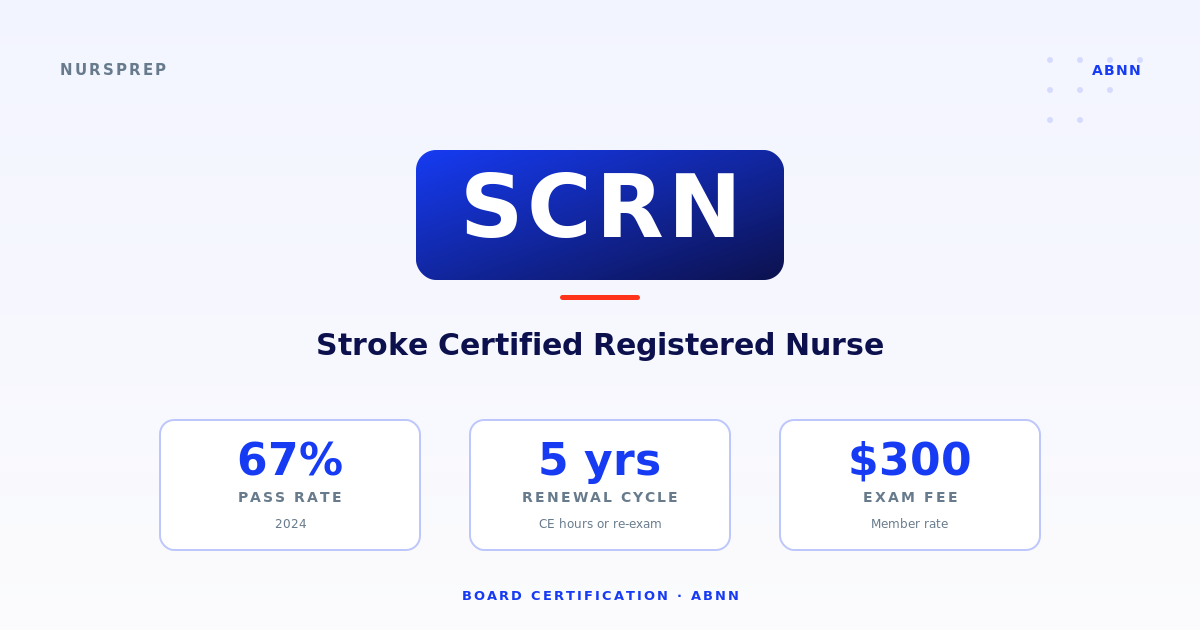
| Exam — AANN member (credit card) | $300 |
| Exam — AANN member (check / money order) | $325 |
| Exam — non-member (credit card) | $400 |
| Exam — non-member (check / money order) | $425 |
| Recertification by exam | Same as initial exam fee |
| CE Exam (recertification, per exam) — non-member | $40 |
| AANN annual membership (individual, approx.) | ~$109 |
Renewal
The SCRN is valid for five years. ABNN offers two renewal pathways. Pathway 1 — Recertification by Exam: retake the current SCRN exam in your renewal window at the standard exam fee. This is most suitable for nurses who find test-taking easier than accumulating targeted stroke-specific CE, or who want a fresh blueprint review every cycle.
Pathway 2 — Recertification by CE: under Option A, log 4,160 practice hours (about 2 years full-time) across the 5-year cycle plus 50 stroke-specific CE contact hours, with a minimum of 20 hours in Category 1. Option B accepts a lower 2,500 practice-hour floor but requires a higher CE load with a minimum of 30 Category 1 hours. All CE hours must be stroke-related — the most common audit failure is generic nursing CE that isn't stroke-specific. Keep certificates for six years in case of audit.
How hard is the SCRN exam?
ABNN reported 932 of 1,389 SCRN candidates passed the exam in 2024 — a 67% pass rate, below the published 5-year average of 71%. Most passing candidates report 8 to 12 weeks of focused study; candidates without direct bedside stroke exposure typically need 12 to 16 weeks.
The exam rewards guideline-based reasoning over rote memorization. Fluency with the AHA/ASA Early Management of AIS guidelines, the pre-tPA and post-tPA BP target grid, and the NIHSS item order is the single biggest pass-rate lever. 2022–2023 candidate volumes trend similarly to 2024, though official year-level counts are pending publication in the 2026 ABNN handbook.
An 8-week SCRN study plan
A structured 8-week plan is enough for most RNs with stroke-unit or ED experience — roughly 69 total study hours across the six blueprint domains. Hyperacute and Acute Care each get two dedicated weeks (weeks 3–6), and the plan wraps with a full-length practice exam and targeted review.
-
1 WeekAnatomy & pathophysiology — map all vascular territories + stroke subtypes
-
2 WeekPrimary & secondary prevention — HTN, AF, dyslipidemia targets
-
3 WeekHyperacute care (Part 1) — NIHSS certified; tPA inclusion/exclusion
-
4 WeekHyperacute care (Part 2) — LVO recognition + thrombectomy window
-
5 WeekAcute care (Part 1) — BP management targets nailed
-
6 WeekAcute care (Part 2) — complications + DVT prophylaxis
-
7 WeekPost-acute + systems — mRS scoring + GWTG-Stroke metrics
-
8 WeekFull-length practice exams (×2) + gap review
How SCRN candidates actually fail — and how to avoid it
Sample SCRN question
This item mirrors ABNN's scenario format: a short clinical stem, a time-pressured decision, and four plausible options where only one is most appropriate. Try it before you read the rationale.
Pre-tPA BP must be ≤185/110 per AHA/ASA guidelines. Administering tPA with uncontrolled BP significantly increases hemorrhagic conversion risk, so labetalol (or nicardipine) is given first to lower BP into range. Option A is unsafe; Option C wastes the tPA window; Option D is unnecessary when the initial CT was diagnostic and negative for hemorrhage.
Key SCRN terms every candidate should know
These terms surface in most SCRN exam items. Review them until the definitions feel automatic — scenario-based stems often hinge on recognizing which framework (tPA window, LVO criteria, GWTG metric) applies.
| Term | Definition | Domain |
|---|---|---|
| Penumbra | Region of ischemic but salvageable brain tissue surrounding the infarct core — the target of reperfusion therapy. | Pathophysiology |
| LVO | Large Vessel Occlusion — proximal blockage of the ICA, M1 MCA, basilar, or P1 PCA; candidate for mechanical thrombectomy. | Hyperacute |
| tPA / Alteplase | IV thrombolytic; standard window 0–4.5 hours from last known well in eligible acute ischemic stroke patients. | Hyperacute |
| TNK / Tenecteplase | Newer IV thrombolytic; increasingly preferred for AIS per the 2024 AHA focused update. | Hyperacute |
| Door-to-Needle (DTN) | Time from ED arrival to IV thrombolytic bolus; AHA Target: Stroke goal ≤60 min, Phase II ≤45 min, Phase III ≤30 min. | Systems |
| NIHSS | NIH Stroke Scale — 0–42 points across 11 items; assesses stroke severity and drives serial post-tPA neuro checks. | Assessment |
| mRS | Modified Rankin Scale — 0 (no symptoms) to 6 (death); the functional-outcome measure used at discharge and follow-up. | Post-Acute |
| Last Known Well (LKW) | Last time the patient was observed at baseline neuro status; the anchor point for tPA and thrombectomy eligibility. | Hyperacute |
| ICH | Intracerebral Hemorrhage — a hemorrhagic stroke subtype; contraindicates tPA; BP management is central. | Pathophysiology |
| SAH | Subarachnoid Hemorrhage — often aneurysmal; complication watch includes vasospasm (days 3–14) and hydrocephalus. | Pathophysiology |
| Watershed Infarct | Ischemia at border zones between two major vascular territories — often hypoperfusion-related rather than embolic. | Pathophysiology |
| GWTG-Stroke | Get With The Guidelines–Stroke — the AHA quality-improvement registry that drives hospital-level stroke metrics. | Systems |
| BE-FAST | Balance, Eyes, Face, Arm, Speech, Time — stroke screening mnemonic; adds Balance + Eyes beyond FAST to catch posterior-circulation strokes. | Prevention |
| Dysphagia Screen | Bedside swallow check required before any PO intake (including oral medications) in all stroke patients. | Acute |
| ABCD² Score | Post-TIA stroke-risk stratification: Age, BP, Clinical features, Duration, Diabetes — 0 to 7; ≥4 drives admission. | Prevention |
SCRN vs. CNRN vs. CCRN
If you're weighing neuroscience certifications, the decision usually comes down to breadth versus depth. Here's how SCRN stacks up against the two credentials it gets compared with most often.
| Credential | Body | Scope | Best fit |
|---|---|---|---|
| SCRN | ABNN (AANN) | Stroke specifically — hyperacute through post-acute | Stroke unit, stroke coordinator, ED at stroke centers |
| CNRN | ABNN (AANN) | Broad neuroscience — stroke, TBI, tumor, epilepsy, neurosurgery | Neuro ICU generalists, neurosurgery floor RNs |
| CCRN (Adult, Neuro population) | AACN | Adult critical care (neuro patients included) | Neuro/critical-care crossover ICU RNs |
Choose SCRN if stroke patients are at least 60% of your caseload. Choose CNRN if your population spans TBI, tumor, epilepsy, and stroke in roughly equal measure. CCRN is the right fit if you are primarily a critical-care nurse who happens to see neuro — it renews every 3 years rather than 5 and has a different blueprint.
Frequently asked questions about SCRN certification
Moderate. The published 5-year average pass rate is 71%, with 2024 dipping to 67% (932 of 1,389 candidates). Most passing candidates report 8 to 12 weeks of focused study. The exam rewards guideline-based reasoning over rote memorization.
For most candidates, yes. The $300–$425 exam fee often pays back within a few months once the credential is reflected in compensation, hiring preference, or role access at Comprehensive or Primary Stroke Centers.
Technically yes — the 2,080-hour requirement allows indirect stroke care from ED, rehab, or administration roles. But candidates without direct bedside stroke experience typically struggle on the Hyperacute and Acute Care domains, which together are nearly half the exam.
8 to 12 weeks is the typical range, at 6 to 10 hours per week. Candidates without strong stroke bedside exposure often need 12 to 16 weeks.
SCRN is stroke-focused. CNRN covers the full neuroscience spectrum — stroke, TBI, tumors, epilepsy, neurosurgery. Pick based on your patient population: SCRN if stroke is ≥60% of your caseload, CNRN if your population is mixed.
Yes — every 5 years. Renew by exam or by completing 50 stroke-specific CE hours plus 4,160 practice hours (Option A). Option B accepts 2,500 practice hours with a higher CE requirement. All CE must be stroke-related.
Many Comprehensive and Primary Stroke Centers reimburse fees as part of clinical-ladder programs. Check your unit's education benefits or ask the stroke program coordinator before paying out of pocket.
Yes — ABNN offers remote proctoring through PSI. Test your equipment, webcam, and room-scan setup 24 hours in advance to avoid day-of disqualification.
You can retake the exam in the next testing window after a waiting period. Use the score report to target your weakest domains rather than re-studying the whole blueprint.
The credential is recognized in the US and Canada. Some international hospitals affiliated with US stroke networks recognize it as well, but outside North America recognition varies by institution.
Trusted sources
All figures on this page are verified against the following primary sources. Fees, blueprint weights, and recertification rules shift on ABNN's revision cycle — always verify numeric facts against the current ABNN handbook before relying on them for application decisions.
- American Board of Neuroscience Nursing (ABNN) — 2026 SCRN Candidate Handbook, eligibility, application, recertification
- American Association of Neuroscience Nurses (AANN) — SCRN Review Course, Self-Assessment Exam, membership pricing
- AHA/ASA 2019 Guidelines for the Early Management of Acute Ischemic Stroke (and subsequent focused updates)
- AHA Target: Stroke — Phase I, II, III door-to-needle targets and GWTG-Stroke quality metrics
- CDC Stroke Facts — 795,000+ annual strokes; 162,639 deaths in 2023; stroke as 4th leading cause of death
- DAWN and DEFUSE 3 trials — 24-hour thrombectomy window eligibility in imaging-selected LVO
- The Joint Commission — Primary Stroke Center and Comprehensive Stroke Center certification standards
- US Bureau of Labor Statistics — Occupational Employment and Wage Statistics for Registered Nurses ($98,430 median)
- Saver JL. Time is brain — quantified. Stroke. 2006 (1.9 million neurons lost per minute in untreated AIS)
Ready to practice SCRN-style items?
Work through a 25-question diagnostic mapped to the 2026 ABNN blueprint — weighted toward Hyperacute and Acute Care. Free to start — no card required.