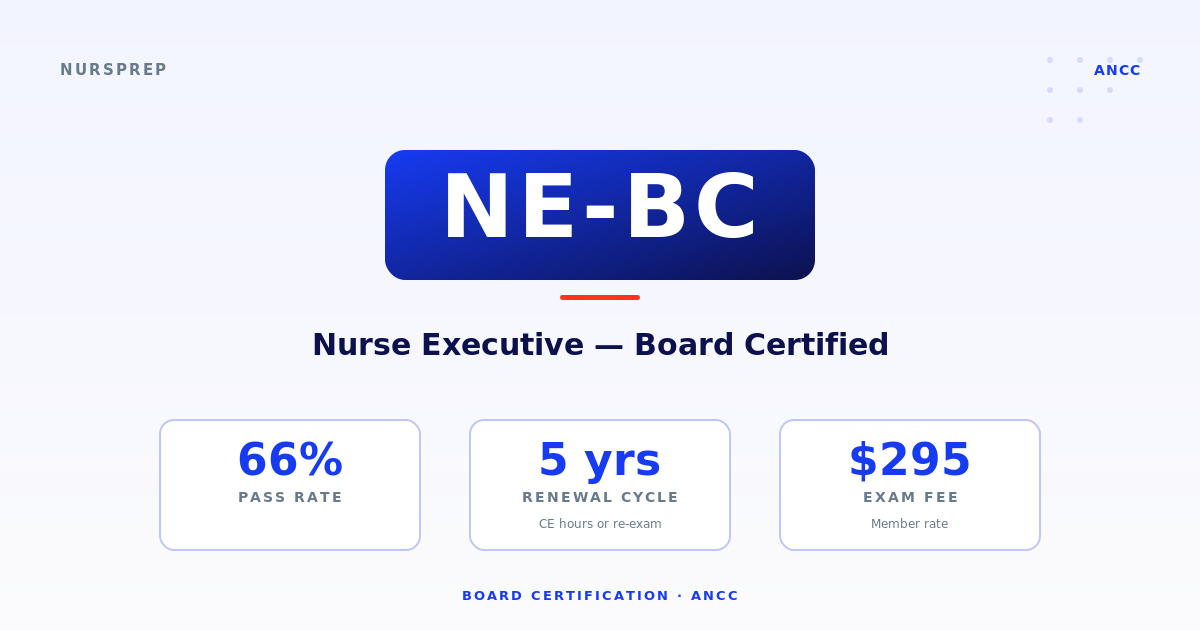
NE-BC certification at a glance
NE-BC — Nurse Executive — Board Certified — is ANCC's credential for nurse leaders with accountability for a single unit, team, service line, department, or program. The credential is issued by the American Nurses Credentialing Center (ANCC), the credentialing arm of the American Nurses Association (ANA), and is reported on the most recent ANCC certification-data release as being held by 9,156 active credential holders.
NE-BC is a board certification, not a course. It is frequently confused with NEA-BC — ANCC's enterprise- or system-level executive credential — but only NE-BC is the first-line and middle-leader credential. Each appears on its own line after RN.
Am I eligible for the NE-BC exam?
You are eligible if you hold an active, unencumbered RN license in the United States (or a legally recognized equivalent in another country) AND meet ANCC's education, practice, and continuing-education gates. Unlike credentials where hours are recommended but not enforced, ANCC enforces these gates as hard rules — applicants who fall short must accumulate the hours before applying.
The five eligibility rules are: (1) active RN license, (2) bachelor's or higher degree in nursing, (3) the equivalent of 2 years of full-time RN practice, (4) 2,000 hours of nursing administration practice within the last 3 years, and (5) 30 hours of continuing education in nursing administration within the last 3 years.
You are a strong candidate if…
- You currently lead a defined group of nurses or non-nursing staff — assistant nurse manager, nurse manager, charge nurse with formal scheduling and staffing responsibility, unit director, service-line director, program manager, or nursing supervisor.
- Your last three years of timesheets show at least 2,000 hours in roles where you direct staff, set schedules, manage budgets, or own quality and safety outcomes — not pure bedside hours.
- You hold a BSN or higher (MSN, DNP, PhD in nursing all qualify); ANCC will not accept a non-nursing bachelor's degree.
- Your CE transcript has at least 30 contact hours in nursing administration, leadership, or management within the last 3 years — clinical-topic CE does not count toward this gate.
NE-BC exam blueprint — five content areas
The NE-BC exam covers five major content areas. ANCC publishes the exact percentage weights in the Test Content Outline PDF on the NE-BC credential page; the five domains themselves are confirmed across the issuing body and corroborating sources.
- Structures and Processes 20%
- Human Resource Management 20%
- Quality and Safety 20%
- Business Management 20%
- Health Care Delivery 20%
Business Management and Quality and Safety are where most candidates lose points. Unit-based managers often spend more day-to-day time on human-resources problems than on operating budgets or quality-improvement methodology — block dedicated weeks to budgets, variance analysis, NDNQI indicators, and PDSA methodology before exam day.
Cost, scheduling, and ANA-member savings
ANCC delivers NE-BC at Prometric testing centers. Once your application is approved, you receive an Authorization to Test (ATT) with a 120-day scheduling window — book your Prometric seat early in that window to avoid reapplying.
| Fee item | Cost (USD) |
|---|---|
| Initial application — ANA member | $295 |
| Initial application — non-member | $395 |
| Retake (after 60-day wait) | $270 |
| Renewal — ANA member | $275 |
| Renewal — non-member | $375 |
| ANA annual membership (reduces exam and renewal fees) | ~$15/month |
Renewal
NE-BC certification is valid for 5 years. ANCC offers two renewal pathways under the Certification Renewal Handbook effective 2025-09-10. Pathway 1 — Continuing Education: complete 75 contact hours of continuing education in nurse executive practice within the 5-year cycle AND complete one additional professional development category (academic credits, presentations, publications, preceptorship, professional service, or an evidence-based practice or research project).
Pathway 2 — Recertification by Examination: retake and pass the current NE-BC exam at the renewal fee. There is no extended grace period for a lapsed NE-BC — lapsed candidates must follow ANCC's reinstatement process to regain the credential.
How hard is the NE-BC exam?
The most recent ANCC certification-data release reports a 66% pass rate on the NE-BC exam, with 9,156 active NE-BC credential holders. Two-in-three first-time candidates pass — but the gap between the passing third and the failing third is almost entirely about structured study of the business-management and quality-and-safety domains, not clinical leadership instinct.
Unit-based managers tend to over-rely on day-to-day operational experience and underprepare for operating budgets, variance analysis, productivity metrics (HPPD, NHPPD), NDNQI indicators, and PDSA methodology. Candidates who block dedicated study weeks for these topics — and who complete at least one full-length timed practice exam — pass at meaningfully higher rates than those relying on work experience alone.
A 10-week NE-BC study plan
A structured 10-week study plan covers the five-domain blueprint for most working nurse leaders — roughly 80 to 120 total study hours. Practice-question volume ramps through weeks 2–8 and peaks in week 9 with a full-length 175-item timed exam; week 10 is for targeted review, logistics, and a rest day.
-
1 WeekRead ANCC NE-BC Test Content Outline + baseline diagnostic
-
2 WeekStructures and processes — governance, Magnet, shared decision-making
-
3 WeekHuman resource management I — staffing, just culture, performance
-
4 WeekHuman resource management II — labor law (FLSA, ADA, FMLA), interview practice
-
5 WeekQuality and safety I — NDNQI, RCA, FMEA, PDSA cycles
-
6 WeekQuality and safety II — sentinel events, never-events, CMS quality programs
-
7 WeekBusiness management — operating + capital budgets, variance, HPPD, business cases
-
8 WeekHealth care delivery — care-delivery models, regulatory framework (TJC, CMS CoP)
-
9 WeekFull-length timed practice exam (175 items in 3.5 hours) + error-log review
-
10 WeekTargeted review of weak domains, rest, test day
How NE-BC candidates actually fail — and how to avoid it
Sample NE-BC question
This item mirrors ANCC's scenario format: a short leadership stem, an operational problem, and four plausibly-correct options where only one is best. Try it before you read the rationale.
A doubled CAUTI rate against a stable patient mix and without an obvious driver is exactly what an RCA is designed for — surface latent factors (workflow, equipment, communication) by engaging frontline staff and the infection prevention team. Mass email reminders rarely change practice. Daily manager audits address symptoms, not causes, and are unsustainable. Adding FTEs without root-cause evidence is a budget action that will not survive variance review.
Key NE-BC terms every candidate should know
These terms surface across the five NE-BC domains. Review them until the definitions feel automatic — scenario-based stems often hinge on recognizing which framework (RCA, FMEA, PDSA, just culture) applies to the operational problem in the stem.
| Term | Definition | Domain |
|---|---|---|
| Just culture | A workplace framework that distinguishes human error, at-risk behavior, and reckless behavior — guiding consistent, fair responses to clinical incidents. | HR Mgmt |
| RCA | Root-cause analysis — a structured method for identifying the underlying causes of a sentinel event or quality failure, focused on system factors rather than individual blame. | Quality/Safety |
| FMEA | Failure Mode and Effects Analysis — a proactive method for identifying potential failure points in a process before they cause harm. | Quality/Safety |
| PDSA | Plan-Do-Study-Act — the four-step iterative cycle for testing small-scale changes to clinical or operational processes. | Quality/Safety |
| NDNQI | National Database of Nursing Quality Indicators — a nursing-sensitive benchmarking database tracking unit-level indicators such as falls, pressure injuries, and CAUTI. | Quality/Safety |
| HPPD / NHPPD | Hours Per Patient Day / Nursing Hours Per Patient Day — staffing productivity metrics comparing nursing labor to patient census. | Business Mgmt |
| Variance analysis | The structured review of differences between budgeted and actual values — for labor, supplies, revenue, or productivity — to identify operational levers. | Business Mgmt |
| Magnet Recognition | ANCC's organization-level recognition program for nursing excellence — used as a quality-and-leadership signal for staffing, governance, and outcomes. | Structures |
| Shared governance | A nursing decision-making structure in which clinical nurses and leaders share authority over practice, quality, and professional development decisions. | Structures |
| EMTALA / TJC / CMS CoP | Emergency Medical Treatment and Labor Act; The Joint Commission accreditation; CMS Conditions of Participation — the three federal/accreditation frameworks most likely to appear in regulatory items. | Health Care Delivery |
NE-BC vs. NEA-BC, CENP, CNML
NE-BC sits alongside three other executive-track credentials nurse leaders sometimes consider. Many candidates Google "NE-BC" when they actually mean NEA-BC, so the distinction matters before you spend time or money.
| Credential | Body | Scope | Best fit |
|---|---|---|---|
| NE-BC | ANCC | Unit, team, service-line, department, or program leadership | First-line and middle nurse leaders (BSN+) |
| NEA-BC | ANCC | Enterprise- or system-level nurse executive practice | Senior nurse executives (master's required) |
| CENP | AONL | Executive-level nurse leadership | Executive nurse leaders aligned with AONL framework |
| CNML | AONL | Nurse manager leadership | Nurse managers aligned with AONL framework |
Take NE-BC if you currently lead a single unit, team, service line, department, or program. Move to NEA-BC once you hold a master's degree and your scope grows to enterprise or system level. Consider CENP or CNML if your employer or magnet program specifically recognizes the AONL credential family.
Frequently asked questions about NE-BC certification
NE-BC stands for Nurse Executive — Board Certified. The credential is issued by the American Nurses Credentialing Center (ANCC).
No. NE-BC is the first-line and middle-leader credential for nurses accountable for a unit, team, service line, department, or program. NEA-BC is the advanced credential for senior nurse executives leading at the enterprise or system level and requires a master's degree.
You need 2,000 hours of nursing administration practice within the last 3 years, plus 30 hours of continuing education in nursing administration in the same window, plus an active RN license and a bachelor's or higher degree in nursing.
The initial NE-BC application fee is $295 for ANA members and $395 for non-members. A retake after a failed attempt costs $270, and you must wait at least 60 days before retesting.
The most recent ANCC certification-data release reports a 66% pass rate. Most candidates lose points in the Business Management and Quality and Safety domains, where formal training is often lighter than day-to-day human-resources work.
The NE-BC exam has 175 multiple-choice items (150 scored plus 25 unscored pretest) delivered over a 3.5-hour time limit at Prometric testing centers.
ANCC reports NE-BC results as a scaled score on a 0–500 scale, with 350 as the passing standard.
Yes. NE-BC is valid for 5 years. You renew by completing 75 contact hours of continuing education in nurse executive practice plus one additional professional development category, or by retaking the current NE-BC exam.
Many Magnet and Pathway-to-Excellence health systems reimburse certification fees through a clinical-ladder or leadership-development benefit. Ask your nursing-professional-development leader or HR before paying out of pocket.
An MSN or higher degree in nursing satisfies the bachelor's-degree requirement. ANCC does not accept a non-nursing bachelor's degree as a substitute.
Trusted sources
All figures on this page are verified against the following primary and secondary sources. ANCC revises fees, blueprint weights, and renewal rules on its own cycle — always verify numeric facts against the current ANCC handbook before relying on them for application decisions.
- American Nurses Credentialing Center (ANCC) — Nurse Executive Certification (NE-BC) credential page: nursingworld.org/our-certifications/nurse-executive/
- ANCC Certification Renewal Handbook, effective September 10, 2025 (renewal requirements, CE rules, and reinstatement)
- 2025 ANCC Certification Data — NE-BC pass rate and active credential holder counts
- ANCC NE-BC Test Content Outline (downloadable PDF on the credential page) — five-domain blueprint and item allocations
- American Nurses Association (ANA) — membership tiers and fee structures used to compute the ANA-member exam fee
- boardcerts.com — NE-BC exam summary (corroborating source for exam format and 175-item / 3.5-hour structure)
- nursingexams.org — ANCC exam costs and retake policy (corroborating source for fees and 60-day retake wait)
Ready to practice NE-BC-style items?
Work through a 25-question diagnostic mapped to the five NE-BC content areas. Free to start — no card required.