NPD-BC certification at a glance
NPD-BC — Nursing Professional Development — Board Certified — is ANCC's specialty board certification for registered nurses who lead the design, delivery, and evaluation of staff education inside healthcare organizations. The credential is issued by the American Nurses Credentialing Center (ANCC), the credentialing arm of the American Nurses Association (ANA), and is reported on the 2024 ANCC certification-data release as being held by 6,574 active credential holders.
NPD-BC is a board certification, not a course. It is frequently confused with NPDA-BC — the advanced NPD credential issued by the Competency & Credentialing Institute (CCI) — and with the legacy ANCC RN-BC (in NPD) label that NPD-BC replaced. Each is a distinct credential; see the comparison section below before deciding which one applies to your role.
Am I eligible for the NPD-BC exam?
You are eligible if you hold an active, unencumbered RN license in the United States (or a legally recognized equivalent in another country) AND meet ANCC's education, practice, and continuing-education gates. Unlike credentials where hours are recommended but not enforced, ANCC enforces these gates as hard rules — applicants who fall short must accumulate the hours before applying.
The five eligibility rules are: (1) active RN license, (2) bachelor's or higher degree in nursing, (3) the equivalent of 2 years of full-time RN practice, (4) 2,000 hours of clinical practice in nursing professional development within the last 3 years, and (5) 30 hours of continuing education in nursing professional development within the last 3 years.
You are a strong candidate if…
- You currently work as a staff-development educator, clinical educator, nursing professional development specialist, simulation educator, transition-to-practice coordinator, orientation coordinator, or NPD program manager.
- Your last three years of timesheets show at least 2,000 hours in NPD practice — designing, delivering, and evaluating education for nursing or interprofessional staff — not pure bedside hours.
- You hold a BSN or higher (MSN, DNP, PhD in nursing all qualify); ANCC will not accept a non-nursing bachelor's degree.
- Your CE transcript has at least 30 contact hours in nursing professional development within the last 3 years — clinical-topic CE does not count toward this gate. ANPD-hosted CE is an obvious source.
NPD-BC exam blueprint — six content domains
The NPD-BC exam covers six content domains with the percentage weights below, taken directly from the ANCC NPD-BC Test Content Outline effective 2025-02-26. The total scored items (125) plus 25 unscored pretest items make up the 150-item exam.
- Educational Process Standards 26%
- Leadership 27%
- Ethical, Legal, and Regulatory Standards 15%
- Evidence-based Practice and Research 6%
- Technology 15%
- Program/Project Management and Process Improvement 11%
Leadership and Educational Process Standards together carry 53% of the scored items — over half the exam. Most failing candidates underprepare for the theoretical-models content (adult learning principles, novice-to-expert, transition-to-practice) and the leadership content (change management, healthy-work-environment, DEI advocacy) and over-rely on day-to-day teaching experience. Block dedicated weeks for both.
Cost, scheduling, and ANA-member savings
ANCC delivers NPD-BC at Prometric testing centers. Once your application is approved, you receive an Authorization to Test (ATT) with a 120-day scheduling window — book your Prometric seat early in that window to avoid reapplying. ANCC's initial-application price includes a $140 non-refundable administrative fee.
| Fee item | Cost (USD) |
|---|---|
| Initial application — ANA member | $295 |
| Initial application — non-member | $395 |
| Retake (after 60-day wait; max 3 attempts in 12 months) | $270 |
| Renewal — ANA member | $250 |
| Renewal — non-member | $350 |
| ANA annual membership (reduces exam and renewal fees) | ~$15/month |
Renewal
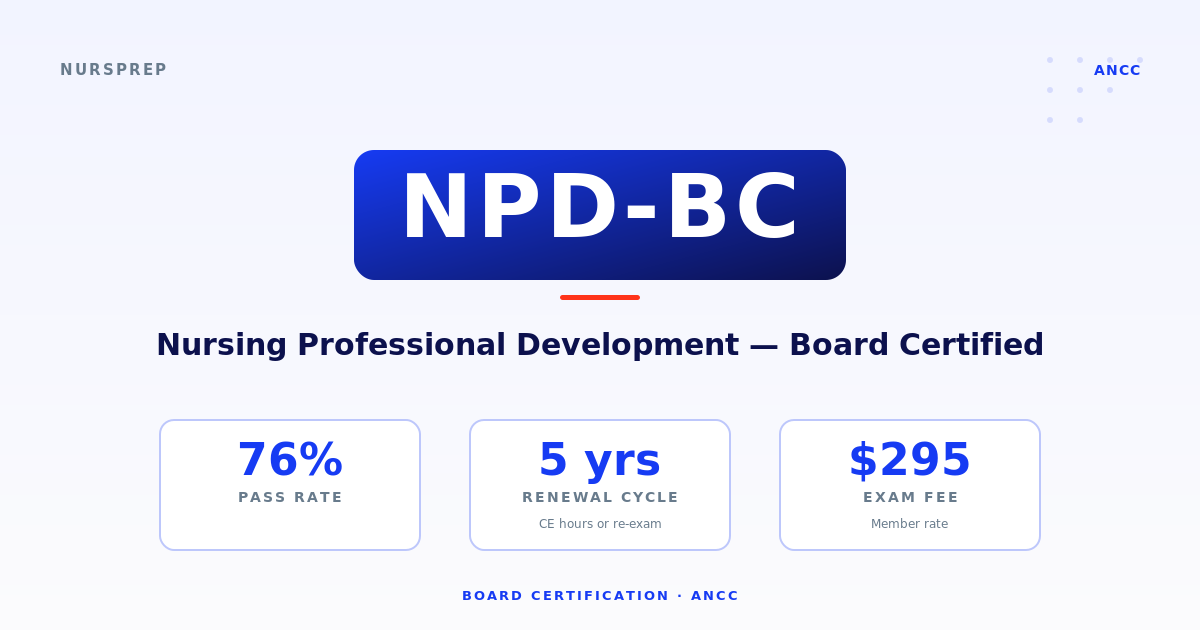
NPD-BC certification is valid for 5 years. ANCC offers two renewal pathways under the Certification Renewal Handbook effective 2025-09-10. Pathway 1 — Continuing Education: complete 75 contact hours of continuing education in nursing professional development within the 5-year cycle AND complete one additional professional development category (academic credits, presentations, publications, preceptorship, professional service, or an evidence-based practice or research project).
Pathway 2 — Recertification by Examination: retake and pass the current NPD-BC exam at the renewal fee. There is no extended grace period for a lapsed NPD-BC — lapsed candidates must follow ANCC's reinstatement process to regain the credential. Existing RN-BC (in NPD) holders renew under the NPD-BC label at their next renewal; the pathway is the same, the credential name changes on certificates issued from that cycle forward.
How hard is the NPD-BC exam?
The 2024 ANCC certification-data release reports a 76% pass rate on the NPD-BC exam, with 1,316 examinees, 1,006 passes, and 6,574 active NPD-BC credential holders. Three-in-four first-time candidates pass — but the failing quarter rarely fails on classroom-delivery skill. They fail on the theory frameworks and the leadership domain.
The most common failure pattern: NPD practitioners over-rely on day-to-day teaching experience and underprepare for the Leadership domain (27% — the largest single block) and the Educational Process Standards domain (26%), where the exam tests teaching/learning theories (behaviorism, cognitivism, social constructivism, adult-learning principles, educational neuroscience), professional-development models (novice-to-expert, transition-to-practice, performance-based competencies), and NPD Scope and Standards content that many candidates last reviewed in graduate coursework.
A 10-week NPD-BC study plan
A structured 10-week study plan covers the six-domain blueprint for most working NPD practitioners — roughly 80 to 120 total study hours. Practice-question volume ramps through weeks 2–8 and peaks in week 9 with a full-length 150-item timed exam; week 10 is for targeted review, logistics, and a rest day.
-
1 WeekRead ANCC NPD-BC Test Content Outline (effective 2025-02-26) + baseline diagnostic
-
2 WeekEducational Process Standards I — NPD Scope and Standards, adult learning theory (andragogy)
-
3 WeekEducational Process Standards II — ADDIE design, types of educational activities, competency management
-
4 WeekLeadership I — change management (Lewin, Kotter), healthy work environment, DEI advocacy
-
5 WeekLeadership II — communication, conflict resolution, mentoring, professional standards and credentialing
-
6 WeekEthical/Legal/Regulatory — ANA Scope & Standards, Code of Ethics, risk management (RCA, FMEA, just culture), HIPAA, copyright
-
7 WeekEvidence-based Practice + Technology — EBP models, LMS, simulation pedagogy, clinical technologies
-
8 WeekProgram/Project Management — PDSA, DMAIC, organizational performance indicators, sustainment strategies
-
9 WeekFull-length timed practice exam (150 items in 3 hours) + error-log review
-
10 WeekTargeted review of weak domains, rest, test day
How NPD-BC candidates actually fail — and how to avoid it
Sample NPD-BC question
This item mirrors ANCC's scenario format: a short education-design stem, an operational problem, and four plausibly-correct options where only one is best. Try it before you read the rationale.
The gap is between knowledge and application — recognized theory-of-practice transfer failure. A high-fidelity simulation with a structured debrief moves learners from declarative knowledge (the pathway exists) to procedural and conditional knowledge (when to escalate). One-page reminders rarely change practice. Re-delivering didactic that learners already passed will not address the transfer gap. Daily chart audits address symptoms, not the underlying learning need, and burn NPD bandwidth.
Key NPD-BC terms every candidate should know
These terms surface across the six NPD-BC domains. Review them until the definitions feel automatic — scenario-based stems often hinge on recognizing which framework (ADDIE, Benner, PDSA, just culture) applies to the education or quality problem in the stem.
| Term | Definition | Domain |
|---|---|---|
| Andragogy | Malcolm Knowles's framework for adult learning — adults learn best when material is relevant, problem-centered, self-directed, and respects prior experience. | Ed Process |
| ADDIE | Analyze, Design, Develop, Implement, Evaluate — the canonical five-phase instructional-design model for building educational activities. | Ed Process |
| Novice-to-expert (Benner) | Patricia Benner's five-stage model of clinical skill acquisition: novice, advanced beginner, competent, proficient, expert. The backbone of transition-to-practice programs. | Ed Process |
| Competency management | The structured process of defining, validating, and documenting role-based competencies — initial competency at hire and ongoing competency through the practice cycle. | Ed Process |
| Change management (Lewin / Kotter) | Lewin's three-stage unfreeze–change–refreeze model and Kotter's 8-step model — the two leadership frameworks for moving teams and organizations through planned change. | Leadership |
| Healthy work environment (HWE) | AACN's six-standard framework — skilled communication, true collaboration, effective decision-making, appropriate staffing, meaningful recognition, and authentic leadership. | Leadership |
| Just culture | A workplace framework that distinguishes human error, at-risk behavior, and reckless behavior — guiding consistent, fair responses to clinical incidents. | Ethical/Legal |
| NCPD | Nursing Continuing Professional Development — ANCC's accreditation framework for organizations providing continuing-education contact hours. | Ed Process |
| Iowa Model / JHN / Stetler | The three most-tested evidence-based-practice translation models — used to move research findings into bedside practice. | EBP/Research |
| PDSA / DMAIC | Plan-Do-Study-Act (rapid-cycle improvement) and Define-Measure-Analyze-Improve-Control (Six Sigma) — the two most-tested process-improvement methodologies. | Program Mgmt |
NPD-BC vs. NPDA-BC, legacy RN-BC, and CNE
NPD-BC sits alongside three other credentials NPD practitioners sometimes consider. Many candidates Google "NPD-BC" when they actually mean the CCI-issued NPDA-BC, or they wonder what to do with a legacy RN-BC. The distinctions matter before you spend time or money.
| Credential | Body | Scope | Best fit |
|---|---|---|---|
| NPD-BC | ANCC | Specialty board certification for the NPD practitioner — staff education in healthcare organizations | Staff-development educators, clinical educators, NPD specialists (BSN+) |
| NPDA-BC | CCI | Advanced NPD credential, separate eligibility track and issuing body | Advanced NPD practitioners with deeper leadership scope |
| RN-BC (legacy, NPD) | ANCC | Same ANCC specialty content as NPD-BC under the prior credential label | Existing holders certified before the NPD-BC rebrand — renew into NPD-BC |
| CNE | NLN | Academic educator credential — pre-licensure and graduate nursing faculty | Nursing faculty teaching in colleges and universities, not staff education |
Take NPD-BC if you currently lead the design, delivery, and evaluation of staff education in a healthcare organization. Move toward NPDA-BC if your scope grows into advanced NPD leadership and your employer recognizes the CCI credential family. Choose CNE if you teach pre-licensure or graduate students in academia. If you already hold the legacy RN-BC in NPD, your next renewal converts you to NPD-BC under the same ANCC content.
Frequently asked questions about NPD-BC certification
NPD-BC stands for Nursing Professional Development — Board Certified. The credential is issued by the American Nurses Credentialing Center (ANCC) and recognizes registered nurses who design, deliver, and evaluate staff education inside healthcare organizations.
No. NPD-BC is ANCC's specialty board certification for the NPD practitioner. NPDA-BC is the advanced NPD credential issued by the Competency & Credentialing Institute (CCI) — a different issuing body, a different eligibility track, and an advanced scope.
You need 2,000 hours of clinical practice in nursing professional development within the last 3 years, plus 30 hours of continuing education in nursing professional development in the same window, plus an active RN license and a bachelor's or higher degree in nursing.
The initial NPD-BC application fee is $295 for ANA members and $395 for non-members. The price includes a $140 non-refundable administrative fee. A retake after a failed attempt costs $270, and you must wait at least 60 days before retesting.
The 2024 ANCC certification-data release reports a 76% pass rate — three in four first-time candidates pass. Most candidates lose points in the Leadership and Educational Process Standards domains, where the exam tests theoretical models (andragogy, novice-to-expert, change management) that working NPDs may not have revisited since graduate coursework.
The NPD-BC exam has 150 multiple-choice items (125 scored plus 25 unscored pretest) delivered over a 3-hour time limit at Prometric testing centers.
ANCC reports NPD-BC results as a scaled score on a 0–500 scale, with 350 as the passing standard.
Yes. NPD-BC is valid for 5 years. You renew by completing 75 contact hours of continuing education in nursing professional development plus one additional professional development category, or by retaking the current NPD-BC exam at the renewal fee.
No. Existing RN-BC (in NPD) holders renew under the new NPD-BC label at their next renewal cycle. The exam content and renewal pathway are the same; the credential name on certificates updates from that cycle forward.
Many Magnet and Pathway-to-Excellence health systems reimburse certification fees through a clinical-ladder, NPD-team, or education-budget benefit. Ask your NPD director or HR before paying out of pocket.
Trusted sources
All figures on this page are verified against the following primary and secondary sources. ANCC revises fees, blueprint weights, and renewal rules on its own cycle — always verify numeric facts against the current ANCC handbook before relying on them for application decisions.
- American Nurses Credentialing Center (ANCC) — Nursing Professional Development Certification (NPD-BC) credential page: nursingworld.org/our-certifications/nursing-professional-development/
- ANCC NPD-BC Test Content Outline, effective 2025-02-26 (six domains, 125 scored items, exact percentage weights)
- ANCC Certification Renewal Handbook, effective 2025-09-10 (renewal requirements, CE rules, and reinstatement)
- 2024 ANCC Certification Data — NPD-BC pass rate, examinee counts, and active credential holders
- American Nurses Association (ANA) — membership tiers and fee structures used to compute the ANA-member exam fee
- Association for Nursing Professional Development (ANPD) — certification-preparation resources and NPD specialty CE
- Competency & Credentialing Institute (CCI) — NPDA-BC credential page (disambiguation source for the advanced NPD credential)
- boardcerts.com — NPD-BC exam summary (corroborating source for exam format)
- nursingexams.org — ANCC exam costs and retake policy (corroborating source for fees and 60-day retake wait)
Ready to practice NPD-BC-style items?
Work through a 25-question diagnostic mapped to the six NPD-BC content domains. Free to start — no card required.