CDCES certification at a glance
CDCES — Certified Diabetes Care and Education Specialist — is the specialty credential for clinicians who deliver Diabetes Self-Management Education and Support (DSMES). The credential is issued by the Certification Board for Diabetes Care and Education (CBDCE), which rebranded the credential from CDE to CDCES in 2020. Older articles that reference "CDE" are talking about today's CDCES — the eligibility, exam, and recognition all carried forward.
Roughly 17,000 clinicians in the US hold the credential across hospitals, ambulatory clinics, primary care, retail pharmacy, community health, and home-based programs. The credential is open to a broad range of disciplines — RNs, dietitians, pharmacists, PAs, physicians, psychologists, and more — as long as your scope of practice includes diabetes self-management education.
Am I eligible for the CDCES exam?
CBDCE offers two eligibility routes. Most candidates qualify under the Standard Pathway: an active, unrestricted license in an eligible discipline, two years of professional experience, and 1,000 DSMES practice hours within the past 5 years (with at least 200 hours in the most recent year), plus 15 diabetes-related CE hours in the 2 years before applying.
The Unique Qualifications (UQ) Pathway is a parallel route for candidates who hold a master's degree or higher in a health-related field. The requirements are largely the same — some UQ applicants need 2,000 DSMES hours — but the application fee is lower at $200 vs. $350.
You are a strong candidate if…
- You hold an active, unrestricted license in an eligible discipline: RN, APRN/CNS, RD/RDN, RPh/PharmD, MD/DO, PA, OT, PT, podiatrist, optometrist, clinical psychologist, ACSM-CEP, MSW, or MCHES.
- You have logged 1,000+ DSMES practice hours in the past 5 years, with at least 200 hours in the most recent year. Telehealth DSMES and volunteer hours count if a supervisor can verify them.
- You have completed at least 15 diabetes-related CE hours in the past 2 years and can produce dated certificates.
- Your work centers on teaching diabetes self-management: assessment, pharmacology education, CGM and insulin pump coaching, nutrition counseling, behavior change, and psychosocial support.
- If your role is primarily medication titration and prescriptive management rather than education, BC-ADM may be the better fit — see the comparison section below.
CDCES exam blueprint — three domains (effective 2024-07-01)
The blueprint is three task-based domains. Domain II — Care and Education Interventions — is 70% of the exam on its own. If you only have time for one domain, drill Domain II: pharmacology (insulin, GLP-1 RAs, SGLT2 inhibitors, metformin, sulfonylureas), diabetes technology (CGM, pumps, AID systems, smart pens), MNT and carb counting, hypoglycemia and DKA prevention, behavior change, and motivational interviewing.
- Assessment 25%
- Care and Education Interventions 70%
- Standards and Practices 5%
Domain I (Assessment) anchors the exam in clinical data — labs, ADCES7 self-care behaviors, health literacy, and readiness to change. Domain III (Standards and Practices) is small at 5% but high-leverage: ADA Standards of Care (current year), the 2022 National Standards for DSMES, scope of practice, ethics, documentation, and program quality improvement.
Cost, scheduling, and return on investment
CBDCE delivers CDCES through PSI testing centers with live remote proctoring also available. The full process from application submission to test day typically runs 6–10 weeks: CBDCE responds to applications in 4–6 weeks and then gives you a 90-day scheduling window at PSI.
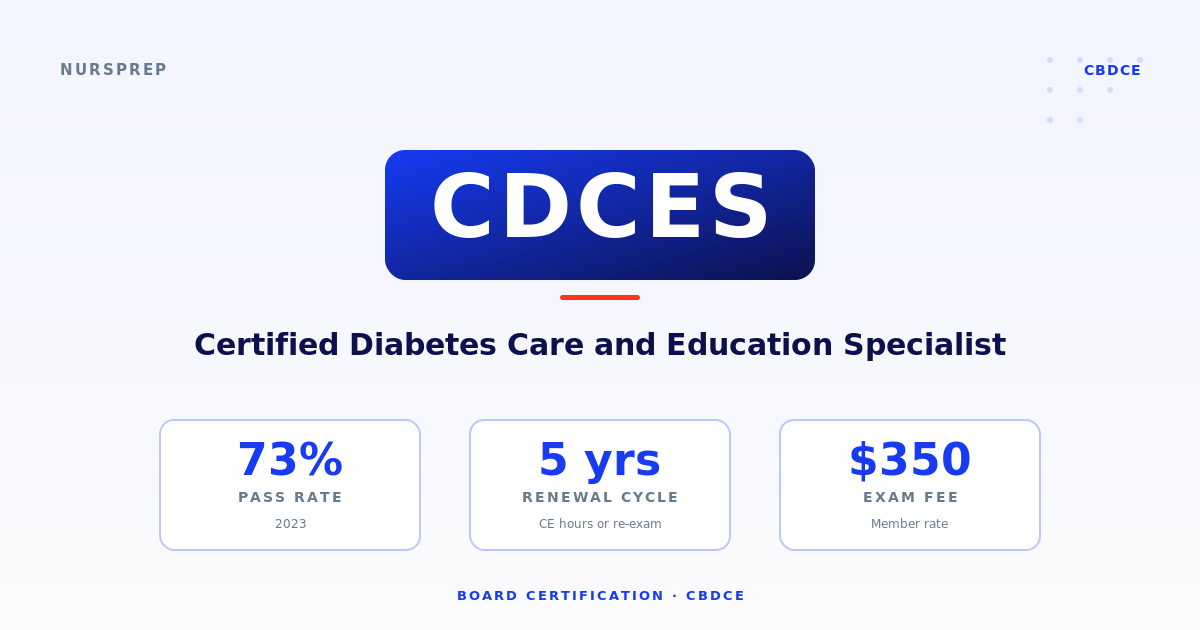
At a $350 application fee and a typical $5,000–$8,000 annual salary lift after certification (per Payscale and ZipRecruiter benchmarks), the credential pays back in roughly one month of post-certification work for most full-time clinicians. DSMES delivered at ADA- or ADCES-accredited programs is Medicare-reimbursable — and most accredited programs require CDCES.
| Fee item | Cost (USD) |
|---|---|
| Initial application — Standard Pathway | $350 |
| Initial application — UQ Pathway (master's degree) | $200 |
| Exam retake | $340 ($220 ADCES member) |
| Renewal by CE (every 5 years) | $350 |
| Renewal by exam (alternative route) | $350 |
| Avg reported salary lift post-certification | $5,000–$8,000 / yr |
Renewal
CDCES certification is valid for five years. Most clinicians renew through continuing education. Pathway 1 — Renewal by CE: continue to hold the same active, unrestricted license used for initial certification; accrue at least 1,000 DSMES practice hours during the 5-year cycle; complete 75 hours of diabetes-related CE; and starting in 2024, complete 2 CE activities focused on the ADA Standards of Care in Diabetes. Pay the $350 renewal fee.
Pathway 2 — Renewal by Examination: if you cannot meet the practice-hour or CE requirement, retake the CDCES exam. The fee mirrors the initial application. If your credential lapses, CBDCE allows reinstatement within 5 years — but reinstatement requires meeting current eligibility and passing the exam again, so renew on time.
How hard is the CDCES exam?
The reported CDCES pass rate was 73% in 2023, with multi-year averages closer to 63%. CBDCE publishes annual exam statistics; the 2023 figure is the most recent publicly available number at the time of writing. Pass rate matters less than how you prepare — candidates who complete a structured 10–14 week plan, score ≥ 75% on two timed practice exams, and address weak domains in the final week consistently report higher first-attempt success.
The top failure mode is underestimating Domain II. At 70% of the exam, Care and Education Interventions dominates — candidates who split their time evenly across all three domains walk in under-prepared on insulin pharmacology, CGM interpretation, and behavior change. Skipping the ADCES7 self-care behaviors and motivational-interviewing content alone typically costs 10–15 questions.
A 12-week CDCES study plan
Most successful candidates study for 10–14 weeks at 8–12 hours per week. The right resources mapped to the new three-domain blueprint save dozens of wasted hours. Anchor your plan around the ADCES Core Concepts Review Guide (latest edition), the ADA Standards of Care (current year), and a third-party question bank with rationales. Drill Domain II heavily — it is 70% of your score.
-
1 WeekDomain I — Assessment, ADCES7 self-care, lab interpretation
-
2 WeekDomain I — Risk factors, complications screening, health literacy
-
3 WeekDomain II — Pharmacology: insulin, GLP-1 RAs, SGLT2i, metformin, SUs
-
4 WeekDomain II — Insulin therapy: basal/bolus, carb ratios, sensitivity factors
-
5 WeekDomain II — Diabetes technology: CGM, pumps, AID, smart pens
-
6 WeekDomain II — CGM data interpretation + 3 device decision cases
-
7 WeekDomain II — MNT, carb counting, behavior change, motivational interviewing
-
8 WeekDomain II — Hypoglycemia, DKA/HHS prevention, sick-day rules, build a full DSMES plan
-
9 WeekDomain III — ADA Standards summary + 2022 National DSMES Standards
-
10 WeekFull-length timed practice exam + error-log review
-
11 WeekSecond full-length timed practice exam — target 75% or higher
-
12 WeekWeak-area review, light practice only, rest before exam day
How CDCES candidates actually fail — and how to avoid it
Sample CDCES question
This item mirrors CBDCE's scenario format: a short clinical stem, a patient on a real-world regimen, and four plausibly-correct options where only one is best. Try it before you read the rationale.
The pattern suggests the Somogyi effect — rebound hyperglycemia after nocturnal hypoglycemia. Confirming the pattern with CGM data is the appropriate first step before changing therapy. Increasing basal insulin (A) would worsen nocturnal hypoglycemia, a bedtime snack (B) may be appropriate later but is premature without data, and sliding-scale (D) is outdated and not evidence-based. This item maps to Domain II — Care and Education Interventions.
Key CDCES terms every candidate should know
Use this glossary while you study. Each term appears on the exam in multiple forms, often as a distractor in scenario-based items. Review until the definitions feel automatic.
| Term | Definition | Domain |
|---|---|---|
| A1C (HbA1c) | Average blood glucose over the previous 2–3 months. ADA target is generally < 7% for most non-pregnant adults. | Assessment |
| ADCES7 | The seven self-care behaviors framework: healthy coping, healthy eating, being active, taking medication, monitoring, reducing risks, problem solving. | Care & Education |
| AID system | Automated Insulin Delivery — closed-loop system that links a CGM and insulin pump to adjust insulin automatically. | Care & Education |
| CGM | Continuous Glucose Monitor — wearable sensor that reports glucose every 1–5 minutes. | Care & Education |
| DKA | Diabetic Ketoacidosis — acute, life-threatening hyperglycemic crisis seen mostly in type 1 diabetes. | Care & Education |
| DSMES | Diabetes Self-Management Education and Support — the core CDCES service, reimbursable under Medicare at accredited programs. | Standards |
| GLP-1 RA | Glucagon-like peptide-1 receptor agonists (semaglutide, liraglutide, tirzepatide-class). Weight loss + glycemic benefit. | Care & Education |
| HHS | Hyperosmolar Hyperglycemic State — hyperglycemic crisis seen mostly in type 2 diabetes; higher glucose and osmolality than DKA, minimal ketosis. | Care & Education |
| MNT | Medical Nutrition Therapy — dietitian-led nutrition counseling, often paired with DSMES. | Care & Education |
| SGLT2 inhibitor | Sodium-glucose cotransporter-2 inhibitors (empagliflozin, dapagliflozin); cardio- and renal-protective. | Care & Education |
| Time in Range | Percentage of CGM readings within target glucose range, typically 70–180 mg/dL. A core CGM outcome metric. | Assessment |
| Somogyi effect | Rebound hyperglycemia after nocturnal hypoglycemia; diagnosed with CGM before adjusting basal insulin. | Care & Education |
| Dawn phenomenon | Early-morning hyperglycemia from counter-regulatory hormones; often confused with the Somogyi effect. | Care & Education |
| MI (Motivational Interviewing) | Evidence-based counseling style that strengthens a patient's own motivation for change; core to Domain II behavior-change items. | Care & Education |
| 2022 National DSMES Standards | ADA and ADCES co-authored standards that define accredited DSMES programs and Medicare reimbursement eligibility. | Standards |
CDCES vs. BC-ADM: which credential fits your practice?
CDCES and BC-ADM are sister credentials — both governed by CBDCE since BC-ADM moved from ADCES to CBDCE in January 2025 — but they target different scopes of practice. Many APRNs and PharmDs hold both.
| Credential | Body | Scope | Best fit |
|---|---|---|---|
| CDCES | CBDCE | Education, behavior change, self-management | RN, RD/RDN, RPh, MD/DO, PA, OT, PT, podiatrist, optometrist, psychologist, MSW, MCHES, ACSM-CEP |
| BC-ADM | CBDCE (since Jan 2025) | Advanced clinical management, medication titration | RN, APRN, RD/RDN, PharmD, PA, MD/DO with graduate degree |
| CDE (pre-2020 name) | CBDCE | Historical name for CDCES — same credential | No longer awarded; existing CDE holders became CDCES |
| BE-MNT (dietitian subspecialty) | CDR | Board certification in medical nutrition therapy | RDs who want MNT depth rather than DSMES breadth |
Quick rule of thumb: choose CDCES if your work centers on teaching self-management. Choose BC-ADM if your license includes prescriptive authority and you adjust medications. BC-ADM requires a graduate degree (MSN, PharmD, MS, etc.) earned within the last 48 months and 500 advanced-management hours over 24 months — a tighter window than CDCES's 1,000 DSMES hours over 5 years. Dual CDCES/BC-ADM is common for APRNs and PharmDs who span both scopes.
Frequently asked questions about CDCES certification
Yes. CBDCE renamed the credential from CDE to CDCES in 2020. The eligibility, exam, and recognition all carried forward — older articles that say "CDE" are talking about today's CDCES.
Most candidates study for 10–14 weeks at 8–12 hours per week. Active diabetes clinicians need less structured review than candidates returning to diabetes practice after a break.
Yes. CBDCE accepts virtual DSMES delivery as long as it falls under your scope of practice and a supervisor can verify the hours if you are audited.
Yes. CBDCE accepts paid and volunteer DSMES hours, but a supervisor or other health professional must verify them if you are audited. Hours are capped at 40 per week regardless of actual time worked.
You may retake the exam in the next testing window for the $340 retake fee ($220 for ADCES members). You may not test three times across three consecutive windows — you must skip a window after two consecutive attempts.
Yes. CDCES certification is valid for 5 years. Renew by CE (75 diabetes CE hours, 2 ADA Standards activities, and 1,000 DSMES practice hours) or by retaking the exam at the same $350 fee.
CBDCE certifies candidates who hold US or Canadian licenses. International recognition varies by country; many international diabetes employers accept the credential as a marker of expertise.
ZipRecruiter (2026) reports an average of $87,671 per year for diabetes educators; Glassdoor reports $104,147 at the higher end. Pay varies by license type, geography, and setting — APRN and PharmD CDCES holders earn at the high end of the range.
The reported CDCES pass rate was 73% in 2023, with multi-year averages closer to 63%. CBDCE publishes annual exam statistics — the 2023 figure is the most recent publicly available number.
Choose CDCES if your work centers on teaching self-management. Choose BC-ADM if your license includes prescriptive authority and you adjust medications. Many APRNs and PharmDs hold both credentials — CDCES has a broader eligible-discipline list, BC-ADM is deeper on clinical management.
Trusted sources
All figures on this page are verified against the following primary sources. Fees, blueprint weights, and renewal rules shift on CBDCE's revision cycle — always verify numeric facts against the current CBDCE handbook before relying on them for application decisions.
- CBDCE — CDCES Eligibility Requirements and Certification Examination Handbook (2026)
- CBDCE — CDCES Renewal Handbook (2025) and July 2024 blueprint update announcement
- American Diabetes Association (ADA) — Standards of Care in Diabetes (current year)
- Association of Diabetes Care & Education Specialists (ADCES) — Practice Guidelines, Workforce Reports, Core Concepts Review Guide
- CDC — National Diabetes Statistics Report and DSMES Toolkit (~40.1M US adults with diabetes; ~115.2M with prediabetes)
- Diabetes Education Services — CDCES exam preparation resources and exam updates
- ZipRecruiter, Glassdoor, Payscale — 2026 salary benchmarks for diabetes educators ($87,671 avg; $104,147 at the high end)
- US Bureau of Labor Statistics (BLS) — Occupational Employment and Wage Statistics, Registered Nurses (May 2024)
Ready to practice CDCES-style items?
Work through a 25-question diagnostic mapped to the July 2024 blueprint — heavy on Domain II, where 70% of your score lives. Free to start — no card required.