CWCN certification at a glance
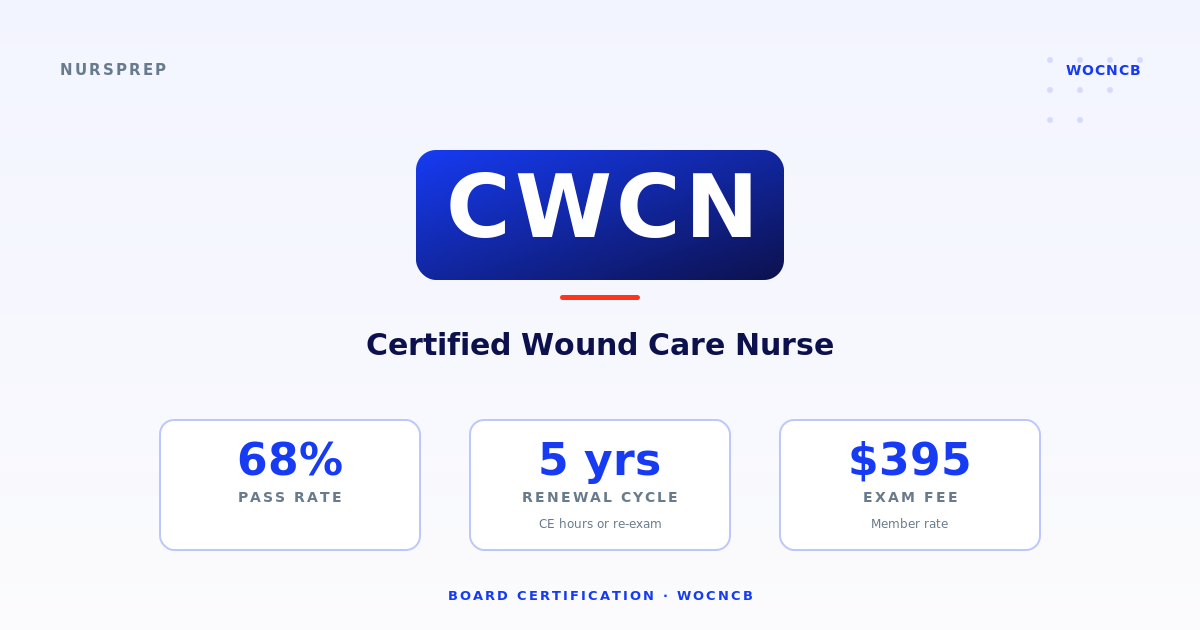
CWCN — Certified Wound Care Nurse — is the wound-only board credential for BSN-prepared RNs. The credential is issued by the Wound, Ostomy and Continence Nursing Certification Board (WOCNCB), a separate entity from the WOCN Society (the membership and education body). WOCNCB credentials are accredited by both the Accreditation Board for Specialty Nursing Certification (ABSNC) and the National Commission for Certifying Agencies (NCCA).
CWCN is a board certification, not a course. It is often confused with WCC (a NAWCO credential open to many clinician types) and with CWOCN (the WOCNCB credential that bundles wound, ostomy, and continence). Only CWCN appears on your credentials line after RN once you pass the WOCNCB exam.
Am I eligible for the CWCN exam?
Yes — if you hold an active, unrestricted RN license in the US or its territories AND a Baccalaureate (BSN) or higher degree in nursing. The BSN gate is a hard requirement; ASN and diploma RNs must complete BSN coursework before applying.
Candidates choose one of two pathways. Traditional Pathway: graduation from an accredited WOC Nursing Education Program (WOCNEP) within the past 5 years. Experiential Pathway: 50 continuing education hours in wound care plus 1,500 direct patient-care hours in wound care within the past 5 years, with at least 375 of those hours completed in the 12 months immediately preceding application.
You are a strong candidate if…
- You hold a BSN or higher and an active RN license in the US or its territories.
- You spend most of your direct-care time on wound assessment, intervention, and education — not ostomy or continence.
- You can document 1,500 wound-care patient-care hours over 5 years with at least 375 in the past year, or you completed an accredited WOCNEP within the past 5 years.
- Your setting fits a recognized wound role: inpatient wound and skin care consult team, home health wound nursing, long-term care wound program, outpatient wound clinic, hyperbaric oxygen therapy program, or surgical and burn unit wound responsibility.
CWCN exam blueprint — five domains (2024 Detailed Content Outline)
The CWCN blueprint is five domains. Treatment is the heaviest domain at 29.5% (32 scored items) — most of your study time should live there. Assessment (23.5%) and Education & Referral (18.6%) round out the top three. Intervention (16.6%) and Care Planning (11.8%) are smaller but still test in clinical-scenario format.
- Assessment 23.5%
- Intervention 16.6%
- Treatment 29.5%
- Care Planning 11.8%
- Education and Referral 18.6%
Do not neglect Care Planning. It is the lightest domain at 11.8% but covers goal-setting language (preventive, palliative, maintenance, curative) and plan-evaluation skills that appear in scenario stems across other domains. Candidates who skim it tend to lose points on multi-step Treatment items where the right answer depends on aligning the intervention to the documented care goal.
Cost, scheduling, and employer discounts
WOCNCB delivers CWCN through PSI testing centers. After WOCNCB approves your application, PSI issues an Authorization to Test (ATT) and you have a 6-month window to schedule and complete the exam. The CWCN exam is offered year-round — there are no fixed testing windows. WOCNCB charges no annual maintenance fees during the 5-year certification cycle.
| Fee item | Cost (USD) |
|---|---|
| Single specialty (CWCN) | $395 |
| Two specialties (e.g., CWCN + CCCN) | $510 |
| Three specialties | $610 |
| Four specialties | $670 |
| First-attempt retake discount | $100 off (one-time) |
| Developing-country applicants | $100 per specialty |
| Recertification by exam | Same as initial fee |
| Annual maintenance fee | None — $0 |
Renewal
CWCN certification is valid for five years. WOCNCB offers two renewal pathways. Pathway 1 — Professional Growth Program (PGP): submit an online portfolio totaling 80 PGP points, of which at least 10 must be continuing education hours in the clinical specialty (wound care). The PGP recognizes CE, publishing, precepting, professional society membership, presentations, and committee service.
Pathway 2 — Recertification by Examination: retake and pass the current CWCN exam at the initial-application fee. There is no extended grace period for a lapsed CWCN — lapsed candidates must sit the full exam again to reinstate the credential.
How hard is the CWCN exam?
WOCNCB reported that 1,417 candidates sat the wound care exam in 2024 with a 68.3% pass rate. That figure sits in the same band as third-party vendor estimates of approximately 71% — both summarize the same WOCNCB statistics. The exam is meaningfully harder than entry-level RN credentials but accessible to BSN-prepared RNs who study the five-domain blueprint and target the heavy Treatment and Assessment domains.
First-attempt failure carries a one-time $100 retake discount. WOCNCB does not impose a long mandatory wait between attempts beyond the application processing window, but candidates who fail should plan a structured restudy block — particularly in Treatment and Assessment — before rebooking rather than scheduling immediately.
A 10-week CWCN study plan
A structured 10-week study plan is enough for most wound care RNs already meeting the eligibility hours — roughly 80 to 120 total study hours across the five blueprint domains. Practice-question volume ramps through weeks 2–8 and peaks in week 9 with a full-length timed exam; week 10 is for targeted review, logistics, and a rest day.
-
1 WeekRead WOCNCB 2024 CWCN Detailed Content Outline + baseline diagnostic
-
2 WeekAssessment — pressure injury staging, vascular assessment, risk tools (Braden, ABI, TBI)
-
3 WeekAssessment — wound etiology, periwound characteristics, phases of healing
-
4 WeekTreatment — wound bed preparation (TIME), debridement modalities
-
5 WeekTreatment — topical therapies, dressing categories, antimicrobials
-
6 WeekTreatment — advanced / adjunctive (NPWT, HBOT, compression, total contact casting)
-
7 WeekIntervention — prevention bundles, support surfaces, offloading, friction/shear
-
8 WeekCare Planning + Education and Referral — goal-setting, patient ed, multidisciplinary referrals
-
9 WeekFull-length timed practice exam (120 items in 2 hours) + error-log review
-
10 WeekTargeted review of weak domains, rest, test day
How CWCN candidates actually fail — and how to avoid it
Sample CWCN question
This item mirrors the WOCNCB scenario format: a short clinical stem, a wound care decision point, and four plausibly-correct options where only one is best. Try it before you read the rationale.
Autolytic debridement is the appropriate modality here. Conservative sharp debridement is contraindicated with the elevated INR of 2.6 (bleeding risk). Surgical debridement is inappropriate because the patient declined transfer. Wet-to-dry gauze is non-selective, painful, and damages healthy granulation tissue — it is no longer considered standard of care. A hydrogel donates moisture to support endogenous enzyme activity and is well tolerated.
Key CWCN terms every candidate should know
These terms surface in most CWCN exam items. Review them until the definitions feel automatic — scenario-based stems often hinge on recognizing which framework or staging system applies.
| Term | Definition | Domain |
|---|---|---|
| Pressure Injury Staging (NPIAP) | Six categories — Stage 1, Stage 2, Stage 3, Stage 4, Unstageable, and Deep Tissue Pressure Injury — defined by visible tissue damage rather than wound depth alone. | Assessment |
| MASD | Moisture-Associated Skin Damage — inflammation and erosion of skin from prolonged exposure to urine, stool, perspiration, or wound exudate; not staged as a pressure injury. | Assessment |
| MARSI | Medical Adhesive-Related Skin Injury — tears, blisters, or maceration caused by adhesive products; distinct from pressure injury or skin tear etiology. | Assessment |
| ABI | Ankle-Brachial Index — ratio of ankle to brachial systolic BP screening for lower-extremity arterial disease; <0.9 abnormal, <0.5 severe, >1.3 non-compressible (often diabetic calcification). | Assessment |
| TIME framework | Tissue management, Inflammation/Infection control, Moisture balance, Edge of wound advancement — the standard mental model for wound bed preparation. | Treatment |
| Autolytic debridement | Use of moisture-retentive dressings (hydrogels, hydrocolloids) to let the body's endogenous enzymes liquefy devitalized tissue; selective and well tolerated. | Treatment |
| Conservative sharp debridement | Bedside removal of clearly devitalized tissue using sterile instruments by a trained clinician; requires bleeding-risk and pain assessment before performing. | Treatment |
| NPWT | Negative Pressure Wound Therapy — application of sub-atmospheric pressure to a sealed wound to remove exudate and promote granulation; contraindicated over malignancy and untreated osteomyelitis. | Treatment |
| Braden Scale | Six-subscale tool (sensory perception, moisture, activity, mobility, nutrition, friction/shear) scoring 6–23; lower scores indicate higher pressure injury risk. | Assessment |
| Wagner Classification | 0–5 grading system for diabetic foot ulcers based on depth and presence of infection or gangrene; guides surgical and offloading decisions. | Assessment |
| Total Contact Casting | Gold-standard offloading device for plantar neuropathic ulcers; redistributes pressure over the entire foot and lower leg, requires intact arterial supply. | Treatment |
| PGP | Professional Growth Program — WOCNCB's portfolio-based recertification path requiring 80 points (10 in clinical specialty CE) over 5 years as an alternative to re-exam. | Renewal |
| WOCNEP | WOC Nursing Education Program — an accredited specialty program graduates can use as the Traditional Pathway to CWCN eligibility within 5 years of completion. | Eligibility |
| Periwound | Skin within 4 cm of the wound edge; assessed for induration, temperature, fluctuance, denudation, maceration, and cellulitis — drives dressing choice. | Assessment |
| Epibole | Rolled or curled wound edge that has rolled inward, signaling stalled migration of epithelial cells; commonly requires edge optimization. | Assessment |
CWCN vs. CWOCN, CWON, WCC, CWS
CWCN sits alongside several related credentials that wound care clinicians sometimes consider. Many candidates Google "CWCN" when they actually mean WCC or CWOCN, so the distinction matters before you spend time or money.
| Credential | Body | Scope | Best fit |
|---|---|---|---|
| CWCN | WOCNCB | Wound care only | BSN-prepared RNs focused on wound management |
| CWOCN | WOCNCB | Wound + ostomy + continence | BSN-prepared RNs spanning all three specialties |
| CWON | WOCNCB | Wound + ostomy (no continence) | BSN-prepared RNs in dual wound/ostomy roles |
| CFCN | WOCNCB | Foot care nursing | BSN-prepared RNs in diabetic and high-risk foot programs |
| WCC | NAWCO | Wound care — interdisciplinary | RNs, LPNs, PTs, MDs, and other clinicians; no BSN required |
| CWS | ABWM | Wound care — advanced interdisciplinary | Any clinician with a bachelor's degree (RN, PT, MD, etc.) |
| CWCA | NAWCO | Entry-level wound care | Non-licensed wound care staff |
Take CWCN if you are a BSN-prepared RN focused on wound care and not on ostomy or continence. Pick CWOCN if your role spans all three specialties; CWON if you cover wound and ostomy. Consider WCC or CWS if you do not hold a BSN, or if you are a non-RN clinician — both accept broader eligibility but are not WOCNCB credentials.
Frequently asked questions about CWCN certification
CWCN stands for Certified Wound Care Nurse. The credential is issued by the Wound, Ostomy and Continence Nursing Certification Board (WOCNCB).
No. CWCN covers wound care only. CWOCN — Certified Wound, Ostomy, and Continence Nurse — covers wound, ostomy, and continence in a single credential. Both are WOCNCB-issued.
Yes. WOCNCB requires a Baccalaureate or higher degree in nursing as a hard eligibility gate. ASN and diploma RNs must complete BSN coursework before applying.
Most wound care RNs prepare for 8 to 12 weeks. A realistic target is 80 to 120 total study hours weighted toward the Treatment (29.5%) and Assessment (23.5%) domains.
The CWCN exam is moderately difficult. The 2024 pass rate was 68.3% across 1,417 candidates. Candidates who skim the Treatment domain or rely on memorization rather than scenario practice tend to struggle.
The Traditional Pathway requires graduation from an accredited WOC Nursing Education Program within the past 5 years. The Experiential Pathway requires 50 CE hours plus 1,500 wound-care patient-care hours in the past 5 years, with at least 375 of those hours in the past 12 months.
WOCNCB offers a one-time $100 discount on the next application after a failed first attempt. There is no long mandatory wait beyond the application processing window, but plan a structured restudy block before rebooking.
Yes. CWCN certification is valid for 5 years. Renew through the Professional Growth Program (80 PGP points including 10 clinical-specialty CE hours) or by retaking the current exam.
Many health systems reimburse the WOCNCB application fee through a certification benefit. Employers can also use the WOCNCB Employer Discount Voucher Program. Ask your wound care program manager or HR before paying out of pocket.
WOCNCB credentials are US-focused, with eligibility tied to a US or US-territory RN license. International applicants should contact WOCNCB directly to confirm eligibility before applying.
Trusted sources
All figures on this page are verified against the following primary sources. Fees, blueprint weights, and recertification rules shift on WOCNCB's revision cycle — always verify numeric facts against the current WOCNCB candidate examination handbook before relying on them for application decisions.
- Wound, Ostomy and Continence Nursing Certification Board (WOCNCB) — WOC Certification page (eligibility, exam format, pathways)
- WOCNCB — 2024 CWCN Detailed Content Outline (PDF) — five-domain blueprint, task-level weights, complexity mix
- WOCNCB — Fees page (single-specialty $395, bundle pricing, retake discount, developing-country tier)
- WOCNCB — Recertification page (Professional Growth Program, 80 points, 10 clinical-specialty CE, re-exam pathway)
- WOCNCB — WOC Exam page (PSI delivery, 6-month eligibility window, year-round scheduling)
- WOCN Society — Core Curriculum for Wound Management (companion study text)
- Mometrix — Free CWCN Practice Test summary (scaled passing score of 500, current pass-rate range)
- WoundEducators — Wound Care Certification difficulty review (2024 wound exam pass rate 68.3% across 1,417 candidates)
- Vivian Health — CWCN Complete Guide (eligibility pathways and salary context)
- Research.com — How To Become a Wound Care Nurse (BLS salary context and career paths)
Ready to practice CWCN-style items?
Work through a 25-question diagnostic mapped to the 2024 WOCNCB blueprint. Free to start — no card required.