What is a PMHNP-BC?
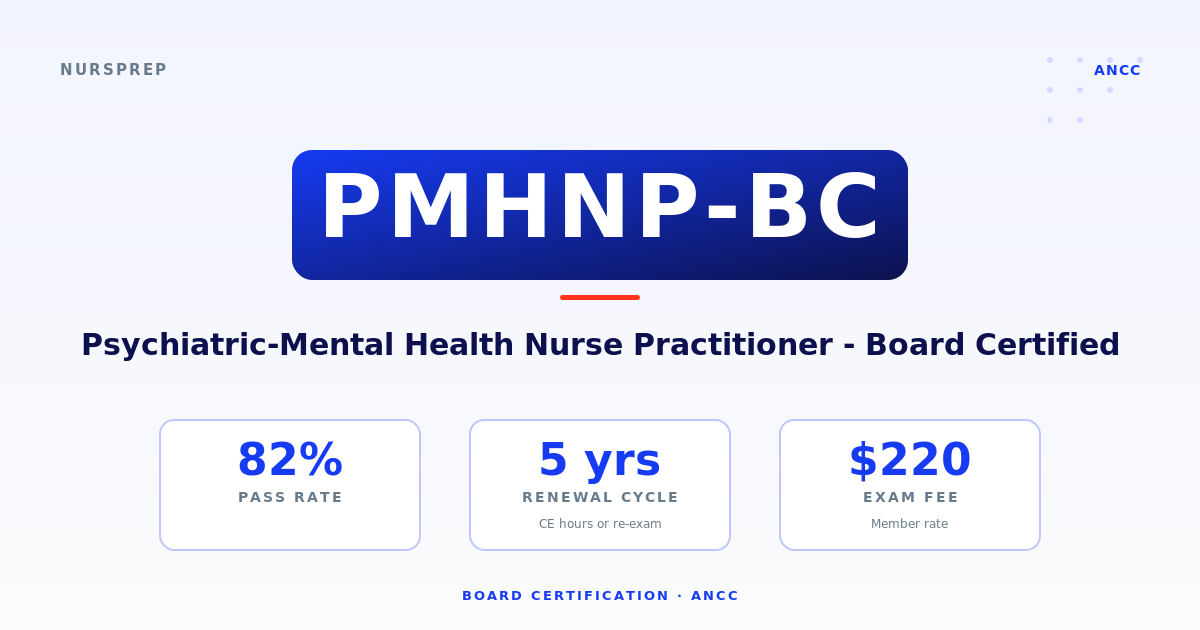
PMHNP-BC stands for Psychiatric-Mental Health Nurse Practitioner — Board Certified. ANCC awards the credential after an APRN completes a psychiatric-mental health nurse practitioner program and passes a 175-item examination, and it is valid for 5 years. ANCC's official exam title is Psychiatric-Mental Health Nurse Practitioner (Across the Lifespan); the credential was formerly labelled Family Psychiatric-Mental Health Nurse Practitioner.
A PMHNP evaluates patients, orders and interprets diagnostic and laboratory tests, applies DSM-5-TR criteria to reach a diagnosis, prescribes and monitors psychotropic medication, and delivers psychotherapy. ANCC reported 58,578 active certificants in the program as of 2025-12-31, which makes it ANCC's second-largest nurse practitioner certification after the family NP credential.
The examination aligns with the Consensus Model for APRN Regulation, and both the Accreditation Board for Specialty Nursing Certification (ABSNC) and the National Commission for Certifying Agencies (NCCA) accredit it. Employers, credentialing committees, and state boards of nursing treat PMHNP-BC as the national certification that supports psychiatric APRN licensure.
What are the eligibility requirements for PMHNP-BC certification?
You qualify when you hold an active RN license in a US state or territory (or a legally recognized equivalent in another country) and have completed a psychiatric-mental health nurse practitioner (Across the Lifespan) master's degree, post-graduate certificate, or Doctor of Nursing Practice (DNP) from a program accredited by the Commission on Collegiate Nursing Education (CCNE), the Accreditation Commission for Education in Nursing (ACEN), or the National League for Nursing Commission for Nursing Education Accreditation (CNEA). Post-graduate certificate applicants must show APRN program accreditation specifically.
ANCC also audits the transcript. Your program must include 500 faculty-supervised clinical hours, three separate graduate-level APRN core courses, coursework content in health promotion and in differential diagnosis and disease management, and clinical training in at least two psychotherapeutic treatment modalities. Candidates discover that last requirement late more often than any other, because it depends on how a program structured its therapy practicum rather than on total hours.
There is no post-graduation practice-hour gate. ANCC can authorize you to test once all coursework and supervised clinical hours are finished, before your degree is conferred, provided your Validation of Education (VOE) form and transcripts are on file. ANCC issues the certification itself only after the final degree-conferred official transcript arrives.
You are a strong candidate if…
- You hold an active, unencumbered RN license and have finished or are finishing a CCNE-, ACEN-, or CNEA-accredited PMHNP (Across the Lifespan) master's, post-graduate certificate, or DNP.
- Your transcript shows all three graduate APRN core courses as separate, comprehensive courses: advanced physiology and pathophysiology, advanced health assessment, and advanced pharmacology.
- Your clinical log totals at least 500 faculty-supervised hours across the lifespan — child and adolescent, adult, and older adult psychiatric populations rather than a single age band.
- You completed supervised clinical training in two or more psychotherapy modalities, such as cognitive behavioral therapy plus motivational interviewing or family systems work.
- You can prescribe and monitor antidepressants, antipsychotics, mood stabilizers, stimulants, and medications for opioid and alcohol use disorder, and you can order and interpret the labs those agents require.
PMHNP-BC exam blueprint — five content domains (effective 2023-04-28)
The PMHNP-BC exam splits 150 scored items across five domains, weighted as shown below and taken directly from the ANCC PMHNP Test Content Outline effective 2023-04-28. Twenty-five unscored pretest items sit alongside the scored questions and cannot be identified during the exam, so every item deserves an answer. The published percentages sum to 99 because ANCC rounds each domain; the item counts sum exactly to 150.
- Scientific Foundation (33 items) 22%
- Advanced Practice Skills (41 items) 27%
- Diagnosis and Treatment (33 items) 22%
- Psychotherapy and Related Theories (17 items) 11%
- Ethics, Legal Principles, and Cultural Care (26 items) 17%
Advanced Practice Skills carries the largest share at 41 items. It tests screening-instrument selection and interpretation — PHQ-9, GAD-7, Vanderbilt ADHD, AUDIT, DAST, CIWA, COWS — plus the mental status exam, psychiatric emergency management, risk assessment, and psychoeducation. Ethics, Legal Principles, and Cultural Care is the domain candidates most often underestimate at 26 items, covering the Patient's Bill of Rights, scope of confidentiality including duty to warn, the ANA Scope and Standards of Practice for psychiatric-mental health nursing, and ethical decision-making around involuntary treatment and least restrictive care.
ANCC also builds items against secondary classifications for body system, drug agent class, and age group, consistent with the APRN Consensus Model. Expect the same clinical concept to appear in a pediatric stem and a geriatric stem with different correct answers.
How much does the PMHNP-BC exam cost, and how do I schedule it?
The PMHNP-BC application costs between $220 and $395 depending on which professional association you belong to, and every price includes a $140 non-refundable administrative fee. ANCC accepts applications year round and delivers the exam at Prometric test centers. Once ANCC approves your application you receive an Authorization to Test (ATT) notice and have 120 days to book a seat. If you cannot test inside that window you may request one new 120-day window for a $100 re-assignment fee.
Claim your membership discount within 5 business days of ANCC receiving your application. Discounts cannot be combined, and ANA e-membership does not qualify for the ANA-member rate.
| Fee item | Cost (USD) |
|---|---|
| Initial application — APNA member | $220 |
| Initial application — AANP student member | $290 |
| Initial application — ANA member | $295 |
| Initial application — AANP, ISPN, or GAPNA member | $340 |
| Initial application — non-member | $395 |
| Renewal — APNA member | $250 |
| Renewal — ANA member | $275 |
| Renewal — non-member | $375 |
| Exam re-assignment (new 120-day window) | $100 |
Renewal
PMHNP-BC certification lasts 5 years, and you may submit a renewal application up to one year before it expires. Under the ANCC Certification Renewal Handbook effective 2025-09-10, renewal requires 75 continuing education contact hours tied to the full scope of the PMHNP role, at least 60 of them formally approved. As an APRN you must complete 25 of those 75 hours in advanced pharmacology, and you must finish at least one of the eight professional development categories in its entirety.
The renewal framework changes on 2027-02-01. ANCC published the 2027 Certification Renewal Handbook in July 2026, and it governs every renewal application submitted on or after that date; applications submitted earlier stay under the current handbook. The 2027 framework keeps the five-year cycle, the 75 contact hours, and the 25 pharmacology hours for APRNs, then replaces the eight-category list with a single Selected Professional Development activity chosen from three groupings — additional continuing education, practice, or scholarship. ANCC frames it as a more flexible way to evidence continuing competence. Letting the credential lapse carries a practical risk beyond paperwork: for APRNs, an expired certification can affect eligibility to practise depending on state licensure rules.
How hard is the PMHNP-BC exam?
The 2025 ANCC certification-data release reports an 82% first-time pass rate for the PMHNP (Across the Lifespan) exam: 8,840 of 10,743 first-time candidates passed. That sits above the 71% recorded for the RN-level PMH-BC exam in the same release. Passing means a scaled score of 350 or higher on a 0–500 scale, with the cut score set by a subject-matter-expert panel using the Modified Angoff method.
Candidates who fail rarely fail on psychopharmacology alone. Score reports break performance out by domain, and the recurring weak spots are Ethics, Legal Principles, and Cultural Care — duty to warn, capacity versus competence, least restrictive alternative, informed consent for minors — together with the screening-instrument content inside Advanced Practice Skills. Both are graduate-coursework topics that fade quickly once a candidate is deep into clinical rotations.
Most candidates test within months of finishing a PMHNP program, which lifts the headline figure. Plan a longer runway if you are returning after a gap in psychiatric practice or entering through a post-graduate certificate after years in another NP specialty.
A 12-week PMHNP-BC study plan
Twelve weeks covers the five-domain blueprint for most candidates finishing or recently graduated from a PMHNP program — roughly 100 to 140 total study hours. Question volume climbs from week 2, peaks in week 11 with a full-length 175-item timed exam under real conditions, and eases in week 12 for targeted review and test-day logistics. Stretch this to 16 weeks and add a second full-length attempt if you are returning to psychiatric practice after time away.
-
1 WeekRead the ANCC PMHNP Test Content Outline (effective 2023-04-28) + baseline diagnostic across all five domains
-
2 WeekScientific Foundation I — advanced pathophysiology, neuroanatomy, neurophysiology, neurodevelopment
-
3 WeekScientific Foundation II — psychopharmacokinetics and pharmacodynamics, EPS, NMS, psychopharmacogenomics and CYP interactions
-
4 WeekAdvanced Practice Skills I — mental status exam, clinical interviewing, risk assessment, psychiatric emergency management
-
5 WeekAdvanced Practice Skills II — screening tools (PHQ-9, GAD-7, Vanderbilt ADHD, AUDIT, DAST, CIWA, COWS), psychoeducation, recovery and resilience
-
6 WeekDiagnosis and Treatment I — DSM-5-TR criteria and differentials across mood, psychotic, anxiety, trauma, and neurodevelopmental disorders
-
7 WeekDiagnosis and Treatment II — lab and diagnostic test selection, medical mimics, psychopharmacotherapeutic selection and monitoring
-
8 WeekDiagnosis and Treatment III — substance use disorders, medications for opioid and alcohol use disorder, complementary and alternative treatments
-
9 WeekPsychotherapy and Related Theories — CBT, interpersonal, humanistic, behavioral, change theories, family systems, therapeutic alliance and boundaries
-
10 WeekEthics, Legal Principles, and Cultural Care — Patient's Bill of Rights, confidentiality and duty to warn, involuntary treatment, least restrictive care, cultural and spiritual competence, advocacy
-
11 WeekFull-length timed practice exam (175 items in 3.5 hours) + error-log review by domain
-
12 WeekTargeted review of the two weakest domains, Prometric logistics, rest, test day
How PMHNP-BC candidates actually fail — and how to avoid it
Sample PMHNP-BC question
This item mirrors ANCC's scenario format: a clinical stem, a prescribing decision, and four defensible-looking options where only one is best. Answer it before you read the rationale.
The presentation is an antidepressant-associated manic switch that reveals previously undiagnosed bipolar I disorder — decreased need for sleep, pressured speech, grandiose goal-directed activity, and excessive spending, all emerging after an SSRI was started, in a patient with a first-degree relative who has bipolar I. Antidepressant monotherapy is contraindicated once mania is evident, so the SSRI comes off and mood stabilization begins. Baseline labs come before the prescription: renal and thyroid studies ahead of lithium, liver function and CBC ahead of valproate, lipids and A1c ahead of a second-generation antipsychotic, plus a pregnancy test because lithium and valproate both carry teratogenic risk. Raising the sertraline dose worsens the switch. A benzodiazepine may calm acute agitation but leaves untreated mania in place. Therapy for insomnia treats a symptom and misses the diagnosis.
Key PMHNP-BC terms every candidate should know
These terms map to the five blueprint domains and surface repeatedly in scenario stems. Review them until recognition is automatic — many items hinge on identifying which framework, statute, or syndrome the stem describes rather than on recalling a dose.
| Term | Definition | Domain |
|---|---|---|
| APRN Consensus Model | The regulatory framework for licensure, accreditation, certification, and education of advanced practice registered nurses. It defines PMHNP as a population-focused role across the lifespan, and the PMHNP-BC exam is built to align with it. | Scientific Foundation |
| Psychopharmacogenomics | How genetic variation, particularly in CYP450 enzymes such as CYP2D6 and CYP2C19, alters drug metabolism and response. Poor-metabolizer and ultra-rapid-metabolizer status changes dosing for several antidepressants and antipsychotics. | Scientific Foundation |
| Extrapyramidal symptoms (EPS) | Movement effects of dopamine blockade: acute dystonia, akathisia, parkinsonism, and tardive dyskinesia. Onset timing and treatment differ for each, and akathisia is often mistaken for worsening anxiety. | Scientific Foundation |
| Neuroleptic malignant syndrome (NMS) | A life-threatening antipsychotic reaction marked by hyperthermia, lead-pipe rigidity, autonomic instability, and altered mental status, usually with elevated creatine kinase. Stop the agent and provide supportive care. | Scientific Foundation |
| Mental status exam (MSE) | Structured assessment of appearance, behavior, speech, mood and affect, thought process and content, perception, cognition, insight, and judgment. It is the PMHNP's core assessment instrument and runs through Advanced Practice Skills items. | Advanced Practice Skills |
| PHQ-9 and GAD-7 | Validated self-report screens for depression severity (9 items) and generalized anxiety (7 items). Exam items test score interpretation and the treatment decision that follows, including PHQ-9 item 9 as a suicide-risk trigger. | Advanced Practice Skills |
| CIWA-Ar and COWS | The Clinical Institute Withdrawal Assessment for Alcohol, revised, and the Clinical Opiate Withdrawal Scale. Both drive symptom-triggered medication decisions, so know the score thresholds that change your plan. | Advanced Practice Skills |
| DSM-5-TR | The Diagnostic and Statistical Manual of Mental Disorders, Fifth Edition, Text Revision. It supplies the diagnostic criteria the exam tests, including the specifiers and duration thresholds that separate close differentials. | Diagnosis and Treatment |
| Medical mimics | Physical conditions that present as psychiatric illness: thyroid disease, B12 deficiency, delirium, autoimmune encephalitis, substance intoxication or withdrawal. Diagnostic and laboratory test selection items usually turn on ruling these out. | Diagnosis and Treatment |
| Therapeutic alliance | The collaborative bond between clinician and patient, built through empathy, consistent boundaries, and a trauma-informed approach. ANCC lists its development and management as a skill under Psychotherapy and Related Theories. | Psychotherapy |
| Transtheoretical Model | Prochaska and DiClemente's stages-of-change framework: precontemplation, contemplation, preparation, action, maintenance. Items ask you to match an intervention to the stage the patient is actually in. | Psychotherapy |
| Duty to warn | The obligation, established in Tarasoff and codified differently by each state, to act when a patient makes a credible threat against an identifiable person. It is the classic exception to confidentiality tested in this domain. | Ethics & Legal |
| Least restrictive alternative | The ethical and legal principle that treatment must use the least limiting intervention that meets the clinical need. It governs decisions about seclusion, restraint, and involuntary hospitalization. | Ethics & Legal |
| Decision-making capacity | A clinical determination that a patient can understand information, appreciate consequences, reason through options, and communicate a choice. Capacity is task-specific and time-specific; competence is a court determination. | Ethics & Legal |
| Full practice authority | AANP's classification for states whose laws let NPs evaluate, diagnose, order and interpret tests, and initiate and manage treatment including controlled substances under the exclusive authority of the state board of nursing. Reduced and restricted states require a collaborative agreement or supervision. | Ethics & Legal |
PMHNP-BC vs. PMH-BC, PMHCNS-BC, and adjacent credentials
The most consequential mix-up in psychiatric nursing is PMHNP-BC against PMH-BC. They share an issuing body and a clinical specialty but sit at different licence levels, with different education gates, different exams, and different legal scopes. Read the table before you apply — applying to the wrong one costs an application fee and a testing window.
| Credential | Body | Scope | Best fit |
|---|---|---|---|
| PMHNP-BC | ANCC | Advanced practice across the lifespan: assessment, DSM-5-TR diagnosis, prescribing and medication management, psychotherapy | APRNs with a PMHNP master's, post-graduate certificate, or DNP including 500 supervised clinical hours |
| PMH-BC | ANCC | RN-level psychiatric-mental health nursing: assessment, planning, implementation, and evaluation of psychiatric nursing care, without diagnosing or prescribing | RNs with 2 yrs full-time practice, 2,000 PMH hours, and 30 PMH CE hours in the last 3 yrs |
| Adult Psychiatric-Mental Health NP | ANCC (renewal only) | Legacy adult-only psychiatric NP credential, superseded by the across-the-lifespan PMHNP-BC | Existing certificants only — closed to new candidates |
| PMHCNS-BC (Adult or Child/Adolescent) | ANCC (renewal only) | Psychiatric-mental health clinical nurse specialist: consultation, treatment, and systems-level practice | Existing CNS certificants only — ANCC retired initial testing |
| FNP-BC | ANCC | Family primary care across the lifespan, including common mental-health presentations but not psychiatric specialty practice | APRNs from a family NP program; some clinicians hold FNP and PMHNP together |
| Psychiatrist (MD or DO) | ABPN | Physician specialty practice in psychiatry, including complex pharmacology and procedures such as ECT | Physicians who complete medical school and a psychiatry residency |
Take PMHNP-BC if you have completed a psychiatric NP program and intend to diagnose and prescribe. If you are an RN delivering psychiatric care without a graduate NP degree, PMH-BC is your credential, and the PMH-BC certification guide covers its separate eligibility rules. A DNP-prepared PMHNP holds a doctoral nursing degree and may be addressed as doctor in academic settings, but remains a nurse practitioner rather than a physician — a distinction worth stating plainly to patients.
Frequently asked questions about PMHNP-BC certification
PMHNP-BC stands for Psychiatric-Mental Health Nurse Practitioner — Board Certified. The American Nurses Credentialing Center (ANCC) awards it, and its full exam title is Psychiatric-Mental Health Nurse Practitioner (Across the Lifespan).
No. PMHNP-BC is the advanced practice nurse practitioner credential and requires a PMHNP master's, post-graduate certificate, or DNP that includes 500 faculty-supervised clinical hours. PMH-BC is ANCC's RN-level psychiatric specialty certification and requires 2 years of RN practice, 2,000 psychiatric practice hours, and 30 psychiatric CE hours instead of a graduate degree.
Yes, within the scope the state grants. AANP classifies state practice environments as full, reduced, or restricted. Full practice states let NPs prescribe medications and controlled substances under the state board of nursing's exclusive authority; reduced and restricted states require a collaborative agreement or physician supervision for at least one element of practice.
An active RN license, plus a PMHNP (Across the Lifespan) master's, post-graduate certificate, or DNP from a CCNE-, ACEN-, or CNEA-accredited program. The program must include 500 faculty-supervised clinical hours, three separate graduate APRN core courses, content in health promotion and in differential diagnosis and disease management, and clinical training in at least two psychotherapeutic modalities.
175 questions in 3.5 hours. Of those, 150 are scored and 25 are unscored pretest items that cannot be distinguished from scored ones. Passing requires a scaled score of 350 or higher on a 0 to 500 scale.
82% of first-time test takers passed in 2025 according to the ANCC certification-data release — 8,840 of 10,743 candidates. That is above the 71% recorded for the RN-level PMH-BC exam in the same release.
Non-members pay $395 and ANA members pay $295. APNA members pay $220, the lowest rate; AANP, ISPN, and GAPNA members pay $340, and AANP student members pay $290. Every price includes a $140 non-refundable administrative fee.
Five years. You may submit a renewal application up to one year before your expiration date, and for APRNs an expired certification can affect eligibility to practise depending on your state's licensure rules.
Under the current ANCC renewal handbook you need 75 continuing education contact hours relevant to the PMHNP role, at least 60 of them formally approved, with 25 of the 75 in advanced pharmacology because you are an APRN, plus one of the eight professional development categories completed in its entirety.
The 2027 ANCC Certification Renewal Handbook applies to every renewal application submitted on or after 2027-02-01. The five-year cycle, the 75 continuing education contact hours, and the 25-hour APRN pharmacology requirement all carry over. The eight professional development categories are replaced by one Selected Professional Development activity chosen from three groupings: additional continuing education, practice, or scholarship.
Your score report shows diagnostic feedback for each of the five content areas. You may retest 60 calendar days after your last attempt and may not test more than three times in any 12-month period. Each retest is a new application reviewed against the eligibility requirements and fees in effect when you submit it.
No. A PMHNP is an advanced practice registered nurse. Some PMHNPs hold a Doctor of Nursing Practice, which is a doctoral nursing degree rather than a medical degree, so the holder is not a physician. A psychiatrist completes medical school and a psychiatry residency.
Trusted sources
Every figure on this page traces to the primary sources below. ANCC revises fees, blueprints, and renewal rules on its own cycle — verify numbers against the current ANCC pages and handbooks before relying on them for an application decision.
- ANCC — Psychiatric-Mental Health Nurse Practitioner (Across the Lifespan) Certification (PMHNP-BC) credential page: eligibility, fees, exam format, renewal pricing — https://www.nursingworld.org/our-certifications/psychiatric-mental-health-nurse-practitioner/
- ANCC — PMHNP Test Content Outline, effective 2023-04-28 (PDF re-issued 2026-07-28): five domains, 150 scored items, 25 pretest items — https://www.nursingworld.org/globalassets/study-aids/exam-35-pmhnp-tco_2026-brand-update_final.pdf
- ANCC — 2025 Certification Data: 10,743 first-time tested, 8,840 passed (82%), 5,464 renewals, 58,578 total certified as of 2025-12-31 — https://www.nursingworld.org/globalassets/docs/ancc/ancc-cert-data-website.pdf
- ANCC — Certification Handbook, effective June 2025 (Version 4, 2026-01-23): scaled passing score of 350 on a 500-point scale, Modified Angoff standard setting, 120-day testing window and $100 re-assignment fee — https://www.nursingworld.org/globalassets/certification/ancc-certification-handbook.pdf
- ANCC — Certification Renewal Handbook, effective 2025-09-10: 75 CE contact hours, 60 formally approved, 25 advanced pharmacology hours for APRNs, one of eight professional development categories — https://www.nursingworld.org/globalassets/certification/renewals/ancc-certrenewalrequirements.pdf
- ANCC — 2027 Certification Renewal Handbook, published July 2026 and effective for applications submitted on or after 2027-02-01 — https://www.nursingworld.org/globalassets/certification/renewals/ancc-certification-renewal-handbook_2027.pdf
- ANCC — Certification Renewal overview: which handbook applies and the 2027-02-01 cutover — https://www.nursingworld.org/certification/renewals/
- ANCC — Test Score Reports and Retest Application Procedures: 60-day wait, maximum three attempts in any 12-month period — https://www.nursingworld.org/certification/certification-policies/scores-retest-application/
- ANCC — PMHNP Role Delineation Study Executive Summary (September 2022): the 2021–2022 practice analysis behind the current blueprint — https://www.nursingworld.org/globalassets/pmhnp-rds-exec-report_10292025-for-webposting.pdf
- ANCC — PMHNP-BC Test Reference List (2025-09-03): ANCC's own recommended preparation resources — https://www.nursingworld.org/globalassets/psychiatric-mental-health-nurse-practitioner-ref-list-2025_09032025.pdf
- American Association of Nurse Practitioners (AANP) — State Practice Environment (updated 05/2026): full, reduced, and restricted practice definitions — https://www.aanp.org/advocacy/state/state-practice-environment
- US Bureau of Labor Statistics — Occupational Outlook Handbook, Nurse Anesthetists, Nurse Midwives, and Nurse Practitioners: nurse practitioner median annual wage $132,300 (May 2025), 336,300 NPs employed, 36% projected growth 2025–2035. BLS publishes no PMHNP-specific occupation code — https://www.bls.gov/ooh/healthcare/nurse-anesthetists-nurse-midwives-and-nurse-practitioners.htm
Ready to practice PMHNP-BC-style items?
Work through a 25-question diagnostic mapped to the five-domain ANCC PMHNP blueprint. Free to start — no card required.