CIC certification at a glance
CIC — Certification in Infection Control — is the recognized board credential for infection preventionists. It is issued by the Certification Board of Infection Control and Epidemiology, Inc. (CBIC), an independent body created by APIC in 1981; CBIC administered its first certification exam in 1983.
CIC is a board certification, not a course. "Infection preventionist" is the job role; CIC is the credential that role earns. Candidates often confuse CIC with CBIC's entry-level a-IPC credential and its long-term-care LTC-CIP credential — only CIC is the experience-gated, all-settings certification.
Am I eligible for the CIC exam?
Likely yes — if you are directly responsible for infection prevention and control program activities and meet CBIC's experience recommendation. CBIC does not enforce a nursing-only rule or a fixed degree gate; nurses, microbiologists, public-health practitioners, and epidemiologists all sit the same exam.
CBIC recommends post-secondary education in a health-related field and qualifying work experience: at least one year full-time, two years part-time, or 3,000 hours of infection-prevention work within the previous three years. Your activity must span the five core IPC areas plus at least two of the remaining three components.
You are a strong candidate if…
- You hold direct responsibility for your facility's infection prevention and control program, reflected in your current job description.
- You have at least one year of full-time IPC experience (or two years part-time, or 3,000 hours within the last three years).
- Your work covers identification of infectious disease processes, surveillance and epidemiologic investigation, transmission prevention, environment of care, and cleaning/sterilization/disinfection/asepsis.
- You also engage in at least two of: employee/occupational health, management and communication, or education and research.
What does the CIC exam cover? Eight domains
The CIC blueprint spans eight domains, drawn from CBIC's 2021 content outline (built on the 2020 practice analysis). The three largest domains — Preventing/Controlling Transmission, Surveillance and Epidemiologic Investigation, and Identification of Infectious Disease Processes — together carry about half of the scored items, so most study time should live there.
- Preventing/Controlling Transmission of Infectious Agents 19%
- Surveillance and Epidemiologic Investigation 18%
- Identification of Infectious Disease Processes 16%
- Cleaning, Sterilization, Disinfection, Asepsis 11%
- Environment of Care 10%
- Management and Communications 10%
- Employee/Occupational Health 8%
- Education and Research 8%
Do not neglect the smaller program domains. Employee/occupational health, management and communication, and education and research feel administrative at the bedside but reliably appear on the exam. The percentages below are NursPrep-computed from CBIC's published scored-item counts (135 scored items total) and are rounded for clarity.
Cost, scheduling, and exam format
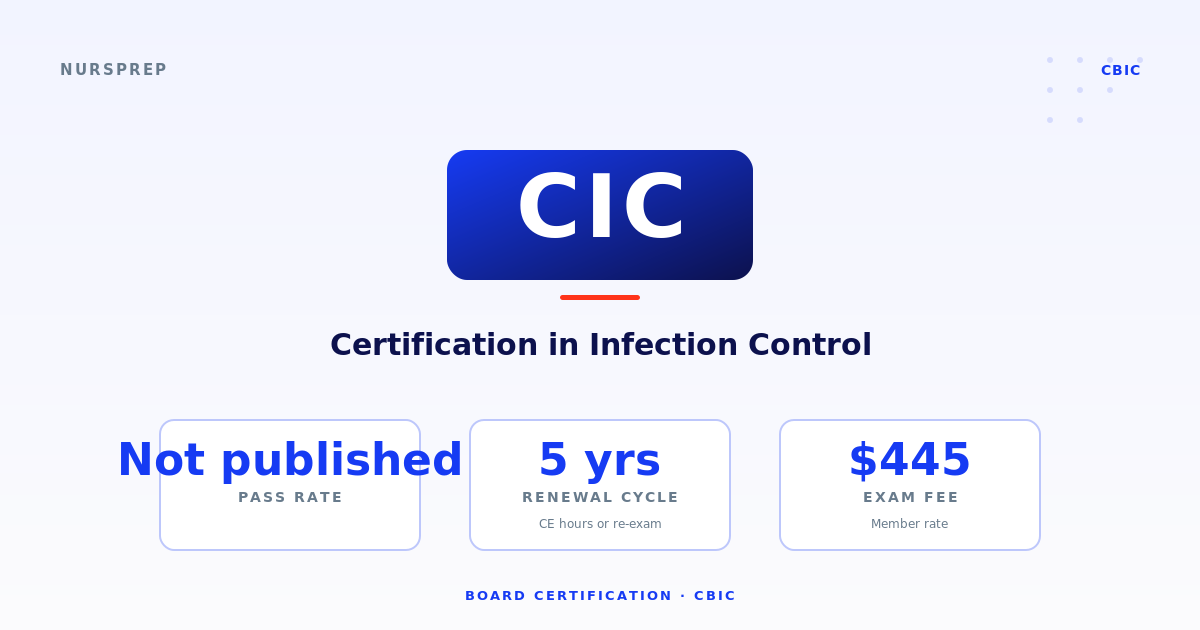
The CIC examination fee is $445 USD, submitted with your application (a January 2025 CBIC fee-schedule PDF listed $430; CBIC's current About-the-Examination page lists $445 — verify the live figure before you pay). CBIC delivers the exam through Prometric test centers and Prometric's ProProctor remote-proctoring system, so you can test in person or from a private location.
The exam runs as two 90-minute sections (180 minutes of testing) with a 10-minute tutorial, an optional 16-minute break after Section 1, and a short closing survey. The first 75 questions must be completed in the first 90-minute section, and you cannot return to Section 1 after the break.
| Fee item | Cost (USD) |
|---|---|
| CIC initial examination fee | $445 |
| CIC recertification by examination | $430 |
| CIC recertification by IPU portfolio | $430 |
| Delivery | Prometric center or ProProctor remote |
| Total items | 150 (135 scored, 15 pretest) |
| Testing time | Two 90-minute sections |
Recertification
CIC certification is valid for five years; all certifications expire on December 31 at the end of the five-year cycle. Effective January 1, 2026, CBIC offers two recertification pathways: Infection Prevention Units (IPU portfolio) or retaking the proctored CIC examination. Both pathways cost $430.
Plan recertification well before your expiration date. Keep documentation of your IPUs throughout the cycle so the portfolio pathway is straightforward when your renewal window opens.
How is the CIC exam scored, and how hard is it?
CIC scoring uses a scaled score from 300 to 900, and you need at least 700 to pass. Passing candidates receive only a "Pass" message — no numeric score — while failing candidates receive a scaled score between 300 and 699. The scaled score adjusts for small differences between exam forms, so a 700 reflects the same standard of knowledge regardless of which version you take.
CBIC does not publicly publish a CIC pass rate, so any specific percentage you see quoted elsewhere is not an official figure. Treat the exam as content-broad rather than trick-based: candidates who underprepare for the program domains (employee health, management, education) tend to lose the most points relative to their bedside strengths.
A study plan for the CIC exam
Most working infection preventionists prepare over 8 to 12 weeks, roughly 60 to 100 total study hours, weighting time toward the three largest domains. Use the APIC text as your spine, then drive retention with practice questions across all eight domains rather than re-reading.
-
1 WeekRead the CBIC content outline + baseline diagnostic across all 8 domains
-
2 WeekIdentification of infectious disease processes — transmission, signs/symptoms, lab interpretation
-
3 WeekSurveillance and epidemiologic investigation — risk assessment, definitions, outbreak workups
-
4 WeekPreventing/controlling transmission — standard + transmission-based precautions, stewardship
-
5 WeekCleaning, sterilization, disinfection, asepsis — reprocessing, Spaulding classification
-
6 WeekEnvironment of care — construction/renovation, water, ventilation, emergency management
-
7 WeekProgram domains — occupational health, management/communication, education/research
-
8 WeekFull-length timed practice exam + error-log review across all domains
How CIC candidates trip up — and how to avoid it
Sample CIC-style question
This NursPrep-authored item mirrors the scenario format of the CIC exam — a short clinical/program stem with four plausible options where only one is best. It is not a CBIC question. Try it before reading the rationale.
A cluster of an epidemiologically significant multidrug-resistant organism on one unit warrants a prompt outbreak investigation. Building a line listing and reviewing shared exposures (staffing, devices, environment) is the first step to identify and interrupt transmission. Delaying for more cases or relaxing precautions would allow continued spread, and routine education is not the immediate priority.
Key infection-control terms every CIC candidate should know
These terms surface across CIC exam items. Review them until the definitions feel automatic — scenario stems often hinge on recognizing which framework applies.
| Term | Definition | Domain |
|---|---|---|
| HAI | Healthcare-associated infection — an infection a patient acquires while receiving care for another condition, not present or incubating at admission. | Surveillance |
| Standard precautions | The baseline infection-prevention practices applied to all patients regardless of diagnosis, including hand hygiene and appropriate PPE. | Transmission |
| Transmission-based precautions | Added precautions — contact, droplet, or airborne — used when standard precautions alone cannot interrupt a known or suspected pathogen. | Transmission |
| Antimicrobial stewardship | Coordinated efforts to optimize antimicrobial use, improving outcomes and reducing resistance and adverse effects. | Transmission |
| Surveillance | Ongoing, systematic collection and analysis of health data to detect, monitor, and guide control of infections. | Surveillance |
| Spaulding classification | A framework that categorizes devices as critical, semi-critical, or non-critical to determine the required level of reprocessing. | Cleaning/Sterilization |
| MDRO | Multidrug-resistant organism — a microbe resistant to one or more classes of antimicrobials, such as MRSA, VRE, or CRE. | Identification |
| Risk assessment | A structured evaluation of a facility's infection risks used to set surveillance priorities and program goals. | Surveillance |
CIC vs. a-IPC, LTC-CIP, and AL-CIP
CIC sits within a family of CBIC credentials. Candidates sometimes apply for the wrong one, so the distinction matters before you spend time or money.
| Credential | Body | Scope | Best fit |
|---|---|---|---|
| CIC | CBIC | Infection prevention across acute, ambulatory, and public-health settings | Experienced infection preventionists with direct IPC responsibility |
| a-IPC | CBIC | Entry-level IPC knowledge | Newcomers to IPC; no experience requirement, no renewal |
| LTC-CIP | CBIC | Infection prevention in long-term care | IPs working in nursing homes and LTC facilities |
| AL-CIP | CBIC | Advanced IPC leadership and program direction | Senior IPC leaders and program directors |
Take CIC if you hold direct responsibility for an infection prevention program and meet the experience recommendation. Start with a-IPC if you are new to the field, choose LTC-CIP if you work in long-term care, and pursue AL-CIP once you move into senior IPC leadership.
Frequently asked questions about CIC certification
CIC stands for Certification in Infection Control. It is the board credential for infection preventionists, awarded by the Certification Board of Infection Control and Epidemiology (CBIC).
CBIC — the Certification Board of Infection Control and Epidemiology — awards the CIC. CBIC was created by APIC in 1981 and administered its first exam in 1983.
The CIC exam has 150 multiple-choice questions. 135 are scored and 15 are unscored pretest items.
You need a scaled score of at least 700 on a 300-to-900 scale. Passing candidates receive a Pass message with no numeric score.
The CIC examination fee is $445 (a January 2025 CBIC fee-schedule PDF listed $430, so verify the current figure before applying). Recertification by exam or by IPU portfolio costs $430.
CBIC requires direct responsibility for infection prevention and control activities plus qualifying experience: at least one year full-time, two years part-time, or 3,000 hours within the previous three years. There is no nursing-only or fixed degree requirement.
The CIC exam is content-broad rather than trick-based, covering eight domains. CBIC does not publish a pass rate, so any quoted percentage is unofficial. Candidates most often lose points on the program domains they use less day to day.
a-IPC is CBIC's entry-level Associate credential with no experience requirement and no renewal. CIC is the experience-gated, renewable credential for practicing infection preventionists.
CIC is valid for five years and expires December 31 at the end of the cycle. From January 1, 2026, you recertify through an IPU portfolio or by retaking the proctored exam.
Yes. CBIC delivers the CIC exam at Prometric test centers and through Prometric's ProProctor remote-proctoring system, so you can test in person or from a private location.
Trusted sources
All figures on this page are verified against the following primary sources. CBIC revises fees, the content outline, and recertification rules over time — always verify numeric facts against the current CBIC pages before relying on them for application decisions.
- CBIC — About the CIC Exam (exam format, 150/135 items, scaled 700 passing score, $445 fee, break structure)
- CBIC — CIC Eligibility Guidelines (direct responsibility, 1-year full-time / 2-year part-time / 3,000-hour experience rule, activity components)
- CBIC — 2021 CIC Examination Content Outline (eight domains; scored-item counts based on the 2020 practice analysis)
- CBIC — CIC Recertification by Proctored Examination and by IPUs (five-year cycle, pathways effective 2026-01-01, $430 fees)
- CBIC — Examination Fees schedule (effective January 6, 2025)
- CBIC — a-IPC (Associate Infection Prevention and Control) credential page
- APIC — History of CBIC (CBIC created 1981; first exam 1983)
- CBIC — Exam & Certification FAQ
Ready to practice CIC-style items?
Work through a 25-question diagnostic mapped to CBIC's eight content domains. Free to start — no card required.