ACHPN certification at a glance
ACHPN: Advanced Certified Hospice and Palliative Nurse — is the APRN-level benchmark for hospice and palliative nursing across inpatient palliative consult services, home hospice with APRN visit roles, oncology palliative clinics, and hospice IDT medical-director-support roles. The credential is issued by the Hospice and Palliative Credentialing Center (HPCC), the credentialing arm of the Hospice and Palliative Nurses Association (HPNA). First national testing of the advanced-practice exam was held in May 2003 in partnership with ANCC; HPCC acquired the exam in December 2004 and ABSNC accredited it in February 2007.
ACHPN is a board certification, not a course, and is restricted to Nurse Practitioners and Clinical Nurse Specialists. As of February 2026, HPCC reports 2,628 active ACHPN credentials. The exam is accredited by the Accreditation Board for Specialty Nursing Certification (ABSNC) through February 2027 and is the APRN-nurse parallel to the physician-side Hospice and Palliative Medicine (HPM) subspecialty.
Am I eligible for the ACHPN exam?
You are eligible if you hold a current, active APRN license in the United States, US territories, or the equivalent in Canada, and you have completed an accredited graduate, postgraduate, or doctoral Nurse Practitioner (NP) or Clinical Nurse Specialist (CNS) educational program. The transcript must demonstrate three separate comprehensive graduate-level courses in advanced pathophysiology, advanced health assessment, and advanced pharmacology, plus a clinical practicum of at least 500 hours.
Beyond the academic gate, candidates must be functioning as an NP or CNS with 500 hours of hospice and palliative advanced nursing practice in the most recent 12 months — or 1,000 hours in the most recent 24 months. The practice hours must be in direct hospice or palliative APRN work, not generalist NP practice. HPCC enforces both the educational and practice-hour requirements as hard gates; there is no waiver.
You are a strong candidate if…
- You are functioning as an NP or CNS with a documented hospice or palliative caseload — inpatient palliative consult service, home hospice with APRN visit role, oncology palliative clinic, or hospice IDT medical-director-support role.
- You routinely manage opioid stewardship and equianalgesic conversions — including methadone, which has the most complex conversion math and is the rotation most often missed at end of life.
- You can recognize and manage hospice and palliative emergencies — spinal cord compression, hemorrhage, seizures, and superior vena cava (SVC) syndrome — and align urgent management with the patient's goals of care.
- You lead family meetings, document POLST and MOLST, facilitate goals-of-care conversations, and address the ethics of withholding, withdrawing, or not escalating treatment.
- You are comfortable distinguishing palliative sedation, medical aid in dying (MAID), and voluntary stopping of eating and drinking (VSED) — three frameworks the DCO explicitly tests under biomedical ethics.
ACHPN exam blueprint — four domains across 150 scored items
The 2026 ACHPN blueprint is four domains summing to 150 scored items. Evaluation and Management is the heaviest domain at 49 items (32.7%); Professionalism and Practice is the smallest at 21 items (14.0%). The distribution is the inverse of CHPN's five near-equal domains — ACHPN concentrates its weight in clinical decision-making and management rather than spreading items across symptom management as discrete sections.
- Assessment and Data Collection 28%
- Evaluation and Management 33%
- Education and Communication 25%
- Professionalism and Practice 14%
The smallest domain still rewards preparation. Professionalism and Practice covers biomedical ethics (withholding/withdrawing treatment, non-beneficial care, palliative sedation, medical aid in dying, voluntary stopping of eating and drinking), professional boundaries, scope of practice, and consultant professionalism. APRNs with strong clinical skills but lighter exposure to ethics committee work tend to lose points here.
Cost, scheduling, and testing windows
HPCC delivers ACHPN through PSI Exams at PSI test centers and via Live Remote Proctoring (LRP), which lets candidates test from a private location. The exam runs in four annual testing windows — March, June, September, and December — with online application deadlines about two weeks before each window opens (Feb 15, May 15, Aug 15, Nov 15). Application start dates open three months before each window. Missing a deadline pushes you to the next quarter.
| Fee item | Cost (USD) |
|---|---|
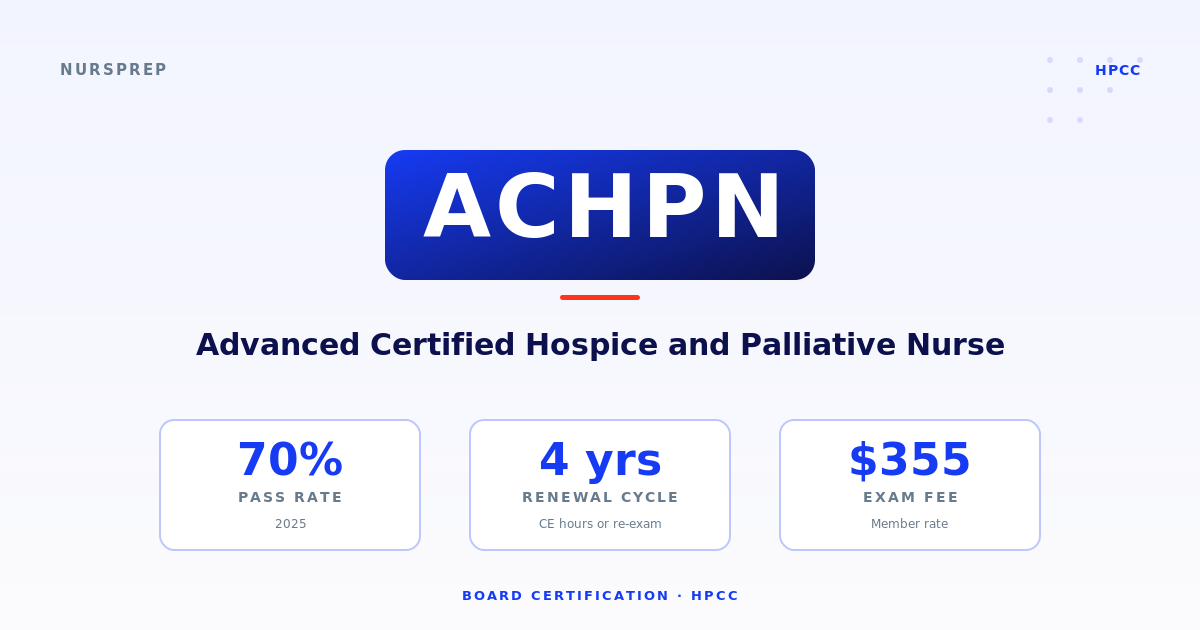
| Initial certification — HPNA member | $355 |
| Initial certification — non-member | $515 |
| reTEST Assured (prepaid retake) | $135 |
| HPNA annual membership (reduces exam fee) | ~$135 |
| Sandra Lee Schafer Certification Scholarship | Covers fee for selected applicants |
| Application start date | Three months before each exam window |
| Score reporting | On-site at test center · within 24 hrs for LRP |
| Payment methods | Visa, MasterCard, Discover, American Express |
Renewal
ACHPN certification is valid for four years. HPCC's renewal program is the Hospice and Palliative Accrual for Recertification (HPAR) — an online portfolio managed in LearningBuilder where holders accumulate 100 HPAR points over the cycle. 1 CE contact hour = 1 HPAR point, and other professional-development activities (publishing, presentations, precepting, mentoring) also earn points.
Since 2014, HPAR has been the standard recertification path for ACHPN; the 100-point requirement was standardized in 2017. The Situational Judgment Exercise (SJE) — case-based scenarios testing critical reasoning and clinical application beyond the initial-exam level — is also required at renewal. ACHPN holders must maintain practice hours during the cycle: 500 hours in the most recent 12 months or 1,000 hours in the most recent 24 months. Lapsed credentials cannot be reactivated by CE catch-up — holders must sit the current ACHPN exam again to reinstate. In 2025, HPCC processed 368 ACHPN renewals and 37 reactivations.
How hard is the ACHPN exam?
HPCC reported 200 of 284 first-time ACHPN candidates passed in 2025 — a 70.4% first-time pass rate. The total pass rate (first-time plus repeaters) was 68.1% (226 of 332). In 2024, the first-time pass rate was meaningfully higher: 76.0% (222 of 292). Year-over-year drift is expected because HPCC's published 2026 Detailed Content Outline introduces content shifts.
Repeater performance is the bigger story. Repeaters in 2025 passed at only 54.2% (26 of 48) — about 16 percentage points below first-time test-takers. The practical implication: a casual second sitting without rebuilt study habits is risky. reTEST Assured (HPCC's $135 prepaid retake) makes sense only when paired with a real restudy plan targeting the domains the candidate underperformed on the first attempt.
A 10-week ACHPN study plan
A structured 10-week plan suits most practicing palliative APRNs — about 80 to 110 total study hours across the four blueprint domains. Because APRNs already have advanced pathophysiology and pharmacology coursework behind them, most catch-up effort goes into the regulatory/ethics content of Professionalism and Practice plus the high-acuity emergencies in Evaluation and Management. Aim for 600–1,000 practice items total before test day.
-
1 WeekRead HPCC 2026 ACHPN Detailed Content Outline + baseline diagnostic exam
-
2 WeekAssessment and Data Collection — prognostic tools (PPS/KPS), advance care planning, hospice criteria
-
3 WeekEvaluation and Management I — pharmacologic interventions, opioid stewardship, methadone rotation math
-
4 WeekEvaluation and Management II — palliative-care emergencies (spinal cord compression, hemorrhage, seizures, SVC syndrome)
-
5 WeekEvaluation and Management III — palliative sedation, life-support devices, complex clinical decision-making
-
6 WeekEducation and Communication — serious-news delivery, conflict resolution, hospice vs. palliative framing
-
7 WeekProfessionalism and Practice — biomedical ethics, MAID, VSED, scope of practice, IDT/IDG role
-
8 WeekWeak-domain remediation based on diagnostic and week-by-week error log
-
9 WeekFull-length timed practice exam (150 scored items, paced) + error log review
-
10 WeekTargeted review of weak domains, rest, logistics, test day
How ACHPN candidates actually fail — and how to avoid it
Sample ACHPN question
This item mirrors the ACHPN scenario format: an APRN-scope clinical stem and four plausibly-correct options where only one is best. Try it before reading the rationale.
The presentation — progressive back pain, new lower-extremity weakness, and a single sphincter event in a patient with known vertebral metastases — is impending malignant spinal cord compression, a hospice and palliative emergency listed explicitly in the 2026 ACHPN DCO (2A2). Urgent MRI plus IV dexamethasone plus neurosurgery and radiation oncology consult is the evidence-based standard and is fully consistent with the patient's documented goal (functional independence through the wedding). Opioid titration alone misses the diagnosis and the functional window. Transfer to inpatient hospice is premature and goal-incongruent. Delaying imaging for a goals-of-care meeting risks irreversible neurologic injury when the patient's stated goal already endorses time-limited aggressive intervention.
Key ACHPN terms every APRN candidate should know
These terms surface in most ACHPN exam items. Review them until the definitions feel automatic — scenario stems often hinge on whether the candidate can name which framework applies (palliative sedation vs MAID vs VSED, spinal cord compression vs back pain workup, methadone vs morphine equianalgesic math).
| Term | Definition | Domain |
|---|---|---|
| Palliative sedation | Proportionate use of sedating medications to relieve refractory symptoms in the dying patient. Intent is symptom relief, not hastened death. Distinct from MAID and VSED. | Evaluation and Management |
| Medical aid in dying (MAID) | Physician-prescribed lethal medication that the patient self-administers, where legal. APRN scope of involvement varies by state law; the ACHPN exam tests recognition of the ethical and legal framework. | Professionalism and Practice |
| Voluntary stopping of eating and drinking (VSED) | Patient-initiated cessation of oral intake to hasten death in the context of irreversible serious illness. APRN role is supportive symptom management; explicitly listed in DCO 4A4. | Professionalism and Practice |
| Opioid stewardship | Evidence-based prescribing of opioids that balances analgesia, opioid-induced toxicity, diversion risk, and stewardship metrics. Explicitly listed as DCO 2H, unique to the APRN-level blueprint. | Evaluation and Management |
| Methadone equianalgesic conversion | Non-linear, dose-dependent cross-titration math used when rotating to or from methadone. Higher baseline morphine equivalents require larger reduction factors than other opioid rotations. | Evaluation and Management |
| Palliative-care emergencies | DCO 2E. Includes spinal cord compression, hemorrhage, seizures, and superior vena cava (SVC) syndrome. Each requires recognition, evidence-based urgent management, and alignment with the patient's documented goals of care. | Evaluation and Management |
| PPS (Palliative Performance Scale) | 0–100 scale measuring functional status in advanced illness. Used in prognostication and hospice eligibility decisions. | Assessment and Data Collection |
| POLST / MOLST | Physician (or Medical) Orders for Life-Sustaining Treatment. Portable, actionable medical orders covering CPR, intubation, artificial nutrition, and antibiotics that travel with the patient across settings. | Assessment and Data Collection |
| Interdisciplinary group (IDG/IDT) | Required hospice care team — APRN/RN, physician, social worker, chaplain, hospice aide, volunteer — that develops and updates the plan of care at least every 15 days under the Medicare Hospice Benefit. | Professionalism and Practice |
| Hospice eligibility | Physician-certified life expectancy of six months or less if the disease runs its expected course. ACHPN candidates must recognize disease-specific criteria (e.g., FAST scale for dementia, NYHA Class IV for heart failure). | Assessment and Data Collection |
| Prolonged grief disorder (PGD) | DSM-5-TR diagnosis (added 2022) characterized by persistent, impairing grief lasting at least 12 months after the death. Distinct from anticipatory grief and from culturally normal grief responses. | Education and Communication |
ACHPN vs. CHPN, CHPPN, HPM, APHSW-C
ACHPN sits alongside several related credentials. Many APRNs Google "ACHPN" when they actually need a different HPCC credential, or when they confuse the APRN exam with its physician (HPM) or social-work (APHSW-C) parallels. The distinction matters before paying the application fee.
| Credential | Body | Scope | Best fit |
|---|---|---|---|
| ACHPN | HPCC | Advanced-practice hospice and palliative nursing | Nurse Practitioners and Clinical Nurse Specialists |
| CHPN | HPCC | Hospice and palliative nursing for adult patients | RNs in hospice, palliative, or serious-illness roles |
| CHPPN | HPCC | Pediatric hospice and palliative | RNs caring for pediatric end-of-life patients |
| HPM | ABIM / ABMS member boards | Hospice and Palliative Medicine subspecialty | Physicians (MD/DO) subspecializing in HPM |
| APHSW-C | HPCC | Advanced palliative hospice social work | Licensed clinical social workers in palliative/hospice settings |
Take ACHPN if you are an NP or CNS with at least 500 documented hospice or palliative APRN practice hours in the past 12 months. Take CHPN if you are an RN. Take CHPPN if your patients are pediatric. HPM is the physician parallel. APHSW-C is the social-work parallel. Note that AGACNP-BC, FNP-BC, and AGPCNP-BC are population-focus APRN certifications used to obtain APRN licensure — ACHPN is a specialty add-on credential, not a replacement.
Frequently asked questions about ACHPN certification
ACHPN stands for Advanced Certified Hospice and Palliative Nurse. The credential is issued by the Hospice and Palliative Credentialing Center (HPCC) and is the APRN-level board certification for hospice and palliative nursing, restricted to Nurse Practitioners and Clinical Nurse Specialists.
HPCC — the Hospice and Palliative Credentialing Center — issues the ACHPN credential. HPCC is the credentialing arm of the Hospice and Palliative Nurses Association (HPNA). First national testing of the advanced-practice exam was held in May 2003 in partnership with ANCC; HPCC acquired the exam in December 2004 and ABSNC accredited it in February 2007.
Candidates need a current, active APRN license; completion of an accredited graduate, postgraduate, or doctoral NP or CNS program with three required graduate-level courses (advanced pathophysiology, advanced health assessment, advanced pharmacology) and a 500-hour clinical practicum; and 500 hours of hospice or palliative APRN practice in the most recent 12 months — or 1,000 hours in the most recent 24 months.
HPCC charges $355 for HPNA members and $515 for non-members. The optional reTEST Assured add-on prepays a single retake for $135. HPNA membership runs about $135 per year, so joining HPNA before applying typically pays for itself on the first sitting.
HPCC's 2026 ACHPN Detailed Content Outline lists 150 scored items across four domains — Assessment and Data Collection (42), Evaluation and Management (49), Education and Communication (38), and Professionalism and Practice (21). Some third-party prep vendors describe additional unscored pretest items; HPCC's published DCO sums to 150 scored.
HPCC reported a 70.4% first-time pass rate in 2025 (200 of 284 candidates). The 2024 first-time pass rate was 76.0% (222 of 292). Repeater pass rates run about 16 points lower, so a casual second attempt without rebuilt study habits carries meaningful risk.
HPCC offers the ACHPN exam during four annual windows: March, June, September, and December. Online application deadlines fall about two weeks before each window opens — Feb 15, May 15, Aug 15, and Nov 15. Application start dates open three months before each window.
Yes. ACHPN is valid for four years. Renewal runs through HPAR — Hospice and Palliative Accrual for Recertification — where holders accumulate 100 points (1 CE contact hour = 1 HPAR point) and complete the Situational Judgment Exercise. ACHPN holders must also maintain 500/1,000 practice hours during the cycle. Lapsed credentials cannot be renewed by CE catch-up and require re-examination.
CHPN is the RN-level credential — any registered nurse with 500/1,000 hospice or palliative practice hours can sit it. ACHPN is the APRN-level credential, restricted to Nurse Practitioners and Clinical Nurse Specialists who completed an accredited graduate NP or CNS program. Both are issued by HPCC. The blueprints, eligibility, and exam content differ; RNs progressing through an APRN program typically move from CHPN to ACHPN.
Many academic medical centers, hospice agencies, and palliative-care consult services reimburse the ACHPN application fee through an APRN-specific education benefit. The Hospice and Palliative Nurses Foundation (HPNF) also runs the Sandra Lee Schafer Certification Scholarship, which covers fees for selected applicants paying out of pocket.
Trusted sources
All figures on this page are verified against the following primary sources. Fees, blueprint counts, and recertification rules shift on HPCC's revision cycle — always verify numeric facts against the current HPCC handbook before relying on them for application decisions.
- Hospice and Palliative Credentialing Center (HPCC) — ACHPN credential page: eligibility, fees, testing windows, PSI scheduling — advancingexpertcare.org/hpcc/credentials/achpn/
- HPCC — Exam Statistics: 2024 and 2025 ACHPN pass rates and active certificant counts — advancingexpertcare.org/hpcc/why-certification/exam-statistics/
- HPCC — History: NBCHN 1993 founding, 2003 first advanced-practice testing, 2004 ACHPN acquisition, 2007 ABSNC accreditation through Feb 2027 — advancingexpertcare.org/hpcc/why-certification/hpcc-history/
- HPCC — 2026 ACHPN Detailed Content Outline (PDF, April 2026 role-delineation study report) — advancingexpertcare.org/wp-content/uploads/2026/05/2026-ACHPN-DCO_for-website.pdf
- HPCC — HPAR recertification program: 100 points, Situational Judgment Exercise — advancingexpertcare.org/hpcc/recertification/hpar/
- HPCC — How to Recertify ACHPN (4-year cycle, practice hours, HPAR + SJE) — advancingexpertcare.org/hpcc/recertification/how-to-recertify-achpn/
- HPCC — reTEST Assured program ($135 prepaid retake) — advancingexpertcare.org/hpcc/retest-assured/
- US Bureau of Labor Statistics — Nurse Anesthetists, Nurse Midwives, and Nurse Practitioners OOH: $129,210 median NP wage (May 2024); hospital setting median $137,790
Ready to practice ACHPN-style items?
Work through a 25-question diagnostic mapped to HPCC's four-domain blueprint. Free to start — no card required.