TCRN certification at a glance
TCRN — Trauma Certified Registered Nurse — is the nursing-side benchmark for trauma care across the full continuum. The credential is issued by the Board of Certification for Emergency Nursing (BCEN), which launched the exam in 2014; by the end of 2024, 8,075 RNs held the credential.
TCRN is a board certification, not a course. It is often confused with TNCC — the two-day Emergency Nurses Association provider course — but only TCRN appears on your credentials line after RN.
Am I eligible for the TCRN exam?
Yes — if you hold an active, unrestricted RN license in the US, a US territory, Canada, or Australia. BCEN does not enforce a minimum-hours rule.
BCEN strongly recommends two years of RN practice plus 1,000 to 1,870 trauma nursing hours within the last three years. That recommendation is not a gate; it is the experience profile at which first-time pass rates historically hold up.
You are a strong candidate if…
- You have logged roughly two years of trauma-focused RN practice, with 1,000 to 1,870 trauma hours inside the last three years.
- You are comfortable with the primary and secondary survey and can run an MTP activation without a checklist.
- You routinely care for blunt, penetrating, and polytrauma patients across at least two points of the continuum — ED plus ICU, ED plus transport, or OR plus rehab.
- Your setting fits a recognized trauma role: Level I–IV ED, trauma/surgical/neuro ICU, trauma OR, HEMS or ground CCT, burn unit, trauma step-down, pediatric trauma, inpatient rehab after trauma, or a trauma PI / program-management role.
TCRN exam blueprint — six domains (effective 2025-11-29)
The TCRN blueprint is six domains, weighted by body region and by the points along the trauma continuum where most nursing decisions happen. Trunk and Pelvis plus Continuum of Care together carry about half of the exam — most of your study time should live there.
- Head and Neck Trauma 31%
- Trunk and Pelvis Trauma 38%
- Musculoskeletal and Wound Trauma 13%
- Special Populations (peds, geri, OB, bariatric, burns, psychosocial) 22%
- Continuum of Care for Trauma 36%
- Professional Practice 10%
Do not neglect Professional Practice. Quality-management, NTDB / TQIP registry work, EMTALA, and disaster-triage items feel abstract at the bedside but reliably appear on the exam. Candidates who rely only on ED experience tend to bleed points in Continuum of Care, Special Populations, and Professional Practice.
Cost, scheduling, and military benefits
BCEN delivers TCRN through Pearson VUE in-person testing centers and also offers Live Remote Proctoring (LRP) for candidates who prefer to test from a private location. After BCEN approves your application, you receive an Authorization to Test (ATT) email with a 90-day scheduling window — book your Pearson VUE seat or LRP slot immediately to avoid reapplying.
| Fee item | Cost (USD) |
|---|---|
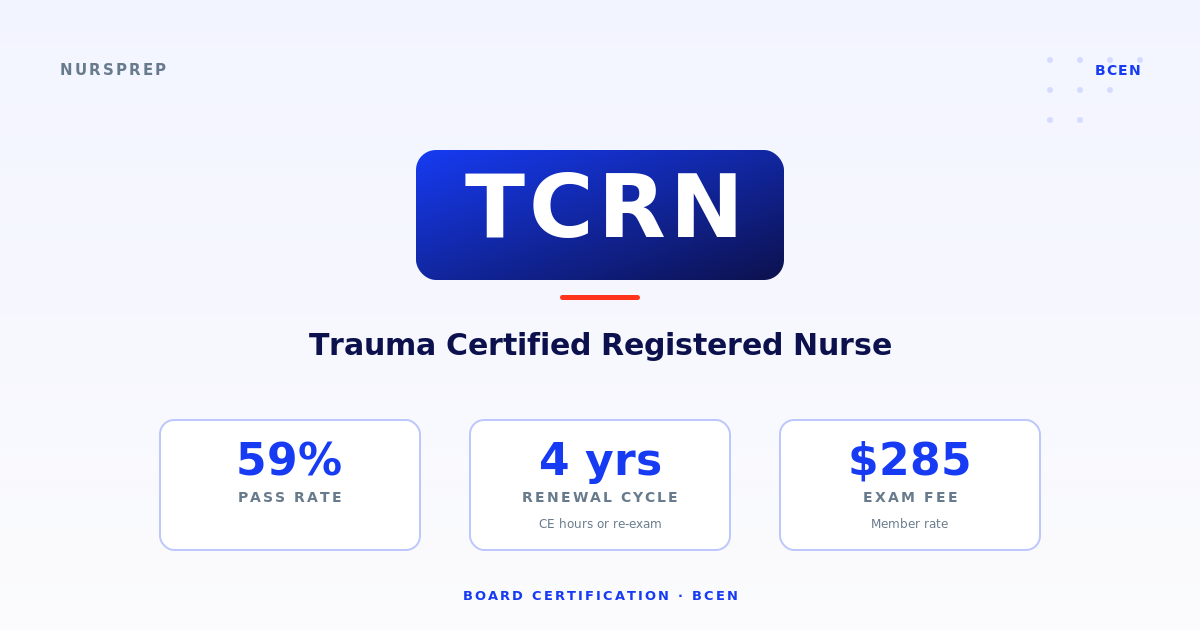
| Initial application — ENA member | $285 |
| Initial application — non-member | $380 |
| Military / veteran application | $195 (or $265 with Test Assurance) |
| Retake | Same as initial fee |
| Recertification by CE — ENA member | $285 |
| Recertification by CE — non-member | $380 |
| Recertification by exam | Same as initial fee |
| ENA annual membership (reduces exam fee) | ~$135 |
Renewal
TCRN certification is valid for four years. BCEN offers two renewal pathways. Pathway 1 — Recertification by CE Attestation: complete 100 contact hours in the current 4-year cycle, with at least 75 hours tied specifically to emergency and trauma content. Submit the attestation through the BCEN portal; BCEN audits at least 10% of renewals, so keep CE certificates and transcripts for the full cycle.
Pathway 2 — Recertification by Examination: retake and pass the current TCRN exam at the initial-application fee. There is no grace period for a lapsed TCRN — lapsed candidates must sit the full exam again to reinstate the credential.
How hard is the TCRN exam?
BCEN reported 1,142 of 1,929 TCRN candidates passed the exam in 2024 — a 59% pass rate. That is lower than headline pass rates for BCEN's broader CEN exam, partly because TCRN covers the full trauma continuum rather than a single unit, and partly because candidates often underprepare for Professional Practice and Special Populations content.
Candidates who follow a structured 8 to 12-week plan and complete at least one full-length timed practice exam pass at meaningfully higher rates than those relying on work experience alone. The November 2025 blueprint change also introduced a new passing-point study, so small year-over-year pass-rate shifts are expected while the new standard beds in.
A 10-week TCRN study plan
A structured 10-week study plan is enough for most trauma RNs with two or more years of practice — roughly 80 to 120 total study hours across the six blueprint domains. Practice-question volume ramps through weeks 2–8 and peaks in week 9 with a full-length timed exam; week 10 is for targeted review, logistics, and a rest day.
-
1 WeekRead BCEN TCRN Content Outline + baseline diagnostic exam
-
2 WeekPrimary + secondary survey, shock physiology, massive transfusion protocol
-
3 WeekHead and neck trauma — TBI, SCI, maxillofacial, ocular
-
4 WeekTrunk and pelvis trauma — chest, abdominal, pelvic fractures
-
5 WeekMusculoskeletal, wound care, burns, Parkland resuscitation
-
6 WeekSpecial populations — pediatric, geriatric, OB, bariatric, psychosocial
-
7 WeekContinuum of care — pre-hospital, OR, ICU, rehab handoffs
-
8 WeekProfessional practice — quality, disaster, EMTALA, ACS verification
-
9 WeekFull-length timed practice exam + error-log review
-
10 WeekTargeted review of weak domains, rest, test day
How TCRN candidates actually fail — and how to avoid it
Sample TCRN question
This item mirrors BCEN's scenario format: a short clinical stem, an unstable patient, and four plausibly-correct options where only one is best. Try it before you read the rationale.
The patient has suspected tension pneumothorax and hemorrhagic shock from likely liver injury. Damage-control resuscitation calls for balanced blood products through MTP and immediate decompression of the chest. Crystalloid chasing worsens dilutional coagulopathy. CT is inappropriate in an unstable patient.
Key TCRN terms every candidate should know
These terms surface in most TCRN exam items. Review them until the definitions feel automatic — scenario-based stems often hinge on recognizing which framework (MTP, damage-control resuscitation, lethal diamond) applies.
| Term | Definition | Domain |
|---|---|---|
| MTP | Massive Transfusion Protocol — balanced delivery of packed red cells, plasma, and platelets, typically in a 1:1:1 ratio, activated for hemorrhagic shock. | Continuum |
| Permissive hypotension | Deliberately accepting a lower systolic BP (around 80–90 mm Hg) in select trauma patients to limit clot disruption until hemorrhage control. | Continuum |
| Damage-control resuscitation | Strategy combining permissive hypotension, hemostatic resuscitation, and damage-control surgery to prevent the lethal diamond. | Continuum |
| Lethal diamond | The four conditions that drive mortality in hemorrhagic shock: hypothermia, acidosis, coagulopathy, and hypocalcemia. | Continuum |
| Le Fort fractures | Classification of midface fractures (types I, II, III) that guide airway and surgical decisions. | Head/Neck |
| Autonomic dysreflexia | A medical emergency in SCI patients at T6 or above, triggered by a noxious stimulus below the lesion. | Head/Neck |
| Beck's triad | Hypotension, muffled heart sounds, and jugular venous distention — the classic sign set for cardiac tamponade. | Trunk/Pelvis |
| Compartment syndrome | Rising pressure within a closed fascial space that compromises perfusion; the 6 Ps include pain, pallor, paresthesia, paralysis, pulselessness, and poikilothermia. | MSK/Wound |
| TBSA | Total Body Surface Area burned — estimated by the Rule of Nines or Lund-Browder chart to guide fluid resuscitation. | Special Pops |
| Parkland Formula | 4 mL × kg × %TBSA of Lactated Ringer's over 24 hours for major burns; half given in the first 8 hours. | Special Pops |
| FAST exam | Focused Assessment with Sonography for Trauma — screens for free intra-peritoneal or pericardial fluid in unstable blunt abdominal trauma. | Trunk/Pelvis |
| GCS | Glasgow Coma Scale — 3 to 15 score for level of consciousness; drives triage and TBI decisions. | Head/Neck |
| ISS | Injury Severity Score — 0 to 75 anatomic score used for trauma registry severity stratification. | Professional |
| EMTALA | Emergency Medical Treatment and Labor Act — federal statute governing ED screening, stabilization, and transfer of trauma patients. | Professional |
| ACS Verification | American College of Surgeons trauma center verification process that confirms a facility meets trauma care standards. | Professional |
TCRN vs. CEN, CFRN, CTRN, CCRN, TNCC, ATCN
TCRN sits alongside several related credentials that trauma RNs sometimes consider. Many candidates Google "TCRN" when they actually mean TNCC, so the distinction matters before you spend time or money.
| Credential | Body | Scope | Best fit |
|---|---|---|---|
| TCRN | BCEN | Trauma nursing across the full continuum | RNs in any trauma-touching setting |
| CEN | BCEN | Breadth of emergency nursing | ED RNs covering all presentations |
| CFRN | BCEN | Flight transport nursing | HEMS or fixed-wing transport RNs |
| CTRN | BCEN | Ground critical-care transport | Ground CCT RNs |
| CCRN | AACN | Adult, pediatric, or neonatal critical care | ICU RNs; pairs well with TCRN |
| TNCC (course, not cert) | ENA | Baseline trauma resuscitation | All ED RNs as foundational training |
| ATCN (course, not cert) | STN | Advanced trauma care paired with ATLS | Trauma-team RNs working with ATLS providers |
Take TCRN if you want to validate trauma expertise across the continuum. Add CFRN or CTRN on top if most of your time is spent in transport. Take CEN instead if your day-to-day is broad ED practice. TNCC and ATCN are baseline education — they do not replace TCRN on your credentials line.
Frequently asked questions about TCRN certification
TCRN stands for Trauma Certified Registered Nurse. The credential is issued by the Board of Certification for Emergency Nursing (BCEN).
No. TCRN is a board certification earned by passing a 175-item exam, while TNCC is a two-day provider course run by the Emergency Nurses Association.
Most trauma RNs prepare for 8 to 12 weeks. A realistic target is 80 to 120 total study hours spread across the six blueprint domains.
The TCRN exam is moderately difficult. The first-time pass rate sits near 59%, and candidates who rely only on ED experience tend to struggle with the Continuum of Care and Special Populations domains.
Yes. BCEN does not enforce an hours requirement. The 1,000 to 1,870 trauma hours within 3 years is a strong recommendation, not a gatekeeping rule.
You must wait 90 days before retaking the exam and submit a new application with the full fee for each retake attempt.
BCEN does not cap retake attempts. However, each retake requires a new application, a new 90-day waiting period, and a new fee.
Yes. TCRN certification expires after 4 years. You renew through CE attestation (100 contact hours, at least 75 in emergency/trauma content) or by retaking the exam.
Many Level I and Level II trauma centers reimburse the TCRN application fee and offer paid study time. Ask your trauma program manager or HR before paying out of pocket.
Yes. Canadian and Australian RNs with an unrestricted nursing license may sit for the exam and hold the credential on the same terms as US candidates.
Trusted sources
All figures on this page are verified against the following primary sources. Fees, blueprint weights, and recertification rules shift on BCEN's revision cycle — always verify numeric facts against the current BCEN handbook before relying on them for application decisions.
- Board of Certification for Emergency Nursing (BCEN) — TCRN Candidate Handbook and TCRN Examination Content Outline (effective 2025-11-29)
- BCEN 2024 Annual Report — TCRN certificant counts and pass-rate data (1,142 of 1,929; 8,075 active holders)
- BCEN — Recertification by CE Attestation policy and fee schedule (2026)
- Emergency Nurses Association (ENA) — membership tiers and TNCC course materials
- Society of Trauma Nurses (STN) — TCRN Review Course and ATCN program
- American College of Surgeons Committee on Trauma (ACS COT) — Resources for Optimal Care of the Injured Patient ("Orange Book")
- US Bureau of Labor Statistics (BLS) — Occupational Employment and Wage Statistics, Registered Nurses (May 2024): $98,430 mean RN wage; ER-focused RNs ~$111,166
- Journal of Trauma Nursing — peer-reviewed research on trauma nursing outcomes and certification
Ready to practice TCRN-style items?
Work through a 25-question diagnostic mapped to the November 2025 blueprint. Free to start — no card required.