CAPA certification at a glance
CAPA — Certified Ambulatory Perianesthesia Nurse — is the board credential for registered nurses who work outside the immediate PACU: preadmission clinics, day-surgery floors, ambulatory surgery centers, endoscopy suites, Phase II recovery, and extended-observation units. The credential is issued by the American Board of Perianesthesia Nursing Certification (ABPANC), which has awarded it since 1994.
CAPA sits alongside CPAN — the sister credential for Phase I PACU nurses — under the same professional umbrella. Both exams are shaped by ASPAN practice standards and the ABPANC Role Delineation Study cycle. Hospitals, ambulatory surgery centers, and office-based surgery sites all recognize CAPA as a mark of advanced clinical skill across the perianesthesia continuum.
Am I eligible for the CAPA exam?
ABPANC requires two things: an active, unrestricted US RN license (based on NCLEX) and 1,200 hours of direct perianesthesia RN care within the past 2 years. Hours must be in direct patient care — management and academic roles do not count toward the eligibility total.
Agency, per-diem, and part-time hours all count as long as they meet the clinical-hours criteria. There is no degree requirement beyond RN licensure. Always confirm the current rule in the ABPANC Candidate Handbook before you apply, since ABPANC updates the handbook on its revision cycle.
You are a strong candidate if…
- You have logged 1,200+ direct patient-care hours in the past 2 years across preadmission, preoperative, Phase II, ambulatory, or extended-observation settings.
- Your work site is an ambulatory surgery center (ASC), hospital-based outpatient surgery unit, office-based surgery practice, preoperative assessment clinic, GI/endoscopy suite, or Phase II PACU.
- You are comfortable with preoperative screening, moderate sedation monitoring, Aldrete and PADSS scoring, PONV management, and discharge teaching across the perianesthesia continuum.
- If most of your shifts happen in Phase I PACU instead, the CPAN credential is the better fit — but dual CPAN/CAPA is common for nurses who rotate across the full continuum.
CAPA exam blueprint — four domains (2023–2027 cycle)
The current CAPA blueprint runs through 2027 and is based on the 2020–2021 ABPANC Role Delineation Study. ABPANC publishes four aggregate domains — the largest combined block (Safety + Patient Advocacy + Education) accounts for nearly half of the exam, so do not treat it as peripheral content.
- Perianesthesia Care Considerations 25%
- Anesthesia 20%
- Professional Nursing Practice and Guidelines 9%
- Safety, Patient Advocacy, and Education (combined) 46%
Perianesthesia Care Considerations covers the full continuum across preadmission, preoperative, Phase I, and Phase II. Anesthesia covers general, regional, local, moderate sedation, MAC, and TIVA. Professional Nursing Practice and Guidelines covers multidisciplinary collaboration and evidence-based care. The combined Safety / Patient Advocacy / Education block covers MH protocols, informed consent, discharge teaching, and psychosocial support.
Cost, scheduling, and Test Assured
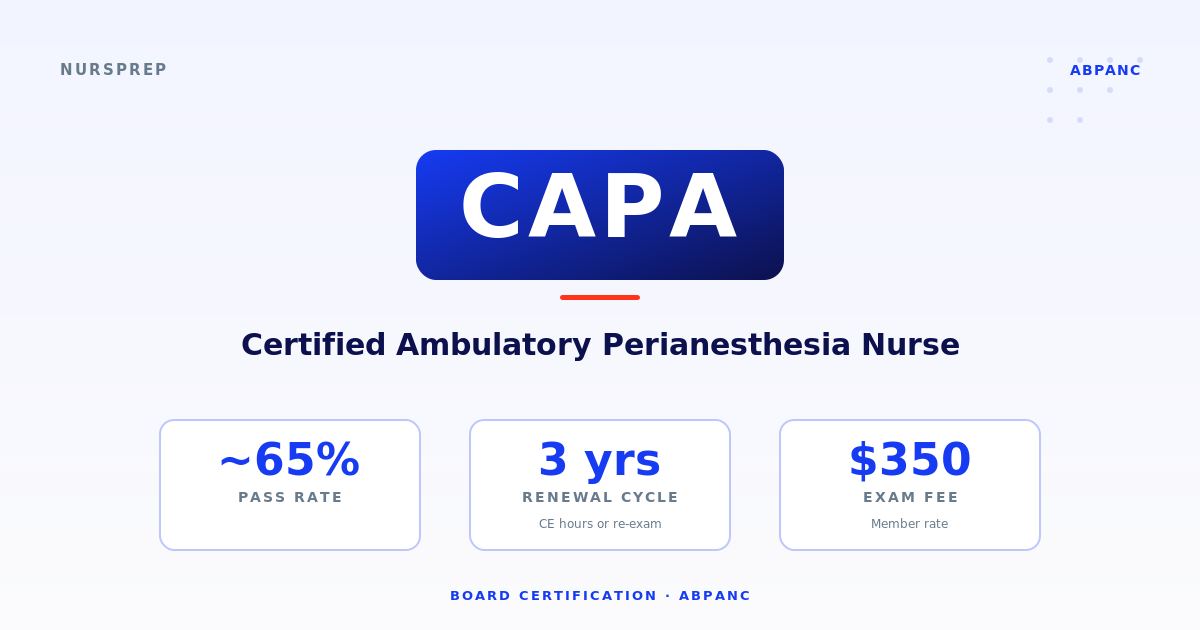
The CAPA application is an online workflow that takes about 20 minutes once you have your hours documented. After ABPANC approves your application and fee, you receive an Authorization to Test (ATT) email within 10 business days and then have a 90-day scheduling window to book your seat through the ABPANC testing vendor.
ASPAN membership pays for itself if you plan to certify or renew — the member discount on the exam fee alone roughly covers annual dues. Test Assured is an optional add-on that lets you retake the exam free if you do not pass on the first try.
| Fee item | Cost (USD) |
|---|---|
| CAPA exam application — ASPAN member | $350 |
| CAPA exam application — non-member | $424 |
| Test Assured (includes one free retake) — member | $400 |
| Recertification by CE (3-year cycle) | ~$275 member / ~$350 non-member |
| Prep materials and CE courses | ~$150–$500 (plan-dependent) |
| ASPAN membership (reduces all ABPANC fees) | Annual dues vary by tier |
Renewal
CAPA certification is valid for three years. ABPANC offers two renewal pathways. Pathway 1 — Recertification by CE: complete 70 contact hours of perianesthesia-relevant continuing education (the 70-hour requirement took effect for 2025 and later renewal cycles) plus 900 hours of perianesthesia nursing practice during the 3-year cycle. Track your CE hours in the ABPANC online portal as you complete them.
Pathway 2 — Recertification by Examination: retake and pass the current CAPA exam. Note: the re-examination renewal option is only available through November 15, 2026. Letting your certification lapse forces you to restart the full initial application, so renew before your expiration date.
How hard is the CAPA exam?
The CAPA exam pass rate averages around 65%. Recent testing windows have ranged from 48% to 81% depending on the quarter — the Spring 2024 window came in at 53%, one of the lower recent cycles. Pass-rate swings reflect candidate preparation more than exam difficulty.
Candidates who pair the ASPAN PeriAnesthesia Nursing Core Curriculum with a timed third-party question bank tend to pass on the first attempt. Most CAPA candidates report that timing, not knowledge, is the hardest part of the real exam, so at least one full-length timed practice run before test day is the single highest-leverage prep task.
An 8-week CAPA study plan
A focused 8-week plan is enough for most candidates who are working full time. Anchor your plan around three core resources: the ASPAN PeriAnesthesia Nursing Core Curriculum, the ABPANC self-assessment exam, and a third-party question bank with rationales. Study in short daily blocks of 30–45 minutes rather than weekend binges, and use spaced repetition for scoring tools like PADSS, Aldrete, and the malignant hyperthermia treatment sequence.
-
1 WeekPerianesthesia Care Considerations — master Phase II discharge criteria + PADSS
-
2 WeekAnesthesia fundamentals — classify techniques and typical recovery patterns
-
3 WeekSafety + malignant hyperthermia — MH protocol + safe patient handoffs
-
4 WeekPatient advocacy + ethics — informed consent + advance directives
-
5 WeekEducation + communication — practice discharge teaching scenarios
-
6 WeekProfessional practice — ASPAN standards + evidence-based care
-
7 WeekMixed practice questions — target 75% average on timed sets
-
8 WeekFull-length simulation + weak-area review, rest before exam day
How CAPA candidates actually fail — and how to avoid it
Sample CAPA question
This item mirrors ABPANC's scenario format: a short clinical stem, a Phase II recovery context, and four plausibly-correct options where only one is best. Try it before you read the rationale.
A PADSS score of 9–10 is the standard discharge threshold, but small volumes of clear fluid can reduce mild PONV and help the patient progress toward that threshold. Immediate discharge at PADSS 8 is unsafe, a second antiemetic may be premature at this severity, and waiting for a perfect score is not required by PADSS criteria.
Key CAPA terms every candidate should know
Use this glossary while you study. Each term appears on the exam in multiple forms, often as a distractor in scenario-based items. Review until the definitions feel automatic.
| Term | Definition | Domain |
|---|---|---|
| Preadmission testing | Pre-surgical screening for health risks before the procedure date. | Perianesthesia Care |
| Phase I recovery | Immediate recovery from anesthesia with close airway and hemodynamic monitoring. | Perianesthesia Care |
| Phase II recovery | Transition to home-readiness after Phase I criteria are met. | Perianesthesia Care |
| Aldrete score | Scoring tool used for Phase I discharge readiness (airway, circulation, consciousness, activity, oxygen saturation). | Perianesthesia Care |
| PADSS | Post Anesthesia Discharge Scoring System used to clear Phase II patients for home; 9–10 is the standard discharge threshold. | Perianesthesia Care |
| PONV | Postoperative Nausea and Vomiting — a common Phase II concern and a frequent cause of delayed discharge. | Anesthesia |
| Moderate sedation | Drug-induced depression of consciousness where the patient still responds purposefully to verbal cues. | Anesthesia |
| MAC | Monitored Anesthesia Care — anesthetic service where a provider monitors the patient's vitals during local or regional anesthesia. | Anesthesia |
| TIVA | Total Intravenous Anesthesia — anesthesia delivered entirely through IV agents rather than inhaled gases. | Anesthesia |
| Malignant hyperthermia | Rare inherited reaction to certain anesthetic agents; life-threatening; first-line treatment is dantrolene. | Safety |
| Dantrolene | The antidote for malignant hyperthermia — mixed urgently and administered IV once MH is recognized. | Safety |
| ERAS | Enhanced Recovery After Surgery — evidence-based protocols to speed post-surgical recovery and shorten length of stay. | Professional Practice |
| Informed consent | The process confirming a patient has the information, capacity, and voluntariness to authorize a procedure. | Advocacy |
| Discharge teaching | Structured, teach-back style instruction delivered before the patient leaves Phase II, covering wound care, medications, and warning signs. | Education |
| Extended observation | A post-procedure stay beyond standard Phase II, used for patients who need additional monitoring but not inpatient admission. | Perianesthesia Care |
CAPA vs. CPAN: which should you take?
CAPA and CPAN are sister ABPANC credentials, but they serve different settings within the perianesthesia continuum. Choose the one that matches where most of your direct-care hours live — or sit for both if you rotate across the full continuum.
| Credential | Body | Scope | Best fit |
|---|---|---|---|
| CAPA | ABPANC | Preop, ambulatory, Phase II — lower acuity, ambulatory-stable | ASCs, endoscopy, preadmission clinics, Phase II PACU |
| CPAN | ABPANC | Immediate Phase I PACU — higher acuity, post-anesthesia recovery | Hospital PACU — airway + hemodynamic focus |
| CPAN/CAPA (dual) | ABPANC | Full perianesthesia continuum | Nurses rotating across Phase I, Phase II, and ambulatory |
| CNOR | CCI | Intraoperative perioperative nursing | OR circulators and scrub RNs |
| CRNFA | CCI | First-assistant subspecialty | RN first assistants in the OR |
Take CAPA if most of your hours are in ambulatory or Phase II. Take CPAN if you primarily work Phase I. Take both (CPAN/CAPA dual credential) if you rotate across the full perianesthesia continuum — the same board administers both exams, and dual-certified nurses often see the strongest career momentum.
Frequently asked questions about CAPA certification
Yes. CAPA signals validated competence in preoperative and Phase II care, and many ambulatory surgery centers prefer or require certified staff. Most Magnet hospitals and ASCs reimburse the application fee and add a certification differential to your base hourly rate.
Most candidates prepare for 8 to 12 weeks while working full time — roughly 50 to 80 total study hours spread across the four blueprint domains. Candidates returning from a long study break often need closer to 10–12 weeks.
Yes. Part-time, per-diem, and agency hours all count toward the 1,200-hour eligibility rule, as long as they are direct perianesthesia clinical hours in a qualifying setting (preadmission, preoperative, Phase II, ambulatory, or extended observation).
You can retake the exam after a short waiting period. The Test Assured program, purchased with the initial application, covers one free retake if you do not pass on the first attempt.
Yes. The credential renews every 3 years through 70 CE hours plus 900 perianesthesia practice hours, or by retaking the CAPA exam. The re-examination renewal option is only available through November 15, 2026.
CAPA is open only to RNs licensed in the US and its territories, though the credential is internationally respected in perianesthesia circles.
Yes, if those hours meet CPAN's Phase I clinical criteria. Time spent in Phase II alone usually does not qualify for CPAN — CPAN requires Phase I PACU direct-care hours specifically.
The CAPA exam pass rate averages around 65%. Recent testing windows have ranged from 48% to 81%, with Spring 2024 reported at 53%. ABPANC publishes quarterly and annual pass-rate data in its exam statistics reports.
The application fee is $350 for ASPAN members and $424 for non-members. Optional Test Assured (covers one free retake) is around $400. Recertification by CE is approximately $275 for members and $350 for non-members.
CAPA covers preoperative, ambulatory, and Phase II care — lower-acuity, ambulatory-stable patients. CPAN covers immediate Phase I PACU — higher-acuity post-anesthesia recovery with airway and hemodynamic focus. Both are ABPANC credentials, and dual CPAN/CAPA is common for nurses who rotate across the continuum.
Trusted sources
All figures on this page are verified against the following primary sources. Fees, blueprint weights, and recertification rules shift on ABPANC's revision cycle — always verify numeric facts against the current ABPANC candidate handbook before relying on them for application decisions.
- ABPANC candidate handbook (cpancapa.org) — eligibility hours, fees, blueprint, recertification rules
- ABPANC exam statistics page — quarterly and annual pass-rate windows
- ABPANC Role Delineation Study 2020–2021 — basis for the 2023–2027 CAPA blueprint
- ASPAN (American Society of PeriAnesthesia Nurses) — PeriAnesthesia Nursing Core Curriculum and practice standards
- US Bureau of Labor Statistics (BLS) — Occupational Employment and Wage Statistics, Registered Nurses (May 2024): $93,600 median RN wage
- Magnet Recognition Program — specialty certification as a preferred criterion in nurse staffing
Ready to practice CAPA-style items?
Work through a 25-question diagnostic mapped to the 2023–2027 blueprint. Free to start — no card required.