CRRN certification at a glance
CRRN — Certified Rehabilitation Registered Nurse — is the specialty credential for RNs practicing in rehabilitation settings. The credential is issued by the Rehabilitation Nursing Certification Board (RNCB), which is the credentialing arm of the Association of Rehabilitation Nurses (ARN). RNCB has offered CRRN continuously since 1984, making it the oldest nationally recognized rehabilitation nursing certification in the United States.
CRRN is now the only active RN-level rehabilitation nursing credential in the US — ANCC retired its RN-BC, Rehabilitation credential around 2018. The exam covers the full rehab continuum: inpatient rehab facilities (IRFs), skilled nursing facilities, long-term acute care, outpatient clinics, home health, and pediatric and geriatric rehab units. CARF-accredited programs and Magnet®-recognized hospitals routinely expect CRRN-credentialed RNs on rehab floors.
Am I eligible for the CRRN exam?
You qualify for CRRN through one of two practice pathways. Both require a current, active, unrestricted RN license in the US, US territories, or Canada. Pathway A — Practice is the standard route: two years of RN practice in rehabilitation nursing within the last five years. Pathway B — Practice + Study is a shorter clinical route for candidates pursuing graduate work: one year of rehab RN practice plus one year of advanced study (graduate-level coursework beyond the BSN) in nursing, both within the last five years.
The two years under Pathway A do not need to be consecutive, but all hours must fall within the 5-year window ending on your application date. Setting and role are flexible: hours earned as a staff nurse, charge nurse, manager, educator, clinical nurse leader, researcher, or consultant in rehabilitation all count. Hours from inpatient, outpatient, home health, or long-term care rehab all qualify.
You are a strong candidate if…
- You hold an active, unrestricted RN license in a US state, US territory, or Canadian province.
- You have logged at least 2 years of rehab nursing practice in the last 5 years (Pathway A), OR 1 year of rehab practice plus 1 year of graduate-level nursing coursework in the last 5 years (Pathway B).
- You are comfortable with FIM or Section GG scoring, autonomic dysreflexia management, Rancho Los Amigos staging, and interdisciplinary team rounds with PT, OT, SLP, physiatry, case management, and social work.
- You routinely manage core rehab diagnoses: stroke, spinal cord injury, traumatic brain injury, amputation, post-op orthopedic recovery, and chronic pain — across adult or pediatric lifespan settings.
- You can list 2 professional references who can verify your rehab experience — at least one must be your immediate supervisor or a current CRRN.
- Med-surg RNs with occasional rehab admissions usually do NOT qualify — RNCB counts only hours where rehabilitation nursing is your primary role. Verify borderline cases with RNCB before you apply.
CRRN exam blueprint — four domains
The RNCB Test Content Outline weights the exam heavily on clinical function: Functional Health Patterns at ~58% dominates the exam — almost three-fifths of your score lives in physiology, assessment, standards of care, and interventions across the lifespan. The second-largest domain is the one most candidates under-prepare for: Legislative, Economic, Ethical, and Legal Issues at ~23%, covering Medicare IRF-PPS rules, IRF-PAI assessment, the 60% Rule, and the three-hour therapy rule.
- Functional Health Patterns 58%
- Legislative, Economic, Ethical, Legal 23%
- Rehab Team & Community Reintegration 13%
- Models, Theories, Concepts 6%
The Rehabilitation Team and Community Reintegration (~13%) covers interdisciplinary roles, family teaching, durable medical equipment, and home-safety assessment. Rehabilitation Nursing Models, Theories, and Concepts (~6%) is the smallest domain — Roy's Adaptation Model, Orem's Self-Care Deficit Theory, the ARN Competency Model, and the WHO ICF framework. Do not ignore it — 6% is still 9–10 scored items, enough to decide a pass margin.
Cost, scheduling, and return on investment
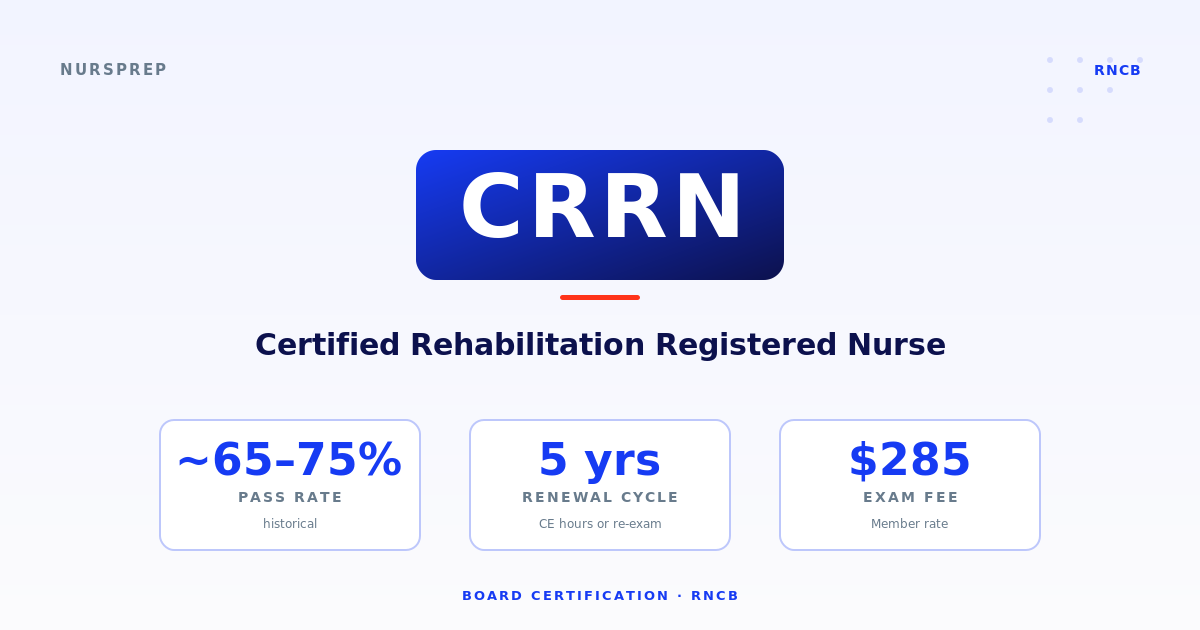
RNCB delivers CRRN at Prometric testing centers during two annual testing windows. The ARN-member application fee is $285; the non-member fee is $425 — a $140 gap. ARN membership runs approximately $120/year, so joining before applying usually pays for itself on the first fee alone and also unlocks ARN journal access and review-course discounts that you will use during prep.
At a one-time fee under $500, typical prep spend of $150–$400, and an RN mean wage of $94,480/year with the upper quartile at $132,680/year (BLS OEWS), the payback period is short when your IRF or Magnet® employer runs a certification pay differential — commonly $0.50–$2.00/hour or a lump-sum bonus. Many Magnet® IRFs reimburse the fee through an education benefit; ask HR or nursing professional development before paying out of pocket.
| Fee item | Cost (USD) |
|---|---|
| Exam application — ARN member | $285 |
| Exam application — non-member | $425 |
| ARN annual membership (recovers the delta) | ~$120 |
| Late application surcharge | Additional fee during late window |
| Renewal by Points of Credit — ARN member | ~$180 |
| Renewal by Points of Credit — non-member | ~$280 |
| Renewal by re-examination | $285 member / $425 non-member |
| Typical certification pay differential | $0.50–$2.00 / hr at IRFs and Magnet® hospitals |
Renewal
CRRN certification is valid for five years. RNCB offers two renewal pathways. Pathway 1 — Points of Credit (POC): hold a current, unrestricted RN license; complete 1,000 hours of rehabilitation nursing practice during the 5-year cycle; and earn 60 points of credit across approved professional activities. One contact hour of CE equals 1 point, and at least two-thirds of CE points must come from nursing-approved providers. ACLS, BLS, CPR, bloodborne pathogens, and fire-safety refreshers do not count.
Pathway 2 — Re-examination: retake and pass the current CRRN exam during an active testing window. The re-exam fee matches the current application fee. Start logging CE, committee work, and presentations in year 1 of the cycle, not year 5 — assembling a 60-point portfolio in the final year is the single most common renewal mistake. RNCB does not offer a grace period. A lapsed CRRN must sit and pass the full exam again to reinstate the credential.
How hard is the CRRN exam?
RNCB does not publish a single pass-rate figure every year. Historically, first-time pass rates sit in the 65–75% range, with retake candidates scoring lower on average. Candidates who complete a structured 8–12 week study plan and at least one full-length timed practice exam pass at meaningfully higher rates. Contact RNCB directly or check the most recent ARN annual report for the current reporting year.
The top failure mode on CRRN is not clinical content — it's under-weighting the Legislative, Economic, Ethical, and Legal domain (~23%). Candidates who spend their prep on stroke and SCI content and skim Medicare IRF-PPS, the 60% Rule, the three-hour therapy rule, and the IRF-PAI assessment walk in weak on roughly one-quarter of the exam. Block two full weeks of prep on regulatory and economic content, not two days.
A 10-week CRRN study plan
Most rehab RNs with 2+ years of practice succeed on a 10-week plan at 8–12 hours per week — roughly 80–120 total study hours. Anchor your plan around the RNCB Test Content Outline, the ARN Core Curriculum for Rehabilitation Nursing (current edition), and at least one question bank with rationales (Pocket Prep CRRN, Board Vitals CRRN, or Mometrix CRRN). The ARN Review Course — in-person or on-demand — is the highest-ROI single investment.
-
1 WeekRead the RNCB TCO + baseline diagnostic exam to calibrate weaknesses
-
2 WeekModels, theories, rehab nursing process, and ARN Competency Model
-
3 WeekStroke rehab — hemiparesis, dysphagia screening, aphasia, unilateral neglect
-
4 WeekSpinal cord injury — autonomic dysreflexia, neurogenic bowel/bladder, ASIA staging
-
5 WeekTraumatic brain injury (Rancho), amputation, post-op orthopedic rehab
-
6 WeekPediatric rehab, geriatric rehab, chronic pain, and lifespan adaptations
-
7 WeekIRF-PAI, CMS 60% Rule, three-hour rule, Medicare Part A, ADA, HIPAA, ethics
-
8 WeekInterdisciplinary team roles, family teaching, DME, community reintegration
-
9 WeekFull-length timed practice exam + error-log review
-
10 WeekTargeted review of weak domains, light practice only, rest before test day
How CRRN candidates actually fail — and how to avoid it
Sample CRRN question
This item mirrors RNCB's clinical-scenario format: a rehab-setting stem with a patient on a specific therapy plan, and four plausibly-correct options where only one is best. Try it before you read the rationale.
This is autonomic dysreflexia — a medical emergency in SCI patients at T6 or above triggered by a noxious stimulus below the lesion. The first rehab nursing action is to raise the head of the bed and remove the noxious stimulus, which is almost always bladder distention. Medication (A) follows only if symptoms persist after the trigger is cleared. Option D (supine, legs elevated) would worsen the hypertension — it is the correct move for orthostatic hypotension, not dysreflexia. Option C (rapid response to ICU) is premature before the rehab RN tries the first-line intervention. This item maps to Functional Health Patterns — the 58% clinical domain.
Key CRRN terms every candidate should know
Use this glossary while you study. Each term appears on the exam in multiple forms, often as a distractor in scenario items. Review until the definitions feel automatic — regulatory vocabulary is where the 23% legal/economic domain gets you.
| Term | Definition | Domain |
|---|---|---|
| IRF-PAI | Inpatient Rehab Facility Patient Assessment Instrument — the CMS-required dataset for every IRF admission, interim, and discharge. | Legislative/Economic |
| 60% Rule | CMS rule requiring at least 60% of an IRF's admissions to fall within 13 qualifying diagnoses (stroke, SCI, TBI, amputation, major multiple trauma, etc.). | Legislative/Economic |
| Three-Hour Rule | Medicare expectation that IRF patients receive at least 3 hours of therapy per day, 5 days per week — combined across PT, OT, and SLP. | Legislative/Economic |
| FIM / Section GG | Standardized tools that measure a patient's functional independence. FIM scores 18–126; Section GG is item-level and now the CMS standard for IRF reporting. | Functional Patterns |
| Autonomic Dysreflexia | Medical emergency in SCI patients at T6 or above triggered by a noxious stimulus below the lesion — usually bladder distention. First action: sit the patient up, remove the trigger. | Functional Patterns |
| Neurogenic Bladder | Loss of normal bladder control from nerve injury; managed with timed voiding, intermittent catheterization, or anticholinergic meds. | Functional Patterns |
| Rancho Los Amigos | 10-level scale describing cognitive recovery after TBI — Level 1 no response to Level 10 purposeful with modified independence. | Functional Patterns |
| ASIA Impairment Scale | American Spinal Injury Association A–E scale grading SCI severity (A = complete, E = normal) — used at admission and follow-up. | Functional Patterns |
| Dysphagia | Difficulty swallowing, common after stroke; managed with SLP-led screening, diet modification, and aspiration-precaution positioning. | Functional Patterns |
| Modified Ashworth Scale | 0–4 scale grading spasticity — commonly used post-stroke and post-SCI for tone assessment and response to therapy. | Functional Patterns |
| Interdisciplinary Team (IDT) | The integrated rehab team — nurse, PT, OT, SLP, physiatry, case manager, social worker, recreational therapist — that holds team rounds and co-owns the plan of care. | Rehab Team |
| Community Reintegration | The process of returning a patient to home, school, work, or community roles after rehabilitation — measured by participation, not just function. | Rehab Team |
| Magnet® Recognition | ANCC program identifying hospitals that meet high nursing quality standards — specialty certification (including CRRN) supports Magnet® designation. | Rehab Team |
| Roy's Adaptation Model | Nursing theory framing patients as adaptive systems responding to environmental stimuli; the rehab nurse facilitates adaptation across physiologic, self-concept, role, and interdependence modes. | Models/Theory |
| WHO ICF | WHO International Classification of Functioning, Disability and Health — the framework underpinning modern rehab outcome measurement. | Models/Theory |
CRRN vs. adjacent credentials: which one fits your role?
CRRN sits alongside several credentials that rehab RNs sometimes stack. Use this table to decide whether CRRN alone fits, or whether a second credential makes sense for your scope.
| Credential | Body | Scope | Best fit |
|---|---|---|---|
| CRRN | RNCB / ARN | Rehabilitation nursing at the RN level, full lifespan and all settings | Staff RNs, charge nurses, educators, managers in any rehab setting — the primary credential |
| CCM (Certified Case Manager) | CCMC | Cross-specialty case management — utilization review, transitions of care | Rehab RNs transitioning into case management or discharge planning roles |
| CBIS (Certified Brain Injury Specialist) | BIAA / ACBIS | Brain-injury-focused practice across multiple disciplines | Rehab RNs with a TBI-heavy caseload — stacks naturally with CRRN |
| RN-BC, Rehabilitation (ANCC) | ANCC (retired ~2018) | Rehabilitation nursing — no longer offered | Mentioned only because it still appears in older materials; not available to new candidates |
| CRRN-A (Advanced) | RNCB (legacy — verify) | Advanced rehabilitation nursing | Verify current status with RNCB — credential consolidation has been discussed; not safe to rely on without confirmation |
Quick rule of thumb: Take CRRN if you want to validate specialty knowledge as a bedside, charge, or leadership RN in rehabilitation — it is the primary RN-level credential and the only currently active one. Stack CCM if you move into case management, or CBIS if your caseload is predominantly brain injury. The retired ANCC RN-BC Rehabilitation still appears in older job postings — if an employer lists it, they mean CRRN.
Frequently asked questions about CRRN certification
CRRN stands for Certified Rehabilitation Registered Nurse. The credential is issued by the Rehabilitation Nursing Certification Board (RNCB), the credentialing arm of the Association of Rehabilitation Nurses (ARN). RNCB has offered the credential continuously since 1984.
Most rehab RNs prepare for 8–12 weeks. A realistic target is 80–120 total study hours, spread across the four exam domains. Candidates who have been out of direct rehab practice for a year or more usually need the upper end of the range.
The CRRN exam is moderately difficult. Clinical content feels familiar to practicing rehab RNs — the 58% Functional Health Patterns domain is the comfort zone. The 23% Legislative, Economic, Ethical, and Legal block is where clinical-focused candidates lose their margin. Block two full weeks of dedicated regulatory study.
Yes. RNCB accepts rehab nursing hours earned in any setting — inpatient, outpatient, home health, or long-term care. Hours as a staff nurse, manager, educator, researcher, or consultant in rehabilitation all count.
You can retake the exam in the next testing window. Because there are only two windows per year, your next opportunity may be about six months away. You must submit a new application and pay the full application fee for each retake. RNCB does not cap retake attempts.
RNCB does not cap retake attempts. However, each retake requires a new application and a new fee, and you are limited to the two annual testing windows (June and a fall window).
Yes. CRRN certification is valid for 5 years. Renew through Points of Credit (60 POC + 1,000 practice hours over the cycle) or by retaking the current exam. RNCB does not offer a grace period — a lapsed credential must be reinstated by passing the full exam again.
Yes. Canadian RNs with a current, unrestricted license may sit for the exam and hold the credential on the same terms as US candidates.
Many Magnet®-recognized IRFs and large health systems reimburse the CRRN application fee through an education benefit. Ask your nursing professional development office or HR before paying out of pocket.
RNCB does not publish a single pass-rate figure every year. Historically, first-time pass rates sit in the 65–75% range, with retake candidates scoring lower on average. Candidates who complete a structured 8–12 week plan and at least one full-length timed practice exam pass at meaningfully higher rates.
No. ANCC retired its RN-BC, Rehabilitation credential around 2018, so CRRN is now the only active RN-level rehabilitation nursing credential in the US. Older job postings that list 'ANCC Rehabilitation Nurse certification' effectively mean CRRN.
Trusted sources
All figures on this page are verified against the following primary sources. Fees, blueprint weights, and renewal rules shift on RNCB's revision cycle — always verify numeric facts against the current RNCB Candidate Handbook before relying on them for application decisions.
- Rehabilitation Nursing Certification Board (RNCB) — CRRN Candidate Handbook (2026 cycle) and Test Content Outline
- Association of Rehabilitation Nurses (ARN) — Earn Your CRRN page, Renewal page, and ARN Core Curriculum for Rehabilitation Nursing
- RNCB — Points of Credit Renewal Criteria and Process
- US Bureau of Labor Statistics (BLS) — Occupational Employment and Wage Statistics, Registered Nurses (mean $94,480; upper quartile $132,680)
- Centers for Medicare & Medicaid Services (CMS) — IRF-PPS, IRF-PAI, 60% Rule, and three-hour therapy rule guidance
- Rehabilitation Nursing (peer-reviewed journal) — research linking specialty certification to reduced falls, pressure injuries, and CAUTI rates
- ANCC — Magnet Recognition Program® requirements that reference specialty certification
Ready to practice CRRN-style items?
Work through a 25-question diagnostic mapped to the RNCB blueprint — weighted toward Functional Health Patterns (58%) with dedicated regulatory scenarios. Free to start — no card required.