NEA-BC certification at a glance
NEA-BC — Nurse Executive, Advanced — Board Certified — is ANCC's senior-executive nursing credential. The letters stand for Nurse Executive, Advanced — Board Certified, and the "Advanced" in the name is what separates it from NE-BC: it is explicitly built for nurse leaders whose accountability spans an entire organization or health system rather than a single unit or department.
Typical NEA-BC holders include Chief Nursing Officers, Vice Presidents of Nursing, Executive Directors of Nursing, System Directors, and Chief Nurse Executives in federal, military, or public-health roles. The credential signals readiness for system-level accountability to search committees, boards, Magnet® surveyors, and the C-suite — and it is the ANCC-side counterpart to AONL's CENP.
Am I eligible for the NEA-BC exam?
You are eligible for the NEA-BC exam if you hold an active, unencumbered RN license (US or US territory), a qualifying master's or doctoral degree, 2,000 executive practice hours in the last 3 years, and 30 hours of continuing education in leadership, management, or administration in the last 3 years. An MSN specifically in nursing administration or nurse executive leadership can substitute for the 30 CE hours.
The "executive practice" bar is what filters NEA-BC candidates from NE-BC candidates: the 2,000 hours must involve organization-wide or system-wide scope — strategy, multi-unit budget ownership, policy setting, workforce decisions spanning service lines — not single-unit or single-department management. Shared-governance committee chair work counts only when the role carries enterprise authority, not unit authority.
You are a strong candidate if…
- You hold an active, unencumbered RN license in a US state or territory.
- You hold a master's or doctoral degree in nursing, or a BSN plus a master's or doctoral degree in a nursing-related field (healthcare administration, public health, business administration, informatics, etc.).
- You have logged 2,000+ hours of executive-level leadership — organization-wide or system-wide scope — within the last 3 years. DNP coursework and federal/military executive time both count when aligned.
- You have completed 30 hours of CE in leadership, management, or administration in the last 3 years — or you can waive the CE requirement with a qualifying MSN in nursing administration / nurse executive leadership.
- Your current title is CNO, Deputy/Associate CNO, VP Nursing, Executive Director of Nursing, System Director, or Chief Nurse Executive — and your decisions regularly extend beyond a single unit or department.
- If you are still leading one unit or department, NE-BC is the better starting point — take NEA-BC once you have held org-wide responsibility for at least 2 of the last 3 years.
NEA-BC exam blueprint — four domains (effective 2025-11-11)
The current ANCC Test Content Outline weights the exam across four domains: Leadership (34%), Health Care Delivery (27%), Quality and Safety (24%), and Human Capital Management (14%). Leadership and Health Care Delivery together account for 61% of scored items — that is where the pass/fail margin lives. ANCC's published weights sum to 99%; the missing 1% is a rounding artifact, not a real gap.
- Leadership 34%
- Health Care Delivery 27%
- Quality and Safety 24%
- Human Capital Management 14%
Do not under-weight Human Capital Management just because it is the smallest domain. Workforce engagement, professional development, employment law, and succession planning items still count — candidates who skip the domain because "it's only 14%" routinely lose the pass margin on it.
Cost, scheduling, and return on investment
ANCC delivers NEA-BC through Prometric testing centers only — there is no live remote proctoring option for this exam. ANCC accepts applications year-round, and approved candidates receive an Authorization to Test (ATT) valid for 120 days to schedule and sit for the exam at Prometric. Plan 4–6 weeks for application review before your ATT arrives.
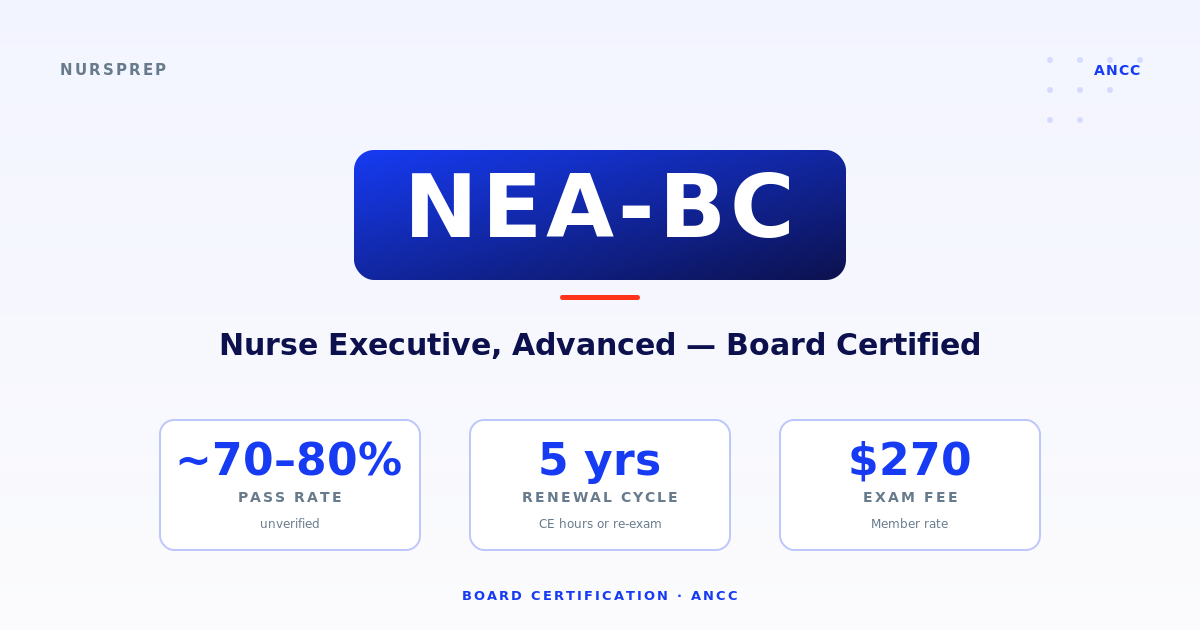
At a $270 (ANA member) or $395 (non-member) application fee and typical CNO / VP-of-Nursing compensation in the $200k–$300k range in US urban markets (per Medscape Nurse Compensation benchmarks), the fee is small relative to the role. The real cost is prep time — budget 80–120 hours of focused study. Many health systems reimburse ANCC certification fees through education or tuition benefit lines; confirm with HR before paying out of pocket.
| Fee item | Cost (USD) |
|---|---|
| Initial application — ANA member | $270 |
| Initial application — non-member | $395 |
| Exam retake | $395 (verify current fee with ANCC) |
| Renewal by portfolio — ANA member | $250 |
| Renewal by portfolio — non-member | $350 |
| ATT validity window | 120 days (vs. 90 days for many other ANCC exams) |
Renewal
NEA-BC certification is valid for five years. ANCC renews NEA-BC through a portfolio model only — there is no retake-exam renewal path. You accumulate evidence across multiple portfolio categories throughout the 5-year cycle: Continuing Education, Academic Credits, Presentations, Publications and Research, Preceptor Hours, Professional Service, Practice Hours, and Professional Development. A minimum number of points must be earned across multiple categories.
Build your portfolio in year 1 of the cycle, not year 5. The portfolio rewards executives who are already doing the work of senior leadership — speaking at AONL or ANA conferences, serving on system or community boards, publishing in JONA or Nurse Leader, precepting DNP students. Treating portfolio categories as a year-5 sprint is where most NEA-BC holders run into trouble.
How hard is the NEA-BC exam?
ANCC publishes annual pass rates in its Certification Data Summary. First-time pass rates for NEA-BC typically run in the 70%–80% range, reflecting a self-selected senior candidate pool — candidates have already cleared master's coursework and 2,000+ executive hours by the time they sit. As a reference point, the NE-BC first-time pass rate was approximately 66% (874 of 1,317 candidates) in the most recent public reporting year.
The pass-rate number matters less than the failure pattern. Candidates who fail NEA-BC tend to share four mistakes: treating the exam as a clinical-recall test, under-weighting Human Capital Management because the percentage is small, skipping financial fluency prep (fiscal scenarios surface across all four domains), and cramming the last week instead of distributing practice. The exam rewards judgment, not memorization — executive scenarios need distributed exposure.
A 12-week NEA-BC study plan
Most successful NEA-BC candidates study for 10–12 weeks at 8–10 hours per week. Anchor your plan around the ANCC Test Content Outline (Nov 2025 version), ANA's Nursing Administration: Scope and Standards of Practice, a current healthcare-finance primer covering capital, operating, and value-based budgets, and a practice question bank with 500–800 items. Well-known review vendors include Fitzgerald, Hess, Barkley, Board Vitals, and Mometrix.
-
1 WeekRead the TCO + diagnostic exam to calibrate weak domains
-
2 WeekLeadership — theory, styles, emotional intelligence, communication
-
3 WeekLeadership — change management, strategic planning, coaching
-
4 WeekLeadership — fiscal stewardship + budget scenarios (capital/operating)
-
5 WeekHealth Care Delivery — care delivery models, ethics, health IT
-
6 WeekHealth Care Delivery — EBP, research methods, patient experience
-
7 WeekQuality and Safety — regulatory standards, risk management, benchmarking
-
8 WeekQuality and Safety — performance improvement, emergency preparedness
-
9 WeekHuman Capital Management — engagement, employment law, succession
-
10 WeekFull-length timed practice exam #1 + error-log review
-
11 WeekFull-length timed practice exam #2 — target 75% or higher
-
12 WeekWeak-area review, light practice only, rest before exam day
How NEA-BC candidates actually fail — and how to avoid it
Sample NEA-BC question
This item mirrors ANCC's scenario format: a short executive stem, a real-world fiscal constraint, and four plausibly-correct options where only one is best. Try it before you read the rationale.
Option B preserves core education spend where it has the strongest workforce-outcome link (onboarding, competency development), yields on lower-leverage discretionary categories (conference travel, non-required symposia), and — critically — ties the compromise to measurable retention metrics the CFO can track. Option A (absorb quietly) abdicates executive voice. Option C (refuse and escalate) burns political capital without offering an alternative and often backfires with boards. Option D (delay) trades one problem for another without resolving it. This item maps to Leadership — specifically fiscal stewardship paired with strategic negotiation — and illustrates why the exam rewards judgment over recall.
Key NEA-BC terms every candidate should know
Use this glossary while you study. Each term appears on the exam in multiple forms, often as a distractor in scenario-based items. Review until the definitions feel automatic — executive vocabulary is where under-prepared candidates give themselves away on ambiguous items.
| Term | Definition | Domain |
|---|---|---|
| Transformational leadership | Leadership style that motivates teams to achieve a shared vision beyond self-interest; Magnet® model anchor. | Leadership |
| Shared governance | Structure that gives nurses authority over professional practice decisions — unit, service-line, and system councils. | Leadership |
| Magnet Recognition Program® | ANCC designation signaling nursing excellence across five model components; NEA-BC often aligns with CNO responsibilities for Magnet redesignation. | Quality & Safety |
| Quadruple Aim | Framework adding clinician well-being to the Triple Aim (cost, care, health) — core to current Health Care Delivery items. | Health Care Delivery |
| Value-based care | Payment model tying reimbursement to patient outcomes rather than service volume — CMS VBP, HRRP, HAC programs. | Health Care Delivery |
| Nursing-sensitive indicator (NSI) | Metric reflecting nursing-specific care quality — falls with injury, pressure injuries, CAUTI, CLABSI — tracked via NDNQI or equivalent. | Quality & Safety |
| Succession planning | Structured process for identifying and preparing future nurse leaders — bench strength at ADN, director, and exec levels. | Human Capital |
| Span of control | Number of direct reports a leader can supervise effectively; heavily tested in workforce-design items. | Human Capital |
| ANA Scope and Standards | ANA publication defining the scope and standards of nursing practice and nursing administration — a primary source for Leadership items. | Leadership |
| Portfolio renewal | Non-exam renewal based on documented professional activities across 8 ANCC portfolio categories; NEA-BC's only renewal pathway. | Professional |
| STEEP | Mnemonic for IOM quality aims — Safety, Timeliness, Effectiveness, Efficiency, Patient-centeredness. Fast recall for Quality & Safety items. | Quality & Safety |
| Just Culture | Framework balancing accountability and learning after error — distinguishes human error, at-risk behavior, and reckless conduct. | Quality & Safety |
| EBP (Evidence-Based Practice) | Integration of best research evidence, clinical expertise, and patient values into care decisions — often tested alongside research methods. | Health Care Delivery |
| Change management (Kotter's 8 steps) | Framework for leading organizational change — urgency, coalition, vision, communication, empowerment, short-term wins, consolidation, anchoring. | Leadership |
| Capital vs. operating budget | Capital funds long-lived assets (equipment, construction); operating funds recurring expenses (labor, supplies). Know both in fiscal scenarios. | Leadership |
NEA-BC vs. NE-BC vs. CENP: which executive credential fits?
Three credentials compete for senior-nurse-leader attention: NE-BC (ANCC, unit/department scope), NEA-BC (ANCC, organization/system scope), and CENP (AONL, system scope, AONL competency framework). Your current role, education, and organization's framework determine the right path.
| Credential | Body | Scope | Best fit |
|---|---|---|---|
| NEA-BC | ANCC | Organization- or system-wide executive scope | CNO, VP Nursing, Exec Director, System Director — MSN nursing or BSN + related master's/doctoral |
| NE-BC | ANCC | Unit- or department-level leadership | Nurse Manager, Clinical Director — BSN minimum; the entry point before NEA-BC |
| CENP | AONL | System-level; maps to AONL Nurse Executive Competencies | CNOs and VPs whose orgs use the AONL framework (AHA/AONL ecosystem) |
| CNML | AONL | Unit- and department-level manager | Nurse managers in AONL-framework organizations — CENP's unit-level counterpart |
Quick rule of thumb: Take NE-BC if you lead a unit or department. Take NEA-BC once you have held organization-wide executive responsibility for at least 2 of the last 3 years. Choose NEA-BC over CENP if your organization operates in the ANA / Magnet ecosystem; choose CENP over NEA-BC if your organization uses the AONL Nurse Executive Competencies as its leadership framework. Dual certification (NEA-BC + CENP) is increasingly common at the CNO level and is allowed — the credentials reinforce each other rather than compete.
Frequently asked questions about NEA-BC certification
NEA-BC stands for Nurse Executive, Advanced — Board Certified. ANCC issues the credential to nurse leaders whose accountability spans an organization or health system.
NEA-BC is for system-level executives such as CNOs and VPs of Nursing with organization-wide scope. NE-BC is for unit- or department-level nurse managers and directors. NE-BC is the entry point; NEA-BC is the advanced step above it.
Yes. You can qualify with a BSN plus a master's or doctoral degree in a nursing-related field — healthcare administration, public health, business administration, or informatics are all common routes. Your 2,000 executive practice hours and 30 hours of leadership CE still apply.
Most candidates need 10–12 weeks of structured study, averaging 8–10 hours per week. Active senior executives typically need less clinical review and more financial-fluency and research-methods review than mid-career managers stepping up.
You must wait 60 days before retesting and pay the retake fee ($395; verify current fee with ANCC). There is no lifetime limit on total attempts — candidates who fail typically pass on a second sitting after tightening their weak-domain review.
Yes. NEA-BC is valid for 5 years. ANCC renews NEA-BC through a portfolio model only — there is no retake-exam renewal path. Build your portfolio in year 1 of the cycle, not year 5.
NEA-BC is a US credential issued by ANCC. International employers often recognize it as equivalent to senior nurse executive certification, though local licensure rules apply. Some Canadian and Middle Eastern health systems specifically list NEA-BC or CENP in CNO job descriptions.
Yes, when the coursework aligns with leadership, management, or administration content. DNP practice hours involving organization-wide leadership also count toward the 2,000 executive practice hours, as long as the scope is genuinely system-level.
Many health systems reimburse ANCC certification fees through education or tuition benefit lines. Confirm with HR or finance before paying out of pocket — Magnet-designated organizations in particular tend to fund NEA-BC and CENP for qualifying leaders.
ANCC-reported NEA-BC first-time pass rates typically run in the 70–80% range, reflecting a self-selected senior candidate pool. As a reference point, NE-BC's first-time pass rate was approximately 66% (874 of 1,317 candidates) in the most recent public reporting year. Verify the current NEA-BC number against the latest ANCC Certification Data Summary.
No. ANCC delivers NEA-BC through Prometric testing centers only. You will need to travel to a Prometric site — there is no at-home remote proctoring option for this exam, unlike some other ANCC credentials.
Trusted sources
All figures on this page are verified against the following primary sources. Fees, blueprint weights, and renewal rules shift on ANCC's revision cycle — always verify numeric facts against the current ANCC General Testing & Renewal Handbook before relying on them for application decisions.
- American Nurses Credentialing Center (ANCC) — NEA-BC Test Content Outline effective 2025-11-11
- ANCC — General Testing & Renewal Handbook and 2026 fee schedule
- ANCC — Certification Data Summary (annual pass-rate reporting, most recent NE-BC figure: 874 of 1,317 = ~66%)
- American Nurses Association (ANA) — Nursing Administration: Scope and Standards of Practice
- American Organization for Nursing Leadership (AONL) — Nurse Executive Competencies and CENP comparison materials
- Medscape Nurse Compensation Report — annual nurse leader compensation benchmarks ($200k–$300k range for CNOs in US urban markets)
- US Bureau of Labor Statistics (BLS) — Registered Nurse and Medical and Health Services Manager Occupational Employment and Wage Statistics
- Magnet Recognition Program® — nurse leader credential expectations for Magnet-designated organizations
Ready to practice NEA-BC-style items?
Work through a 25-question diagnostic mapped to the Nov 2025 ANCC blueprint — weighted toward Leadership and Health Care Delivery, where 61% of your score lives. Free to start — no card required.