OCN certification at a glance
OCN — Oncology Certified Nurse — is the benchmark RN-level credential for adult oncology nursing. It is issued by the Oncology Nursing Certification Corporation (ONCC), the certifying arm affiliated with the Oncology Nursing Society, and is an NCCA-accredited certification program. OCN is the foundational ONCC credential that more specialized oncology certifications build on.
OCN is a board certification, not a course. It is sometimes confused with the ONS chemotherapy/immunotherapy certificate — a continuing-education course — but only OCN appears on your credentials line after RN. To earn it, you sit and pass a 165-item exam based on ONCC's published Test Content Outline.
Am I eligible for the OCN exam?
Eligibility for OCN is gated, not recommended. Unlike some certifications that only suggest experience, ONCC requires you to meet all four criteria below at the time of application and at the time you test.
The headline gate is 2,000 hours of adult oncology nursing practice within the four years (48 months) before you apply. Those hours can come from clinical practice, nursing administration, education, research, or consultation — they do not have to be bedside.
You are eligible if…
- You hold a current, active, unencumbered RN license in the US, a US territory, or Canada — at both application and examination.
- You have completed at least 2,000 hours of adult oncology nursing practice within the four years (48 months) prior to application.
- You have at least two years (24 months) of experience as an RN within the four years (48 months) prior to application.
- You have completed at least 10 contact hours of oncology nursing continuing education — or an academic oncology nursing elective — within the three years (36 months) prior to application.
OCN exam blueprint — six subject areas
The OCN blueprint is six subject areas, each weighted by percentage; the weights sum to 100%. Symptom Management and Supportive Care (25%) and Treatment Modalities (20%) together carry nearly half the exam — most of your study time should live there.
- Symptom Management and Supportive Care 25%
- Treatment Modalities 20%
- Oncologic Emergencies 16%
- Oncology Nursing Practice 15%
- Care Continuum 14%
- Psychosocial Dimensions of Care 10%
Do not neglect Psychosocial Dimensions of Care. At 10% it is the smallest domain and the most under-studied, but it reliably appears on the exam. Candidates who lean only on hands-on chemotherapy experience tend to lose points in Care Continuum, Oncology Nursing Practice, and the psychosocial items.
Cost, scheduling, and renewal
ONCC delivers the OCN exam by computer through PSI (psiexams.com). After ONCC approves your application, you receive an Authorization to Test (ATT) email within about 4–6 weeks; the ATT opens an almost-immediate 90-day testing window, so schedule your PSI seat right away. Results are reported the same day.
| Fee item | Cost (USD) |
|---|---|
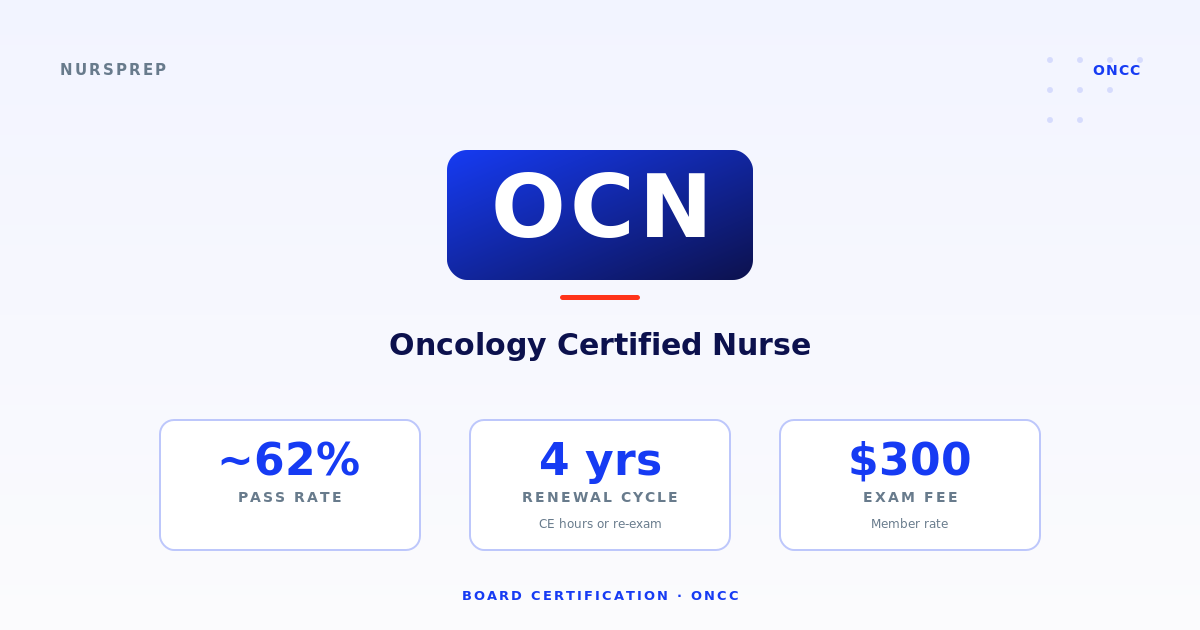
| Initial exam — ONS/APHON member | $300 |
| Initial exam — non-member | $420 |
| DoubleTake add-on (retake insurance) | +$100 at registration |
| Oncology Nursing Month promo | Periodic 20% off test fees |
Renewal
OCN certification is valid for four years. Most nurses renew through Option 1 — Practice Hours plus Professional Development (Renewal Points) under ONCC's ILNA (Individual Learning Needs Assessment) model. You need a current OCN, an active unencumbered RN license, at least 12 months of RN experience within the prior 36 months, and at least 1,000 hours of adult oncology nursing practice within the prior 30 months.
Renewal points are earned mainly through continuing education and must match the subject areas and weighting of the current Test Content Outline. A standard OCN learning plan is typically about 100 points, though the exact number is set by each nurse's Test or Assessment Results Report. Options 2 (Practice Hours plus successful re-testing) and 3 (Points plus successful re-testing) are also available.
How hard is the OCN exam?
Recent OCN pass rates run about 62% overall, with first-time candidates passing at a somewhat higher rate (roughly 65%). These figures are a medium-confidence estimate drawn from corroborating prep sources and ONCC's annual examination statistics — verify the current year against ONCC's published statistics before relying on them.
The OCN passing standard is a scaled score of at least 55, not a simple percentage of items correct. ONCC sets the cut score through a criterion-referenced Passing Score Study using the judgment of panels of oncology nursing professionals, and a 2025 OCN Passing Score Task Force reviewed that standard. The biggest lever for a first-time pass is structured study plus at least one full-length timed practice exam.
A 10-week OCN study plan
A structured 10-week plan suits most oncology RNs who already meet the 2,000-hour gate — roughly 80 to 120 total study hours across the six blueprint domains. Practice-question volume ramps through weeks 2–8 and peaks in week 9 with a full-length timed exam; week 10 is for targeted review and rest.
-
1 WeekRead the ONCC OCN Test Content Outline + baseline diagnostic exam
-
2 WeekOncology Nursing Practice — carcinogenesis, staging, scope & standards
-
3 WeekTreatment Modalities — chemotherapy, radiation, targeted & oral therapies
-
4 WeekSymptom Management I — hematologic, GI, integumentary, pain
-
5 WeekSymptom Management II — VADs, nutrition, complementary modalities
-
6 WeekOncologic Emergencies — TLS, SIADH, sepsis, cord compression, CRS
-
7 WeekCare Continuum — screening, survivorship, palliative & end-of-life care
-
8 WeekPsychosocial Dimensions — coping, distress, sexuality, financial concerns
-
9 WeekFull-length timed practice exam + error-log review
-
10 WeekTargeted review of weak domains, rest, test day
How OCN candidates actually fail — and how to avoid it
Sample OCN question
This item mirrors ONCC's scenario format: a short clinical stem and four plausible options where only one is the best next action. Try it before reading the rationale.
This is tumor lysis syndrome. While all values are deranged, the potassium of 6.2 mEq/L with palpitations is the most immediately life-threatening because hyperkalemia can precipitate fatal cardiac dysrhythmias. The nurse should prioritize cardiac monitoring and potassium-lowering measures while supporting hydration and rasburicase/allopurinol therapy.
Key OCN terms every candidate should know
These terms surface across OCN exam items. Review them until the definitions and first nursing actions feel automatic — scenario stems often hinge on recognizing which oncologic emergency or concept applies.
| Term | Definition | Domain |
|---|---|---|
| Tumor lysis syndrome (TLS) | Metabolic emergency from rapid tumor cell breakdown: hyperkalemia, hyperphosphatemia, hyperuricemia, and hypocalcemia, risking dysrhythmias and renal failure. | Oncologic Emergencies |
| Neutropenic fever / sepsis | A single temperature ≥38.3°C (or ≥38.0°C sustained) with an absolute neutrophil count <500 — an oncologic emergency requiring prompt blood cultures and broad-spectrum antibiotics. | Oncologic Emergencies |
| Nadir | The lowest point of blood counts (especially neutrophils) after chemotherapy, typically 7–14 days post-treatment, when infection risk peaks. | Symptom Management |
| Extravasation / vesicant | Leakage of a vesicant chemotherapy agent into surrounding tissue, causing local necrosis; demands immediate stop, aspiration, and agent-specific antidote. | Treatment Modalities |
| Cytokine release syndrome (CRS) | A systemic inflammatory response to immune-effector therapies such as CAR-T, ranging from fever to hypotension and organ dysfunction. | Treatment Modalities |
| ECOG performance status | A 0–5 scale rating a patient's functional ability, used to guide treatment decisions and prognosis. | Oncology Nursing Practice |
| Spinal cord compression | An oncologic emergency from tumor compressing the cord; back pain with neurologic changes requires urgent imaging and corticosteroids. | Oncologic Emergencies |
| SIADH | Syndrome of inappropriate antidiuretic hormone secretion — a paraneoplastic cause of hyponatremia, common with small cell lung cancer. | Oncologic Emergencies |
OCN vs. BMTCN, CBCN, CPHON, AOCNP
OCN sits at the center of ONCC's oncology credential family as the broad, foundational adult-oncology certification. Several narrower ONCC credentials branch off it; many candidates Google "OCN" when they actually want a population- or practice-specific credential, so the distinction matters before you apply.
| Credential | Body | Scope | Best fit |
|---|---|---|---|
| OCN | ONCC | Broad adult oncology nursing across the cancer continuum | Adult oncology RNs in any oncology setting |
| BMTCN / TCTCN | ONCC | Blood & marrow transplant and cellular therapy | RNs in HSCT and cellular-therapy units |
| CBCN | ONCC | Breast care nursing | RNs focused on breast cancer care |
| CPHON | ONCC | Pediatric hematology / oncology | RNs in pediatric oncology (not adult) |
| AOCNP | ONCC | Advanced-practice oncology | Oncology nurse practitioners (graduate-level) |
Take OCN if you are an adult oncology RN seeking the foundational specialty credential. Choose BMTCN/TCTCN if your practice is transplant and cellular therapy, CBCN for breast care, or CPHON for pediatric oncology. AOCNP is for nurse practitioners, not staff RNs. The ONS chemotherapy/immunotherapy certificate is a course, not a board certification, and does not replace OCN.
Frequently asked questions about OCN certification
OCN stands for Oncology Certified Nurse. The credential is issued by the Oncology Nursing Certification Corporation (ONCC) and is the foundational board certification for adult oncology nursing.
You need an active, unencumbered RN license, 2,000 hours of adult oncology nursing practice within the prior 48 months, at least 24 months of RN experience within the prior 48 months, and 10 oncology continuing-education contact hours within the prior 36 months. All criteria must be met at application and examination.
The OCN exam costs $300 for ONS/APHON members and $420 for non-members. The optional DoubleTake retake add-on is an additional $100, selected at registration.
The OCN exam has 165 multiple-choice questions, of which 145 are scored and 20 are unscored pretest items. You have 3 hours to complete it.
The OCN passing standard is a scaled score of at least 55. ONCC sets the cut score through a criterion-referenced Passing Score Study, so it is not a simple percentage of items correct.
Recent OCN pass rates run about 62% overall, with first-time candidates passing at a somewhat higher rate. This is a medium-confidence estimate; verify against ONCC's current examination statistics.
No. OCN is a board certification earned by passing an exam, while the ONS chemotherapy/immunotherapy certificate is a continuing-education course. Only OCN appears on your credentials line after RN.
Most oncology RNs prepare for 8 to 12 weeks, roughly 80 to 120 total study hours across the six blueprint domains, including at least one full-length timed practice exam.
Yes. OCN certification is valid for four years. You renew through ONCC's ILNA model — practice hours plus professional-development points matched to the current blueprint — or by re-testing.
DoubleTake is an optional ONCC add-on, selected and paid at initial registration for an extra $100, that gives you a retake without paying the full exam fee again if you do not pass on the first attempt.
Trusted sources
All figures on this page are verified against the following sources. Fees, blueprint weights, passing standards, and renewal rules shift on ONCC's revision cycle — always confirm numeric facts against the current ONCC candidate materials before relying on them for application decisions.
- Oncology Nursing Certification Corporation (ONCC) — Oncology Certified Nurse (OCN) credential page (eligibility, fees, exam format)
- ONCC — 2026 OCN Test Content Outline (PDF): six subject areas and weights (Symptom Management 25%, Treatment Modalities 20%, Oncologic Emergencies 16%, Oncology Nursing Practice 15%, Care Continuum 14%, Psychosocial 10%)
- ONCC — Certification Renewal Guide (4-year cycle, Option 1 ILNA renewal, 1,000-hour practice requirement)
- ONCC — 2025 OCN Passing Score Task Force (criterion-referenced passing standard)
- ONCC — 2024 Examination Statistics and Pass Rates (annual pass-rate report)
- ONCC — Testing and Renewal resource page
- Oncology Certified Nurse (OCN) Complete Guide — Vivian Health (corroborating fee and eligibility detail)
- Oncology Nurse Certification (OCN) Exam Review — TestPrepReview (scored/pretest split, scaled passing score)
- US Bureau of Labor Statistics — Occupational Employment and Wage Statistics, Registered Nurses (May 2024): $98,430 mean RN wage
Ready to practice OCN-style items?
Work through a 25-question diagnostic mapped to the six-domain ONCC blueprint. Free to start — no card required.