CPN certification at a glance
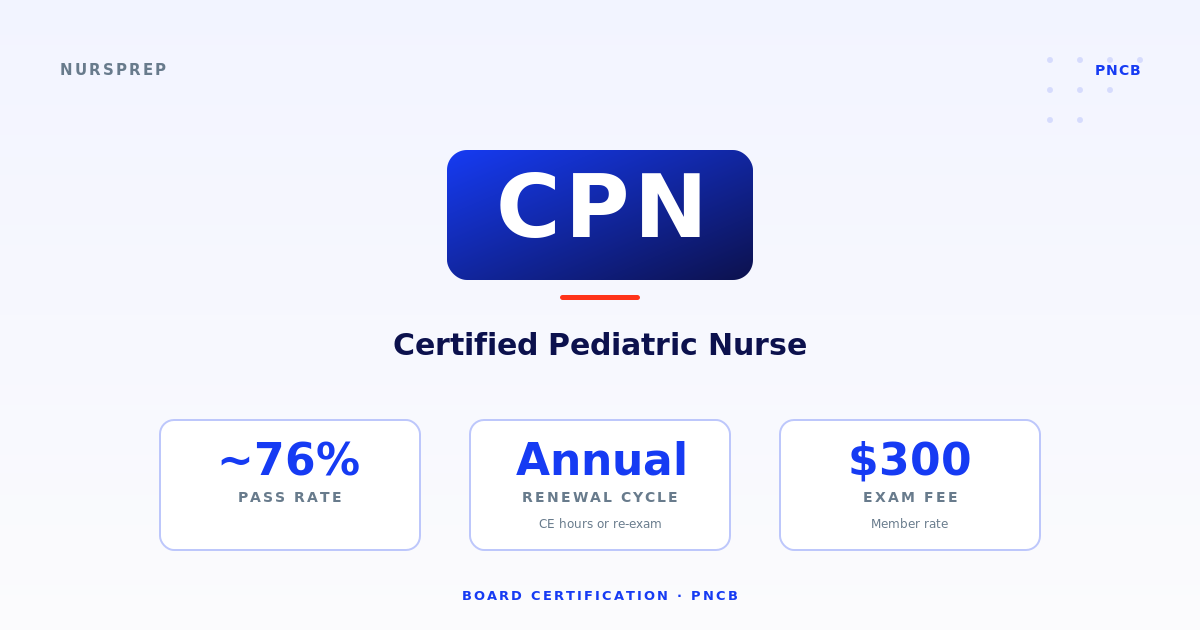
CPN — Certified Pediatric Nurse — is the RN-level benchmark for pediatric nursing across inpatient and outpatient care. The credential is issued by the Pediatric Nursing Certification Board (PNCB), which first offered the CPN exam in 1989; today more than 30,000 nurses actively hold the credential.
CPN is a board certification, not a course. It is sometimes confused with the PNCB Pediatric Nurse Practitioner credentials (CPNP-PC and CPNP-AC), which are advanced-practice certifications for APRNs — only CPN is the generalist, RN-level pediatric credential.
Am I eligible for the CPN exam?
Yes — if you hold an active, unrestricted RN license in the US, Canada, or a US territory and meet one of two pediatric experience pathways. PNCB accepts any nursing degree level (diploma, ADN, BSN, MSN, or higher); there is no additional degree requirement beyond RN licensure.
Pathway 1: at least 1,800 hours of pediatric clinical experience within the past 24 months. Pathway 2: at least five years as an RN in pediatric nursing with 3,000 pediatric hours in the last five years, including at least 1,000 hours within the past 24 months. Pediatric experience may be direct care or indirect (teaching, administration, research, consultation).
You are a strong candidate if…
- You have logged at least 1,800 hours of pediatric nursing within the last 24 months, or you meet the five-year pathway with 3,000 pediatric hours.
- You care for children and adolescents across the lifespan, not just one age band — infants, toddlers, school-age, and teens.
- Your setting fits a recognized pediatric role: inpatient peds, PICU or NICU, pediatric ED, pediatric ambulatory or specialty clinic, school nursing, pediatric home care, or a pediatric education or research role.
- You are comfortable with weight-based dosing, growth-and-development milestones, and family-centered care — the threads PNCB runs through every blueprint domain.
CPN exam blueprint — four domains
The CPN blueprint is built from PNCB's 2021–2022 Job Task Analysis and organized into four content domains. Assessment and Planning and Management together carry about two-thirds of the exam — most of your study time should live there.
- Assessment (physical and psychosocial) 35%
- Planning and Management 33%
- Health Promotion 23%
- Professional Responsibilities 9%
PNCB also runs three threads through every domain: safety, growth and development, and evidence-based practice. Treat them as lenses on each topic rather than separate study blocks. Candidates who study only acute bedside tasks tend to underprepare for Health Promotion and Professional Responsibilities.
Cost, scheduling, and scoring
PNCB delivers the CPN exam by computer at Prometric testing centers in the US and abroad. After PNCB reviews your online application, you receive an Approval & Scheduling Notice with a 90-day window to book and sit the exam — schedule promptly so the window does not lapse.
| Fee item | Cost (USD) |
|---|---|
| Initial exam fee | $300 (includes $100 non-refundable registration) |
| Retake fee | $245 |
| Total items | 175 (150 scored, 25 unscored pretest) |
| Time limit | 3 hours |
| Score scale | 200–800 (scaled) |
| Passing score | 400 (the cut point across all forms) |
| Scheduling window | 90 days after PNCB approval |
Renewal
CPN certification is renewed annually. CPNs recertify each year between November 1 and January 31 by submitting a short online application attesting to 15 contact hours (or PNCB-accepted equivalents) completed during the year.
You can meet the 15-hour requirement several ways: CE/CNE/CME, Professional Practice Learning, academic credit, teaching, or clinical practice hours (200 practice hours count as 5 contact hours; 400 count as 10). Keep your documentation — PNCB audits a random sample of renewals each year.
How hard is the CPN exam?
The CPN exam is moderately difficult. The most recent figure that could be verified for this page is a ~76% pass rate (2022), meaning roughly three in four candidates passed. PNCB publishes annual exam statistics, but a reliable year-specific CPN figure after 2022 was not available at the time of writing — always check PNCB's current statistics before relying on a number for planning.
Candidates who follow a structured 8 to 10-week plan and complete at least one full-length timed practice exam pass at meaningfully higher rates than those relying on work experience alone. The biggest avoidable gaps are in Health Promotion and Professional Responsibilities, which bedside-focused study tends to skip.
An 8-week CPN study plan
A structured 8-week study plan is enough for most pediatric RNs with a year or more of practice — roughly 60 to 90 total study hours across the four blueprint domains. Practice-question volume ramps through weeks 2–6 and peaks in week 7 with a full-length timed exam; week 8 is for targeted review, logistics, and a rest day.
-
1 WeekRead the PNCB CPN content outline + baseline diagnostic
-
2 WeekAssessment — physical exam, growth and development, pain, psychosocial
-
3 WeekAssessment continued + pediatric early warning signs and triage
-
4 WeekPlanning and Management — acute and chronic care, weight-based dosing, safety
-
5 WeekPlanning and Management — behavioral health, palliative, family-centered care
-
6 WeekHealth Promotion — anticipatory guidance, immunizations, injury prevention
-
7 WeekProfessional Responsibilities + full-length timed practice exam
-
8 WeekTargeted review of weak domains, rest, test day
How CPN candidates actually fail — and how to avoid it
Sample CPN-style question
This item mirrors the CPN format: a short pediatric scenario and four plausible options where only one is best. It is illustrative and is not a released PNCB question. Try it before you read the rationale.
Delayed capillary refill plus tachycardia signals impaired perfusion and impending hypovolemic shock — the most time-critical finding. Dry mucous membranes and a sunken fontanelle confirm dehydration but are markers of fluid loss, not the immediate perfusion threat. The history is important context but is not an acute physiologic finding requiring intervention now.
Key CPN terms every candidate should know
These concepts surface across CPN exam items. Review them until the definitions feel automatic — pediatric stems often hinge on recognizing the developmentally appropriate framework or the weight-based calculation.
| Term | Definition | Domain |
|---|---|---|
| Family-centered care | A care model that treats the child and family as a unit, with the family as a partner in assessment, planning, and decisions. | Planning & Mgmt |
| Weight-based dosing | Pediatric medications dosed per kilogram of body weight; a core safety competency tested throughout the exam. | Planning & Mgmt |
| Growth and development milestones | Expected physical, cognitive, and psychosocial achievements by age band; the basis for anticipatory guidance and assessment. | Assessment |
| Anticipatory guidance | Age-appropriate counseling to families about expected development, safety, nutrition, and prevention. | Health Promotion |
| PEWS | Pediatric Early Warning Score — a bedside tool that flags clinical deterioration in children before a critical event. | Assessment |
| Atraumatic care | Minimizing physical and psychological distress of procedures for children, using comfort positioning, distraction, and developmentally appropriate explanation. | Planning & Mgmt |
| Immunization schedule | The recommended childhood and adolescent vaccine timeline; a frequent Health Promotion topic. | Health Promotion |
| Scope of practice | The legal and professional boundaries of pediatric RN practice, including advocacy and interdisciplinary collaboration. | Professional Resp. |
CPN vs. CPEN, CPNP-PC/AC, PMHS
CPN sits alongside several pediatric credentials that nurses sometimes consider. Many candidates Google "CPN" when they actually mean the practitioner (CPNP) or emergency (CPEN) credential, so the distinction matters before you spend time or money.
| Credential | Body | Scope | Best fit |
|---|---|---|---|
| CPN | PNCB | Generalist pediatric nursing, inpatient and outpatient | RNs caring for children across settings |
| CPEN | BCEN | Pediatric emergency nursing | RNs in pediatric or general EDs |
| CPNP-PC | PNCB | Pediatric primary care, advanced practice | Pediatric NPs (graduate degree) |
| CPNP-AC | PNCB | Pediatric acute care, advanced practice | Pediatric NPs in acute/critical care |
| PMHS | PNCB | Pediatric primary care mental health (add-on specialty) | Pediatric primary care RNs and NPs |
Take CPN if you want to validate generalist pediatric RN expertise across inpatient and outpatient settings. Choose CPEN instead if your day-to-day is the pediatric emergency department. CPNP-PC and CPNP-AC are advanced-practice credentials that require a graduate NP degree — they do not replace CPN on an RN's credentials line.
Frequently asked questions about CPN certification
CPN stands for Certified Pediatric Nurse. The credential is issued by the Pediatric Nursing Certification Board (PNCB).
No. CPN is an RN-level board certification, while CPNP-PC and CPNP-AC are advanced-practice Pediatric Nurse Practitioner credentials that require a graduate NP degree. All three are issued by PNCB.
You need an active, unrestricted RN license plus either 1,800 hours of pediatric clinical experience in the past 24 months, or a five-year pathway with 3,000 pediatric hours in the last five years (including 1,000 in the past 24 months).
The CPN exam has 175 multiple-choice items — 150 scored and 25 unscored pretest questions — with a 3-hour time limit, delivered by computer at Prometric testing centers.
PNCB uses a scaled score from 200 to 800. A scaled score of 400 is the passing cut point on every form of the exam.
The initial exam fee is $300, which includes a $100 non-refundable registration fee. A retake costs $245.
The CPN exam is moderately difficult. The most recent verified figure for this page is a roughly 76% pass rate (2022). Candidates who underprepare for Health Promotion and Professional Responsibilities tend to struggle.
CPN is renewed annually. CPNs recertify each year between November 1 and January 31 by attesting to 15 contact hours, which can include CE, clinical practice hours, teaching, or academic credit.
You may reapply after your official results are released and receive a new 90-day testing window. The retake fee is $245.
Yes. RNs with an active, unrestricted US RN license may use international pediatric practice experience, and Canadian RNs are eligible on the same terms.
Trusted sources
All figures on this page are verified against the following sources. Fees, blueprint weights, and recertification rules shift on PNCB's revision cycle — always verify numeric facts against the current PNCB pages before relying on them for application decisions.
- Pediatric Nursing Certification Board (PNCB) — Certified Pediatric Nurse (CPN) overview
- PNCB — CPN Exam FAQs (eligibility pathways and accepted experience)
- PNCB — CPN Exam Administration (Prometric, 175 items, 3-hour limit, 90-day window)
- PNCB — CPN Exam Scoring (scaled 200–800, passing cut point 400)
- PNCB — CPN Certification Steps (fees: $300 initial, $245 retake)
- PNCB — CPN Recertification (annual renewal, 15 contact hours, Nov 1–Jan 31)
- PNCB — 2022 CPN Exam Content Outline (four-domain blueprint, 2021–2022 Job Task Analysis)
- PNCB — About / organization history (PNCB founded 1975; CPN offered since 1989)
- US Bureau of Labor Statistics (BLS) — Occupational Employment and Wage Statistics, Registered Nurses (May 2024): $98,430 mean RN wage
Ready to practice CPN-style items?
Work through a 25-question diagnostic mapped to the PNCB four-domain blueprint. Free to start — no card required.