CNOR certification at a glance
CNOR — Certified Perioperative Nurse — is the nursing-side benchmark for surgical services. The credential is issued by the Competency & Credentialing Institute (CCI), a non-profit that has certified perioperative RNs since 1979. CCI operates independently from the Association of periOperative Registered Nurses (AORN), but the CNOR exam blueprint is built on AORN's evidence-based Guidelines for Perioperative Practice.
CNOR is a specialty certification, not a course. The Joint Commission and the ANCC Magnet Recognition Program both weigh the percentage of certified perioperative nurses when evaluating surgical services — so a CNOR signals both individual competence and unit-level quality.
Am I eligible for the CNOR exam?
Yes — if you hold an active, unrestricted RN license in the US, Canada, or a US territory; you have logged 2 years and at least 2,400 hours of perioperative nursing; and you are currently employed in a perioperative role (full-time, part-time, or per diem).
CCI accepts two experience pathways. The direct-care pathway requires 2,400 total perioperative hours with at least 1,200 (50%) in the intraoperative setting. The indirect-care pathway requires 2,400 total perioperative hours in a manager, educator, researcher, or CNS role, with 50% documented in perioperative practice.
You are a strong candidate if…
- You hold a current, unrestricted RN license.
- You have at least 2,400 perioperative hours logged in the past two years, with at least 1,200 intraoperative (direct-care pathway) or 50% documented perioperative practice (indirect-care pathway).
- You are currently employed in a perioperative role — inpatient OR, ambulatory surgery centre, endoscopy, PACU, or perioperative education / leadership.
- Your manager can verify your hours in writing if CCI audits your application.
- You are comfortable with the AORN Guidelines for Perioperative Practice as your primary evidence base — not just local policy.
CNOR exam blueprint — nine domains
The CNOR blueprint is organised around the perioperative patient journey — from preoperative assessment through intraoperative activities, transfer of care, instrument processing, and post-op outcomes. Nine domains in total.
- I. Preoperative Patient Assessment & Diagnosis 1%
- II. Plan of Care & Intraoperative Activities 1%
- III. Communication (SBAR, time-out, interprofessional) 1%
- IV. Transfer of Care (PACU handover, equipment, report) 1%
- V. Instrument Processing & Supply Management 1%
- VI. Emergency Situations (MH, fire, anaphylaxis, arrest) 1%
- VII. Management of Personnel, Services & Materials 1%
- VIII. Professional Accountability (ethics, compliance) 1%
- IX. Perioperative Patient Outcomes (SSI, pressure injury, normothermia) 1%
CCI does not publish per-domain weights for the 2026 cycle. The donut below shows the nine domains in equal segments for navigation only — allocate your actual study time against the current CCI 2026 Candidate Handbook once you have it in hand. The high-yield domains most candidates under-prepare are Instrument Processing, Emergency Situations, and Professional Accountability — content that is abstract at the bedside but appears reliably on the exam.
Cost, scheduling, and employer benefits
CCI delivers the CNOR through PSI testing centres, with live online proctoring available for eligible candidates who prefer to test from a private workstation. After CCI approves your application you will receive an Authorization to Test (ATT) email — typically within 10 business days — that opens a 90-day testing window. Schedule your PSI seat immediately to avoid reapplying.
| Fee item | Cost (USD) |
|---|---|
| Initial exam — AORN member | ~$390 |
| Initial exam — non-member | ~$490 |
| Retake (after 90-day wait) | ~$290 |
| Recertification by exam | ~$275 |
| Recertification by CE | Per CCI schedule (verify current) |
| AORN annual membership (reduces exam fee) | Pays for itself on one attempt |
Renewal
CNOR renews on a 5-year cycle. Two main pathways. Pathway 1 — Continuing Education: complete 125 contact hours over the 5-year cycle across CCI's defined perioperative categories. The most common renewal rejection reason is logging generic nursing CE that does not meet CCI's perioperative-specific category rules — keep a simple spreadsheet with date, category, hours, and provider for each activity.
Pathway 2 — Recertification by Exam: retake and pass the current CNOR exam. Best for candidates with gaps in CE documentation or who prefer a fresh blueprint review every cycle. CCI has also offered a CNOR Advantage Track that rewards leadership, education, and evidence-based-practice contributions — confirm current Advantage Track criteria directly with CCI before relying on it.
How hard is the CNOR exam?
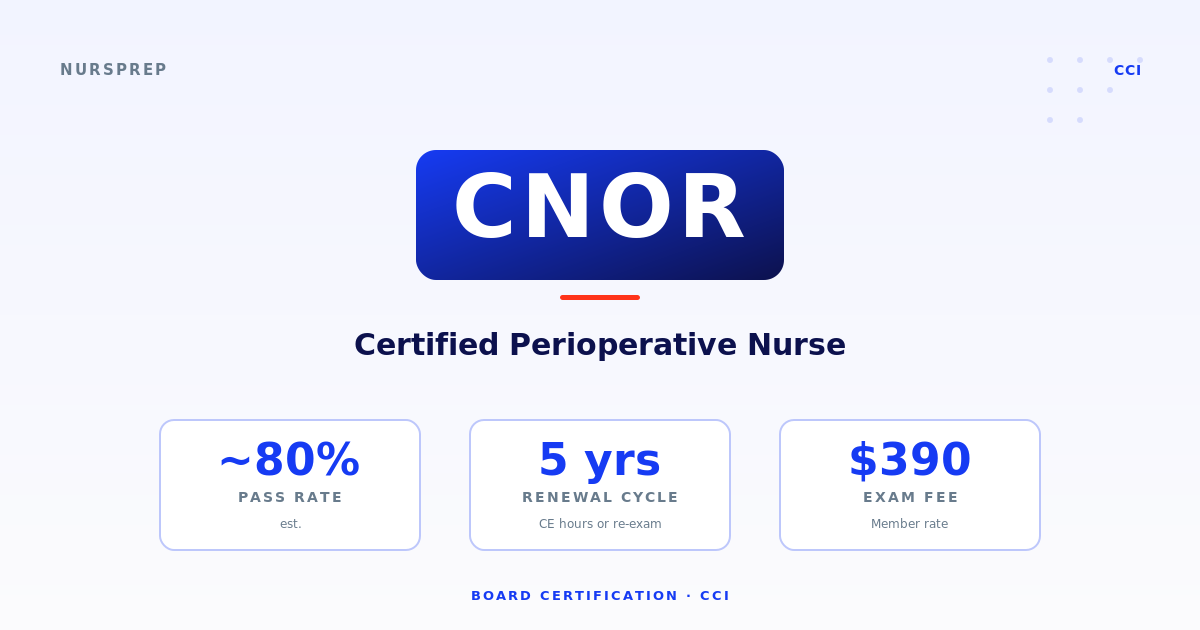
CCI does not publish a CNOR pass rate on a routine schedule. Historical CCI communications and third-party candidate summaries place the first-time pass rate in the high-70s to low-80s percent range — so the ~80% bar shown below is a midpoint estimate, not an official CCI figure.
Whatever the current-cycle number, the pattern among passing candidates is consistent: 10 to 14 weeks of structured study at 6 to 10 hours per week, at least 500 practice questions with every rationale reviewed, and one or two full-length timed practice tests before exam day. Candidates who rely on daily bedside practice alone tend to stumble on domains they do not touch every shift — instrument processing, emergency management, and professional accountability top that list.
A 12-week CNOR study plan
A structured 12-week plan is enough for most perioperative RNs with two or more years of experience — roughly 72 to 120 total study hours. Weeks 1–2 cover the handbook and diagnostic. Weeks 3–9 rotate through the nine blueprint domains. Weeks 10–11 are full-length timed practice. Week 12 is targeted review and rest.
-
1 WeekRead CCI 2026 Candidate Handbook + baseline diagnostic
-
2 WeekMap weak domains; pick AORN study resources for each
-
3 WeekDomain I — Preoperative assessment & diagnosis
-
4 WeekDomain II — Plan of care & intraoperative activities (positioning, counts, specimens)
-
5 WeekDomain III–IV — Communication + Transfer of Care (SBAR, time-out, PACU handoff)
-
6 WeekDomain V — Instrument Processing & Supply Management (BI, IUSS, sterilization)
-
7 WeekDomain VI — Emergency Situations (MH, fire triangle, anaphylaxis, arrest)
-
8 WeekDomain VII–VIII — Management + Professional Accountability
-
9 WeekDomain IX — Perioperative Patient Outcomes (SSI, pressure injury, normothermia)
-
10 WeekFull-length timed practice exam #1 + error-log review
-
11 WeekFull-length timed practice exam #2 + targeted gap closure
-
12 WeekReview missed questions; rest; avoid night shifts; test day
How CNOR candidates actually fail — and how to avoid it
Sample CNOR question
This item mirrors CCI's applied-analysis format: a short clinical stem and four plausible options where only one is best. Try it before you read the rationale.
The alcohol-based prep solution is the fuel element of the fire safety triangle. Proper drying time and drape management remove fuel from the triangle, which is the circulator's primary preventive action. Oxygen is managed by anaesthesia; the heat source is the electrosurgical unit in the surgeon's hand; smoke is a downstream indicator, not a triangle element.
Key CNOR terms every candidate should know
These terms surface in most CNOR exam items. Review them until the definitions feel automatic — scenario-based stems often hinge on recognizing which framework (Universal Protocol, biological indicator, fire triangle) applies.
| Term | Definition | Domain |
|---|---|---|
| Aseptic technique | Practices that prevent contamination of the sterile field and sterile items during an invasive procedure. | Intraop |
| Surgical count | Systematic count of instruments, sponges, and sharps performed before, during, and after a case to prevent retained surgical items (RSIs). | Intraop |
| Time-out | Final verification step immediately before incision — confirms correct patient, procedure, site, and side; part of the Joint Commission Universal Protocol. | Communication |
| SBAR | Situation, Background, Assessment, Recommendation — structured handoff framework used at PACU transfer and team communication. | Communication |
| Biological indicator (BI) | Spore-based indicator used to verify the effectiveness of a sterilization cycle; instruments should not be used before a BI result is confirmed except in documented emergencies. | Instrument Processing |
| Immediate-use steam sterilization (IUSS) | Rapid sterilization for critical items required immediately; reserved for true urgency — not a routine workflow. | Instrument Processing |
| Fire safety triangle | Oxygen, fuel, and heat — the three elements that must be controlled to prevent surgical fires; the circulator most directly controls fuel through prep drying and drape management. | Emergencies |
| Malignant hyperthermia (MH) | Life-threatening hypermetabolic reaction to volatile anaesthetics or succinylcholine; treated with IV dantrolene, cooling, and supportive care. | Emergencies |
| Universal Protocol | Joint Commission protocol to prevent wrong-site, wrong-procedure, and wrong-person surgery — pre-procedure verification, site marking, and time-out. | Professional |
| Surgical site infection (SSI) | Infection occurring at or near a surgical incision within 30 days (or 90 days for implants); driven by perioperative bundles — antibiotic timing, normothermia, glucose control, skin antisepsis. | Outcomes |
| Normothermia | Maintenance of core body temperature (36.0–37.5 °C) perioperatively to reduce SSI, coagulopathy, and cardiac risk. | Outcomes |
| Pressure injury | Localized skin and/or underlying tissue damage caused by sustained pressure — perioperative prevention centres on positioning and support surfaces. | Outcomes |
| Reverse Trendelenburg | Patient positioning with the head elevated above the feet; used in laparoscopic cholecystectomy to improve gallbladder access and displace abdominal organs. | Intraop |
| CFPN | Certified Foundational Perioperative Nurse — CCI credential for RNs who do not yet meet the CNOR experience bar. | Career |
| CRNFA | Certified Registered Nurse First Assistant — CCI credential for first-assisting practice; requires CNOR plus completion of an accredited RNFA program. | Career |
CNOR vs. CRNFA, CSSM, CNAMB
CNOR is the foundation credential for perioperative nursing, but CCI offers several related certifications for different career stages. Match the credential to your current role.
| Credential | Body | Scope | Best fit |
|---|---|---|---|
| CNOR | CCI | Perioperative RN practice — inpatient or mixed OR | OR staff RNs, charge nurses, perioperative educators |
| CRNFA | CCI | RN first-assisting — scrub in as surgical first assist | RNs who already function as first assistants (CNOR + RNFA program required) |
| CSSM | CCI | Surgical services leadership — management and operations | OR managers and directors (2 yrs perioperative leadership) |
| CNAMB | CCI | Ambulatory perioperative practice — ASC-specific | RNs working exclusively in ambulatory surgery centres |
| CFPN | CCI | Foundational entry-level perioperative practice | New OR RNs who do not yet meet CNOR hours |
Choose CNOR if your practice is inpatient or mixed OR. Choose CNAMB if you work exclusively in an ambulatory surgery centre. Move to CSSM once you take on a formal management role. Add CRNFA if you already function as a first assistant. Start with CFPN if you are new to the OR and do not yet meet CNOR's 2,400-hour bar — the natural ladder is CFPN → CNOR → CSSM or CRNFA.
Frequently asked questions about CNOR certification
Rigorous but not designed to fail candidates who study the blueprint. Most passers report 10 to 14 weeks of focused preparation at 6 to 10 hours per week, with at least 500 practice questions completed before exam day.
CCI does not publish a public CNOR pass rate on a routine schedule. Historical CCI communications and third-party summaries suggest pass rates in the high-70s to low-80s percent range, though figures vary by cohort. Verify the current figure with CCI.
No — CNOR itself requires 2 years and 2,400 perioperative hours. CCI offers the CFPN (Certified Foundational Perioperative Nurse) credential for RNs who do not yet meet the full CNOR experience bar.
Yes. Ambulatory surgery, endoscopy, and PACU hours generally count as perioperative, provided the role includes intraoperative or direct perioperative responsibilities. Consult the 2026 CCI Candidate Handbook for edge-case specifics.
Five years from the date you pass the exam. Renew by completing 125 perioperative-specific CE hours or by retaking the exam.
Yes — live online proctoring is available through PSI for eligible candidates. You will need a quiet, private room and a compliant workstation; test your setup 24 hours in advance.
You can retake the exam after a 90-day waiting period. Pay the retake fee (approximately $290) and schedule again through PSI. Use the score report to target your weakest domains rather than re-studying the whole blueprint.
For most perioperative RNs, yes. Salary uplift, travel-rate premiums, and career mobility typically recover the cost within the first year. Many hospitals reimburse 50–100% of the exam fee through education funds.
CCI issues CNOR in the United States, Canada, and US territories. Recognition elsewhere varies by institution — check with the relevant national nursing body before relying on it abroad.
CNOR validates general perioperative nursing practice. CRNFA validates first-assisting skills and requires both CNOR and completion of an accredited RNFA program.
Trusted sources
All figures on this page are verified against the following primary sources. Fees, blueprint weights, and recertification rules shift on CCI's revision cycle — always verify numeric facts against the current CCI handbook before relying on them for application decisions.
- Competency & Credentialing Institute (CCI) — 2026 CNOR Candidate Handbook, eligibility, application, recertification
- CCI — Advantage Track criteria and Specialty Certifications (CRNFA, CSSM, CNAMB, CFPN)
- Association of periOperative Registered Nurses (AORN) — Guidelines for Perioperative Practice (current edition)
- AORN Journal and AORN member webinars — domain-specific perioperative evidence
- PSI Testing Services — test-centre and live-online-proctoring logistics
- CDC — Guideline for Prevention of Surgical Site Infection; HAI surveillance data
- The Joint Commission — Universal Protocol for Preventing Wrong-Site Surgery and Magnet-relevant standards
- ANCC Magnet Recognition Program — nurse-certification metrics
- ECRI Institute — perioperative safety briefs and hazard alerts
Ready to practice CNOR-style items?
Work through a 25-question diagnostic mapped to CCI's nine-domain blueprint — heavy on intraoperative activities, instrument processing, and emergency situations. Free to start — no card required.