CFRN certification at a glance
CFRN — Certified Flight Registered Nurse — validates RNs who practice in air medical transport: rotor-wing HEMS, fixed-wing inter-facility transport, and critical care transport. The credential is issued by the Board of Certification for Emergency Nursing (BCEN), which has offered the exam since July 1993 (403 nurses passed the first cycle).
CFRN confirms specialty expertise in the flight transport environment — altitude physiology, scene safety, in-flight equipment use, and inter-facility critical care transport. While the credential is voluntary, CAMTS-accredited air medical programs and most HEMS employers expect specialty-certified RNs on their crews.
Am I eligible for the CFRN exam?
Yes, if you hold an active, unrestricted RN license. BCEN does not require a specific number of practice hours to sit for the CFRN exam — it strongly recommends two years of flight or transport nursing experience, but there is no mandatory gate.
The practical on-ramp is different. Every flight program adds its own hiring requirement — commonly 3 to 5 years of recent ED or ICU experience — regardless of CFRN status. BCEN lets you test with zero transport hours, but a flight program will not hire a zero-transport-hour candidate. Plan your CFRN against the hiring timeline, not just the exam calendar.
You are a strong candidate if…
- You hold 3–5 years of recent ED or ICU experience at a busy facility.
- You manage intubation, vasoactive drips, ventilator settings, and blood products without hand-holding.
- You hold ACLS, PALS, TNCC, and NIHSS; NRP is expected for pediatric or neonatal transport.
- Your setting fits a recognized flight role: hospital-based HEMS (LifeFlight, Mayo One, LifeLink III), independent HEMS operators (Air Methods, REACH, PHI, Med-Trans, Metro Aviation), fixed-wing inter-facility, specialty peds/neonatal transport, ground critical care transport, or DoD/VA medevac.
CFRN exam blueprint — five domains (effective 2026-08-31)
The CFRN blueprint is five domains, weighted toward medical emergencies and patient-care management. Put simply: the exam assumes you already know how to run a sick patient — its job is to check whether you can do it 6,500 feet up in a noisy cabin with one other crew member and a finite oxygen supply.
- Medical Emergencies 27%
- Patient Care Management (airway, ventilation, access, pharmacology) 25%
- General Principles of Flight Transport Nursing Practice 19%
- Trauma 19%
- Special Populations (OB, neonatal, peds, geri, bariatric) 10%
Medical Emergencies and Patient Care Management together account for more than half the exam. General Principles and Trauma carry the flight-specific content — altitude physiology, CAMTS standards, in-flight decompression, and damage-control transport. Weights above are approximate; verify against the current BCEN CFRN Examination Content Outline before your exam date.
Cost, scheduling, and ROI
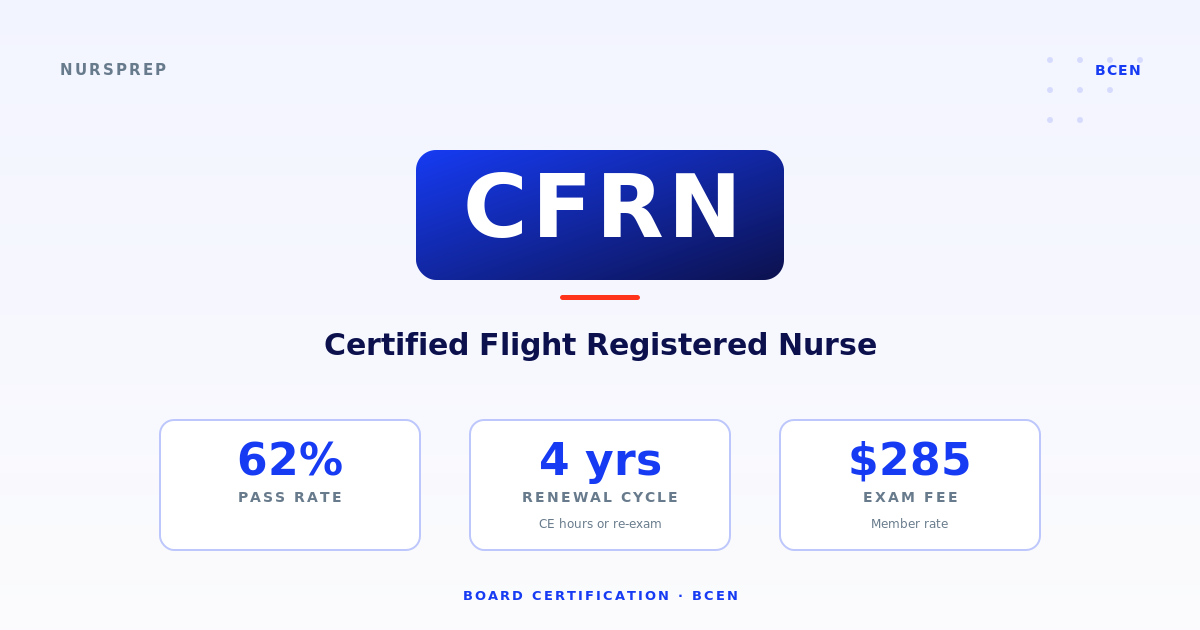
The CFRN exam fee is $285 for ENA or ASTNA members and $380 for non-members (2026 BCEN schedule). ENA annual membership currently runs about $135 per year, so joining before applying often saves money on the first fee alone. Many HEMS programs reimburse the certification fee through an education benefit — ask your clinical educator or HR before paying out of pocket.
After BCEN approves your application, you receive an Authorization to Test (ATT) email with a 90-day testing window; schedule your seat at a Pearson VUE test center immediately to avoid missing the window.
| Fee item | Cost (USD) |
|---|---|
| Exam application — ENA/ASTNA member | $285 |
| Exam application — non-member | $380 |
| Retake application fee | Same as initial ($285 / $380) |
| Recertification by CE — member | $240 |
| Recertification by CE — non-member | $340 |
| Recertification by exam | Same as current application fee |
| ENA annual membership (optional, reduces fee) | ~$135 |
Renewal
CFRN certification is valid for four years. BCEN offers two recertification pathways. Pathway 1 — CE Attestation: complete 100 contact hours in the current 4-year cycle, with at least 75 hours related specifically to flight or transport nursing content. At least 50 contact hours must come from accredited sources (BCEN Learn, AACN, ANCC, ENA, a State Board of Nursing, or a State Nurses Association). Content must be delivered at the nursing practice level or higher (CME accepted). EMS-only approvals such as CAPCE, PHTLS, ITLS, or AMLS are not accepted unless dually approved by a nursing provider.
Pathway 2 — Re-examination: retake and pass the current CFRN exam during your recertification window at the current application fee. There is no grace period — a lapsed CFRN must sit and pass the full exam again to restore the credential. Start logging CE in year 1 of the cycle to avoid a scramble.
How hard is the CFRN exam?
BCEN's most recent data reports a CFRN first-time pass rate of 62% (2024). The multi-year average sits around 62.6%, placing CFRN among the harder BCEN exams. Candidates who complete a structured 6–8 week study plan and at least one full-length timed practice exam pass at meaningfully higher rates.
Nurses with strong ED or ICU backgrounds but no transport exposure tend to underperform on transport principles and altitude physiology sections. Check BCEN's Certification Exam Statistics page for the most current reporting year.
An 8-week CFRN study plan
A structured 8-week study plan is realistic for most RNs with recent transport or critical care experience — roughly 80 to 120 total study hours. The plan below is built from BCEN's content outline and is designed so that every blueprint domain gets dedicated time before week 7's full-length timed practice exam.
-
1 WeekRead BCEN content outline + baseline diagnostic exam
-
2 WeekTransport principles — altitude physiology, gas laws, stress of transport, scene safety
-
3 WeekTrauma — blunt, penetrating, burns, spinal, MTP, thoracic decompression
-
4 WeekAirway, ventilator, and pharmacology — RSI, post-intubation sedation, PEEP, vasopressors
-
5 WeekMedical emergencies — sepsis, ARDS, stroke, ACS, status epilepticus
-
6 WeekCardiovascular, endocrine, renal, environmental, toxicologic emergencies
-
7 WeekFull-length timed practice exam + error-log review + OB/peds/neonatal/geri
-
8 WeekTargeted review of weak domains, light reading, rest, test day
How CFRN candidates actually fail — and how to avoid it
Sample CFRN question
This item mirrors BCEN's scenario format: a short clinical stem, a transport-specific twist, and four plausibly-correct options where only one is best. Try it before you read the rationale.
Tension pneumothorax expands with reduced barometric pressure at altitude (Boyle's law). Tracheal deviation, unilateral diminished breath sounds, rising peak pressures, and desaturation during flight demand immediate needle decompression. PEEP and fluids worsen the obstructive shock. Descent and FiO2 help, but decompression is the first action.
Key CFRN terms every candidate should know
These terms surface in most CFRN exam items. Review them until the definitions feel automatic.
| Term | Definition | Domain |
|---|---|---|
| CAMTS | Commission on Accreditation of Medical Transport Systems. Sets staffing and safety standards for air and ground medical transport. | General Principles |
| Boyle's Law | As pressure decreases, gas volume increases. Explains pneumothorax and ETT cuff expansion at altitude. | General Principles |
| Dalton's Law | Total pressure is the sum of partial pressures. PaO2 falls as altitude increases. | General Principles |
| Henry's Law | Dissolved gas volume is proportional to partial pressure. Relevant to decompression sickness. | General Principles |
| RSI | Rapid Sequence Intubation — near-simultaneous sedation and paralysis to secure the airway. | Patient Care Management |
| DSI | Delayed Sequence Intubation — preoxygenation with procedural sedation before paralysis in agitated hypoxic patients. | Patient Care Management |
| MTP | Massive Transfusion Protocol — balanced 1:1:1 plasma, platelets, RBCs for hemorrhagic shock. | Trauma |
| REBOA | Resuscitative Endovascular Balloon Occlusion of the Aorta — advanced hemorrhage control. | Trauma |
| Autonomic Dysreflexia | Dangerous hypertensive response in SCI at T6 or above, triggered by a noxious stimulus below the lesion. | Medical Emergencies |
| IABP | Intra-Aortic Balloon Pump — afterload reduction in cardiogenic shock, sometimes transported. | Medical Emergencies |
| HELLP | Hemolysis, Elevated Liver enzymes, Low Platelets — severe pre-eclampsia variant. | Special Populations |
| Parkland Formula | 4 mL × kg × %TBSA of Lactated Ringer's over 24 hours for major burns. | Trauma |
| Shock Index | Heart rate divided by systolic BP. Values greater than 0.9 suggest occult shock. | Trauma |
CFRN vs. CTRN, CEN, TCRN, CCRN, FP-C, CCP-C
If you already hold another transport or critical-care credential, the right question is which one should I hold next. CFRN sits alongside several transport and critical care credentials — the table below contrasts CFRN with the most common alternates so you can match exam to scope.
| Credential | Body | Scope | Best fit |
|---|---|---|---|
| CFRN | BCEN | Air medical transport — rotor and fixed wing | RNs in HEMS or fixed-wing transport |
| CTRN | BCEN | Ground critical care transport | RNs on ground critical care teams |
| CEN | BCEN | Hospital-based emergency nursing | ED RNs; common feeder credential before CFRN |
| TCRN | BCEN | Hospital-based trauma nursing | Trauma center ED and ICU RNs |
| CCRN (Adult) | AACN | Hospital-based adult critical care | ICU RNs; accepted by some HEMS programs |
| FP-C | IBSC | Flight paramedic | Paramedics, not RNs (partner crew member) |
| CCP-C | IBSC | Critical care paramedic | Paramedics, not RNs |
Take CFRN if you fly or plan to fly. Add CEN, TCRN, or CCRN on top only if your program requires the combination or your scope spans bedside and transport.
Frequently asked questions about CFRN certification
CFRN stands for Certified Flight Registered Nurse. The credential is issued by the Board of Certification for Emergency Nursing (BCEN).
Most candidates prepare for 6 to 8 weeks. A realistic target is 80 to 120 total study hours, spread across all five blueprint domains.
The CFRN exam is considered difficult. The 2024 first-time pass rate was 62%. Transport-specific content like altitude physiology and in-flight ventilation trips up candidates without flight exposure.
Yes. BCEN has no job or hour requirement. However, most HEMS programs require 3 to 5 years of ED or ICU experience before hire, regardless of CFRN status.
You can retake the exam after a waiting period set by BCEN. Each retake requires a new application and the full exam fee.
BCEN does not cap retake attempts. Each attempt requires a new application and fee.
CFRN certification expires after 4 years. You renew through 100 contact hours of CE (at least 75 flight/transport-specific) or by retaking the exam.
CFRN is not legally required, but most HEMS programs require CFRN at hire or within 12 months of hire as a condition of employment.
CFRN covers air medical transport; CTRN covers ground critical care transport. BCEN uses separate exam content outlines for each beginning 2026-03-30.
Most CAMTS-accredited HEMS programs reimburse the CFRN exam fee through an education benefit. Ask HR or your clinical educator before paying out of pocket.
Trusted sources
All figures on this page are verified against the following primary sources. Fees, blueprint weights, and recertification rules shift on BCEN's revision cycle — the updated CFRN content outline takes effect 2026-08-31. Always verify numeric facts against the current BCEN handbook before relying on them for application decisions.
- Board of Certification for Emergency Nursing (BCEN) — CFRN Candidate Handbook (2026 cycle)
- BCEN — CFRN Examination Content Outline, updated version effective 2026-08-31
- BCEN — Certification Exam Statistics (2024 reporting year, CFRN first-time pass rate 62%)
- BCEN — Recertification by CE Attestation policy and Decision Tree
- ASTNA — Patient Transport: Principles and Practice (current edition)
- AAOS / ACEP — Critical Care Transport (current edition)
- CAMTS — Accreditation Standards for Air and Ground Medical Transport
- US Bureau of Labor Statistics — Occupational Employment and Wage Statistics, Registered Nurses
- Air Medical Journal — peer-reviewed research on flight nursing and transport outcomes
Ready to practice CFRN-style items?
Jump into a 25-question diagnostic that maps to the 2026 blueprint. Free to start — no card required.