CPEN certification at a glance
CPEN — Certified Pediatric Emergency Nurse — is the RN-level benchmark for pediatric emergency nursing. The credential is issued by the Board of Certification for Emergency Nursing (BCEN), which launched the exam in January 2009.
CPEN began as a 50-50 partnership between BCEN and the Pediatric Nursing Certification Board (PNCB). In June 2016 the two boards dissolved that partnership, and BCEN became the sole owner of CPEN. You may still see the credential listed as "BCEN/PNCB" in older references.
CPEN is a board certification, not a course. It is sometimes confused with CPN — the PNCB's general Certified Pediatric Nurse credential — but only CPEN validates pediatric emergency nursing specifically.
Am I eligible for the CPEN exam?
Yes — if you hold a current, unencumbered RN license in the United States, a US territory, Canada, or Australia. BCEN does not enforce a minimum-hours rule for CPEN.
An international nursing certificate equivalent to a US RN license is also accepted, provided it is verified through TruMerit (BCEN's international credential-evaluation partner). Any active restriction, suspension, or probation on a nursing license disqualifies a candidate.
BCEN recommends at least two years of pediatric emergency nursing experience before testing. That recommendation is guidance, not a gate — you may sit the exam without it.
You are a strong candidate if…
- You have roughly two years of pediatric emergency RN practice, in a pediatric ED, mixed ED, or children's hospital.
- You triage children confidently using the Pediatric Assessment Triangle (PAT) and an acuity tool such as ESI.
- You routinely manage respiratory, cardiac, neurologic, and multi-system pediatric emergencies, including sepsis and anaphylaxis.
- Your setting fits a recognized pediatric emergency role: pediatric or mixed ED, children's hospital, pediatric trauma center, urgent care, or prehospital and critical-care transport.
CPEN exam blueprint — six domains (150 scored items)
The CPEN blueprint is six domains, weighted by where most pediatric emergency nursing decisions happen. System-Focused Emergencies alone carries about 37% of the scored exam — most of your study time should live there.
- Triage Process (PAT, ESI, emergency preparedness) 20%
- Assessment (history, physical, pain) 25%
- System-Focused Emergencies (respiratory, cardiac, neuro, GI/GU, ENT, MSK, heme/onc, endocrine) 56%
- Special Considerations (neonatal, behavioral health, maltreatment, environmental, toxicology, communicable disease) 25%
- Multi-System Considerations (sepsis, anaphylaxis, sedation) 12%
- Professional Issues 12%
Do not neglect Triage and Assessment. Together they account for roughly 30% of scored items and anchor nearly every scenario stem. Professional Issues feels abstract at the bedside but reliably appears on the exam.
Cost, scheduling, and military benefits
BCEN delivers CPEN through Pearson VUE in-person testing centers and via Live Remote Proctoring (LRP) for candidates who prefer to test from a private location. After BCEN approves your application, you receive an Authorization to Test with a scheduling window — book your Pearson VUE seat or LRP slot promptly.
| Fee item | Cost (USD) |
|---|---|
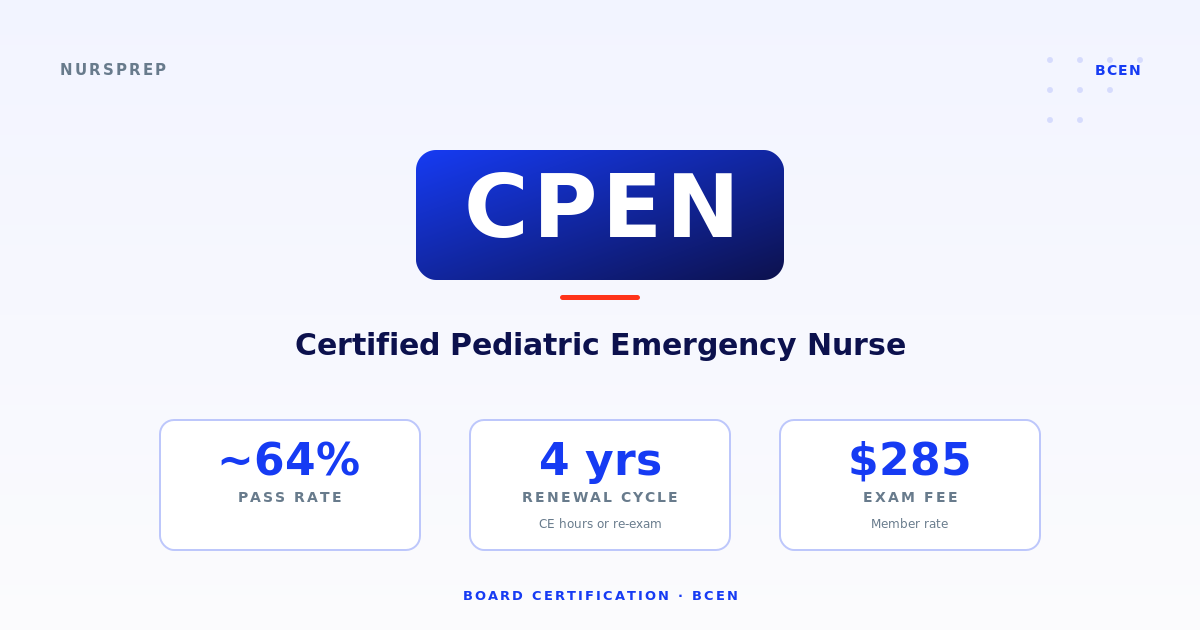
| Initial application — ENA member | $285 |
| Initial application — non-member | $380 |
| Military / veteran application | $195 (or $265 with Test Assurance) |
| Retest (within one year of initial exam) | $200 |
| Initial with BCEN Test Assurance — non-member | $450 |
| Initial with BCEN Test Assurance — ENA member | $355 |
Renewal
CPEN certification is valid for four years. BCEN offers two renewal pathways. Pathway 1 — Recertification by CE Attestation: complete 100 continuing education contact hours in the cycle and attest to an active, unencumbered RN license. Keep your CE certificates, because BCEN audits a share of renewals.
Pathway 2 — Recertification by Examination: retake and pass the current CPEN exam. Recertification fees mirror the initial-application schedule, and military/veteran and voucher discounts also apply to recertification.
How hard is the CPEN exam?
In 2024, 673 of 1,058 CPEN candidates passed the exam — a pass rate near 64%. That sits in the moderate range for BCEN specialty exams, partly because CPEN spans the full breadth of pediatric emergencies rather than a single body system.
Candidates who follow a structured 8 to 10-week plan and complete at least one full-length timed practice exam pass at meaningfully higher rates than those relying on work experience alone. The biggest avoidable gap is under-studying System-Focused Emergencies, which is more than a third of the scored exam.
An 8-week CPEN study plan
A structured 8-week study plan is enough for most pediatric emergency RNs with two or more years of practice — roughly 60 to 100 total study hours across the six blueprint domains. Practice-question volume ramps through weeks 2–6 and peaks in week 7 with a full-length timed exam; week 8 is for targeted review and a rest day.
-
1 WeekRead the BCEN CPEN content outline + a baseline diagnostic exam
-
2 WeekTriage (PAT, ESI) and assessment — history, physical, pain
-
3 WeekRespiratory and cardiac emergencies (highest-yield systems)
-
4 WeekNeurologic, GI/GU, ENT, MSK, heme/onc, endocrine emergencies
-
5 WeekSpecial considerations — neonatal, maltreatment, toxicology, environmental
-
6 WeekMulti-system — sepsis, anaphylaxis, sedation — and professional issues
-
7 WeekFull-length timed practice exam + error-log review
-
8 WeekTargeted review of weak domains, rest, test day
How CPEN candidates actually fail — and how to avoid it
Sample CPEN question
This item mirrors BCEN's scenario format: a short pediatric clinical stem, an unstable child, and four plausible options where only one is best. Try it before you read the rationale.
The child shows compensated-to-decompensated septic shock — abnormal appearance plus abnormal circulation on the PAT, tachycardia, and delayed capillary refill. Early, aggressive fluid resuscitation (a 20 mL/kg isotonic bolus through prompt vascular access) is the priority. Antipyretics and waiting on cultures delay the time-critical intervention.
Key CPEN terms every candidate should know
These terms surface across CPEN exam items. Review them until the definitions feel automatic — scenario stems often hinge on recognizing which pediatric framework applies.
| Term | Definition | Domain |
|---|---|---|
| PAT | Pediatric Assessment Triangle — a rapid, hands-off first impression using appearance, work of breathing, and circulation to the skin. | Triage |
| ESI | Emergency Severity Index — a five-level triage acuity tool that ranks patients by severity and predicted resource needs. | Triage |
| Length-based tape | A color-coded tape (e.g., Broselow) that estimates a child's weight from length to guide drug dosing and equipment sizing. | Assessment |
| Compensated shock | Early shock where blood pressure is maintained by tachycardia and vasoconstriction; recognized by delayed capillary refill before hypotension appears. | Multi-System |
| Weight-based dosing | Pediatric medication dosing calculated in mg/kg, the foundation of safe resuscitation and a frequent CPEN item type. | System-Focused |
| Croup vs. epiglottitis | Two upper-airway emergencies CPEN tests: croup (viral, barky cough, stridor) versus epiglottitis (bacterial, drooling, tripod posture, toxic appearance). | System-Focused |
| Child maltreatment | Suspected abuse or neglect; CPEN tests recognition of red-flag injury patterns and the nurse's mandatory-reporting duty. | Special |
| Criterion-referenced score | A pass/fail standard set against a fixed competency benchmark, not a curve — your result does not depend on other candidates. | Professional |
CPEN vs. CPN, CEN, and ENPC
CPEN sits alongside several pediatric and emergency credentials that nurses sometimes confuse. Many candidates Google "CPEN" when they actually mean CPN or ENPC, so the distinction matters before you spend time or money.
| Credential | Body | Scope | Best fit |
|---|---|---|---|
| CPEN | BCEN | Pediatric emergency nursing | RNs caring for children in emergency settings |
| CPN | PNCB | General pediatric nursing across settings | RNs in inpatient or outpatient peds |
| CEN | BCEN | Adult and pediatric emergency nursing | ED RNs covering all presentations |
| ENPC (course, not cert) | ENA | Baseline pediatric emergency assessment | ED RNs as foundational training |
| TCRN | BCEN | Trauma nursing across the continuum | RNs in trauma-touching roles |
Take CPEN if you want to validate pediatric emergency expertise specifically. Take CPN instead if your work is general pediatrics across inpatient and outpatient settings. Take CEN if your day-to-day is broad, all-ages ED practice. ENPC is baseline education — it does not replace CPEN on your credentials line.
Frequently asked questions about the CPEN exam
CPEN stands for Certified Pediatric Emergency Nurse. The credential is issued by the Board of Certification for Emergency Nursing (BCEN).
BCEN issues CPEN and has been its sole owner since June 2016. The exam launched in 2009 as a 50-50 partnership between BCEN and the Pediatric Nursing Certification Board (PNCB).
No. CPEN is BCEN's pediatric emergency nursing certification, while CPN is the PNCB's general Certified Pediatric Nurse credential covering pediatric care across all settings.
Yes. BCEN recommends two years of pediatric emergency experience but does not require it. You only need a current, unencumbered RN license.
The CPEN exam has 175 multiple-choice items — 150 scored and 25 unscored pretest items — with a 3-hour time limit.
The CPEN exam costs $285 for ENA members and $380 for non-members. Active-duty service members, reservists, and veterans pay $195, and the retest fee is $200.
The CPEN exam is moderately difficult. The 2024 pass rate was about 64% (673 of 1,058 candidates). Most failures come from under-studying System-Focused Emergencies.
CPEN is valid for four years. You renew by completing 100 continuing education contact hours and attesting to an active RN license, or by retaking and passing the exam.
You can apply to retake the exam at a discounted retest fee of $200 within one year of your initial exam date. BCEN Test Assurance covers a free retest if purchased upfront.
Yes. CPEN is accredited by the Accreditation Board for Specialty Nursing Certification (ABSNC) and accepted by the ANCC Magnet Recognition Program.
Trusted sources
All figures on this page are verified against the following sources. Fees, blueprint weights, and recertification rules shift on BCEN's revision cycle — always verify numeric facts against the current BCEN materials before relying on them for application decisions.
- Board of Certification for Emergency Nursing (BCEN) — CPEN Certification program page (bcen.org/cpen/)
- BCEN — CPEN Exam Fees & Discounts ($380 / $285 ENA / $195 military / $200 retest; Test Assurance)
- BCEN — CPEN Eligibility (unencumbered RN license; TruMerit for international; 2-year recommendation)
- BCEN — About the CPEN Exam (175 items, 150 scored / 25 pretest, 3 hours, Pearson VUE + LRP)
- BCEN — Pediatric Emergency Excellence: CPEN Program Overview (2009 launch; co-sponsorship history)
- BCEN — News release: CPEN Certification to be Solely Owned by BCEN (June 2016)
- BCEN — How to Recertify (4-year cycle; 100 CE hours or re-exam)
- CPEN 101 — CPEN Pass Rates (2024: 673 of 1,058; ~63.6%)
- US Bureau of Labor Statistics (BLS) — Occupational Employment and Wage Statistics, Registered Nurses (May 2024): $98,430 mean RN wage
Ready to practice CPEN-style items?
Work through a 25-question diagnostic mapped to the six-domain CPEN blueprint. Free to start — no card required.