CHPN certification at a glance
CHPN — Certified Hospice and Palliative Nurse — is the RN-level benchmark for hospice and palliative nursing across home hospice, inpatient hospice units, palliative consult services, and serious-illness care teams. The credential is issued by the Hospice and Palliative Credentialing Center (HPCC), the credentialing arm of the Hospice and Palliative Nurses Association (HPNA). HPCC launched the CHPN credential in 1999; its 1994–2002 predecessor, CRNH, is no longer used.
CHPN is a board certification, not a course. As of February 2026, HPCC reports 7,283 active CHPN credentials — by volume, the largest credential in HPCC's portfolio. The exam is accredited by the Accreditation Board for Specialty Nursing Certification (ABSNC) through February 2027.
Am I eligible for the CHPN exam?
You are eligible if you hold a current, active, unencumbered RN license in the United States, US territories, or the equivalent in Canada, and you have completed 500 hours of hospice or palliative nursing practice in the most recent 12 months — or 1,000 hours in the most recent 24 months.
Unlike some BCEN credentials where practice hours are recommended but not enforced, HPCC enforces the 500/1,000-hour rule as a hard gate. There is no hours waiver: candidates short of the threshold must accumulate the hours before submitting an application. Direct clinical experience in either hospice or palliative care counts toward the requirement.
You are a strong candidate if…
- You have logged at least 500 hospice or palliative practice hours in the past 12 months (or 1,000 hours across 24 months) as a primary case-manager, visit RN, inpatient hospice RN, or palliative consult RN.
- You routinely manage pain with opioid rotation and equianalgesic conversions, including breakthrough vs background dosing decisions at end of life.
- You are comfortable assessing and treating terminal symptoms — refractory dyspnea, terminal secretions, delirium, nausea, and constipation — without reaching for an order set every time.
- Your setting fits a recognized hospice or palliative role: home hospice, free-standing or hospital-based inpatient hospice, palliative consult service, oncology palliative team, long-term care palliative champion, or pediatric-adolescent palliative transition role.
- You facilitate family meetings and surrogate-decision-making conversations and document advance directives, POLST, and code-status changes in the medical record.
CHPN exam blueprint — five near-equal domains
The CHPN blueprint is five domains, with each carrying close to 20% of the scored items. Unlike credentials with one or two dominant domains, CHPN candidates cannot afford to skip any section — the Patient Care cluster (Assessment, Pain, Symptom) makes up 58.5% of scored items, and the Support/Advocacy and Practice Issues domains make up the remaining 41.5%.
- Patient Care — Assessment and Planning 25%
- Patient Care — Pain Management 26%
- Patient Care — Symptom Management 28%
- Support, Education, and Advocacy 28%
- Practice Issues 28%
Practice Issues feels abstract at the bedside — it covers the Medicare Hospice Benefit certification windows (90/90/60/60), interdisciplinary team composition, CMS Conditions of Participation, ethics of withdrawing nutrition and hydration, and quality reporting. Candidates with strong clinical skills but light regulatory exposure tend to lose points here.
Cost, scheduling, and testing windows
HPCC delivers CHPN through PSI Exams at PSI test centers and via Live Remote Proctoring (LRP), which lets candidates test from a private location. The exam runs in four annual testing windows — March, June, September, and December — with online application deadlines about two weeks before each window opens (Feb 15, May 15, Aug 15, Nov 15). Missing a deadline pushes you to the next quarter.
| Fee item | Cost (USD) |
|---|---|
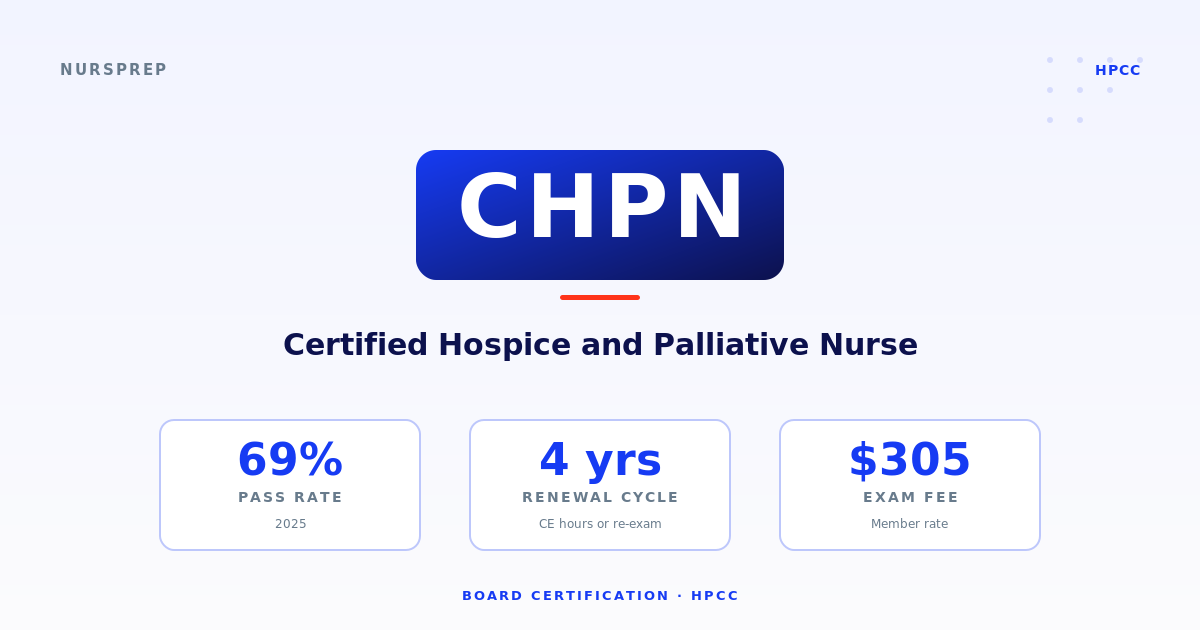
| Initial certification — HPNA member | $305 |
| Initial certification — non-member | $445 |
| reTEST Assured (prepaid retake) | $135 |
| HPNA annual membership (reduces exam fee) | ~$135 |
| Sandra Lee Schafer Certification Scholarship | Covers fee for selected applicants |
| Application window | Opens 3 months before each exam window |
| Score reporting | On-site at test center · within 24 hrs for LRP |
| Payment methods | Visa, MasterCard, Discover, American Express |
Renewal
CHPN certification is valid for four years. HPCC's renewal program is the Hospice and Palliative Accrual for Recertification (HPAR) — an online portfolio managed in LearningBuilder where holders accumulate 100 HPAR points over the cycle. 1 CE contact hour = 1 HPAR point, and other professional-development activities (publishing, precepting, committee service) also earn points.
Since 2014, HPAR has been the standard recertification path; the Situational Judgment Exercise (SJE) — case-based scenarios testing clinical decision-making beyond initial-exam content — is also required at renewal. CHPN holders must additionally maintain clinical-practice hours during the cycle; the exact hour minimum is published in each candidate's HPAR Packet at the time of renewal. Lapsed credentials cannot be reactivated by CE catch-up — holders must sit the current CHPN exam again to reinstate.
How hard is the CHPN exam?
HPCC reported 825 of 1,190 first-time CHPN candidates passed in 2025 — a 69.3% first-time pass rate. The total pass rate (first-time plus repeaters) was 66.8% (907 of 1,358). In 2024, the first-time pass rate was meaningfully higher: 72.9% (939 of 1,288). Year-over-year drift is expected as HPCC's published 2026 Detailed Content Outline introduces small content shifts.
Repeater performance is the bigger story. Repeaters in 2025 passed at only 48.8% (82 of 168) — about 20 percentage points below first-time test-takers. The practical implication: a casual second sitting without rebuilt study habits is risky. reTEST Assured (HPCC's $135 prepaid retake) makes sense only when paired with a real restudy plan that targets the domains the candidate underperformed on the first attempt.
A 10-week CHPN study plan
A structured 10-week plan suits most hospice or palliative RNs with at least one year of practice — about 70 to 100 total study hours across the five blueprint domains. Question-bank volume ramps from week 2 and peaks in week 9 with one full-length timed exam; week 10 is for targeted review and logistics. Aim for 600–1,000 practice items total before test day.
-
1 WeekRead HPCC 2026 CHPN Detailed Content Outline + baseline diagnostic exam
-
2 WeekAssessment and planning — PPS/KPS, hospice eligibility, advance care planning
-
3 WeekPain management — WHO ladder, opioid rotation, equianalgesic conversions
-
4 WeekSymptom management I — dyspnea, secretions, nausea, constipation
-
5 WeekSymptom management II — delirium, anxiety, terminal sedation, refractory symptoms
-
6 WeekSupport, education, advocacy — grief types, family meetings, cultural humility
-
7 WeekPractice issues — Medicare Hospice Benefit, IDG/IDT, ethics, CoPs
-
8 WeekWeak-domain remediation based on diagnostic and week-by-week error log
-
9 WeekFull-length timed practice exam (150 items in 3 hours) + error log review
-
10 WeekTargeted review of weak domains, rest, logistics, test day
How CHPN candidates actually fail — and how to avoid it
Sample CHPN question
This item mirrors HPCC's scenario format: a short clinical stem and four plausibly-correct options where only one is best. Try it before reading the rationale.
Low-dose oral immediate-release morphine is the evidence-based first-line treatment for refractory dyspnea in advanced disease and is the standard of care in hospice and palliative practice. Increasing oxygen above the patient's baseline saturation does not relieve dyspnea perception and may dry secretions. Inpatient transfer is premature for a symptom managed effectively at home. Holding opioids in a hospice patient with refractory dyspnea — citing a non-indicated stat ABG — runs against the patient's expressed goals and the published evidence base.
Key CHPN terms every candidate should know
These terms surface in most CHPN exam items. Review them until the definitions feel automatic — scenario stems often hinge on whether the candidate can name which framework applies (hospice vs palliative, anticipatory vs complicated grief, hyperactive vs hypoactive delirium).
| Term | Definition | Domain |
|---|---|---|
| Medicare Hospice Benefit | Federal benefit covering hospice care for Medicare beneficiaries with a physician-certified life expectancy of six months or less if the disease runs its expected course. Recertification windows follow a 90/90/60/60 schedule. | Practice Issues |
| Palliative care | Specialized care focused on relief of serious-illness symptoms and stress; no prognostic requirement and may run concurrently with curative treatment. | Practice Issues |
| PPS (Palliative Performance Scale) | 0–100 scale measuring functional status in advanced illness; used in prognostication and hospice eligibility decisions. | Assessment |
| Equianalgesic conversion | Cross-titration math comparing potencies of different opioids by route. A reduction factor of 25–50% is applied during rotation to account for incomplete cross-tolerance. | Pain |
| Breakthrough pain | Transient flare of pain on a background of stable analgesia. Typical immediate-release dose is 10–20% of the 24-hour scheduled opioid total. | Pain |
| Terminal secretions | Audible upper-airway secretions in the dying patient, sometimes called the death rattle. Family education and repositioning are first-line; anticholinergics are second-line. | Symptom |
| Palliative sedation | Proportionate use of sedating medications to relieve refractory symptoms in the dying patient. Distinct from euthanasia: intent is symptom relief, not hastened death. | Symptom |
| Anticipatory grief | Grief experienced by patient or family before the actual death, in response to expected loss. Differs from complicated grief, which arises after death and persists with impairment. | Support |
| Interdisciplinary group (IDG/IDT) | Required hospice care team — RN, physician, social worker, chaplain, hospice aide, volunteer — that develops and updates the plan of care at least every 15 days. | Practice Issues |
| POLST / MOLST | Physician Orders for Life-Sustaining Treatment (or Medical Orders) — portable, actionable medical orders covering CPR, intubation, artificial nutrition, and antibiotics that travel with the patient across settings. | Assessment |
| Delirium subtypes | Hyperactive (agitated), hypoactive (withdrawn), and mixed presentations. Hypoactive delirium is the most commonly missed at end of life. | Symptom |
CHPN vs. ACHPN, CHPPN, CHPLN, OCN
CHPN sits alongside several related credentials. Many candidates Google "CHPN" when they actually need a different HPCC credential, so the distinction matters before paying the application fee.
| Credential | Body | Scope | Best fit |
|---|---|---|---|
| CHPN | HPCC | Hospice and palliative nursing for adult patients | RNs in hospice, palliative, or serious-illness roles |
| ACHPN | HPCC | Advanced-practice hospice and palliative | Nurse Practitioners and Clinical Nurse Specialists |
| CHPPN | HPCC | Pediatric hospice and palliative | RNs caring for pediatric end-of-life patients |
| CHPLN | HPCC | Hospice and palliative practice at the LPN scope | LPNs and LVNs |
| OCN | ONCC | Oncology nursing across the cancer continuum | Oncology RNs (may pair with CHPN for oncology palliative work) |
Take CHPN if you are an RN spending most of your time in hospice or palliative care. Move to ACHPN once you complete an APRN program. CHPPN is the parallel credential if your patients are pediatric. CHPLN is the scope-appropriate option for LPN/LVN colleagues. OCN may be a better fit if you work in oncology where curative treatment is still the primary frame.
Frequently asked questions about CHPN certification
CHPN stands for Certified Hospice and Palliative Nurse. The credential is issued by the Hospice and Palliative Credentialing Center (HPCC) and is the RN-level board certification for hospice and palliative nursing.
HPCC — the Hospice and Palliative Credentialing Center — issues the CHPN credential. HPCC is the credentialing arm of the Hospice and Palliative Nurses Association (HPNA). HPCC launched CHPN in 1999 after expanding its earlier CRNH credential to cover palliative care.
Candidates need a current, active, unencumbered RN license in the US, US territories, or the equivalent in Canada, plus 500 hours of hospice or palliative nursing practice in the most recent 12 months — or 1,000 hours in the most recent 24 months. HPCC enforces the hours rule as a hard gate; there is no waiver.
HPCC charges $305 for HPNA members and $445 for non-members. The optional reTEST Assured add-on prepays a single retake for $135. HPNA membership runs about $135 per year, so joining HPNA before applying typically pays for itself on the first sitting.
The CHPN exam contains 150 multiple-choice items — 135 scored plus 15 unscored pretest items — and runs three hours in a single block. PSI delivers the exam at PSI test centers and via Live Remote Proctoring.
HPCC reported a 69.3% first-time pass rate in 2025 (825 of 1,190 candidates). The 2024 first-time pass rate was 72.9% (939 of 1,288). Repeater pass rates run roughly 20 points lower, so a casual second attempt without rebuilt study habits carries meaningful risk.
HPCC offers the CHPN exam during four annual windows: March, June, September, and December. Online application deadlines fall about two weeks before each window opens — Feb 15, May 15, Aug 15, and Nov 15.
Yes. CHPN is valid for four years. Renewal runs through HPAR — Hospice and Palliative Accrual for Recertification — where holders accumulate 100 points (1 CE contact hour = 1 HPAR point) and complete the Situational Judgment Exercise. Lapsed credentials cannot be renewed by CE catch-up and require re-examination.
CHPN is the RN-level credential. ACHPN is the advanced-practice version for Nurse Practitioners and Clinical Nurse Specialists. Both are issued by HPCC, but the eligibility, scope, and exam content are different. RNs progressing through an APRN program typically move from CHPN to ACHPN.
Many hospice agencies and health systems reimburse the CHPN application fee through an education benefit. The Hospice and Palliative Nurses Foundation (HPNF) also runs the Sandra Lee Schafer Certification Scholarship, which covers fees for selected applicants paying out of pocket.
Trusted sources
All figures on this page are verified against the following primary sources. Fees, blueprint counts, and recertification rules shift on HPCC's revision cycle — always verify numeric facts against the current HPCC handbook before relying on them for application decisions.
- Hospice and Palliative Credentialing Center (HPCC) — CHPN credential page: eligibility, fees, testing windows, PSI scheduling — advancingexpertcare.org/hpcc/credentials/chpn/
- HPCC — Exam Statistics: 2024 and 2025 CHPN pass rates and active certificant counts — advancingexpertcare.org/hpcc/why-certification/exam-statistics/
- HPCC — History: 1994 CRNH launch, 1999 CHPN renaming, ABSNC accreditation through Feb 2027 — advancingexpertcare.org/hpcc/why-certification/hpcc-history/
- HPCC — HPAR recertification program: 100 points, Situational Judgment Exercise — advancingexpertcare.org/hpcc/recertification/hpar/
- HPCC — 2026 CHPN Detailed Content Outline (PDF, published May 2026) — advancingexpertcare.org/wp-content/uploads/2026/05/2026-CHPN-DCO_for-website.pdf
- HPCC — Live Remote Proctoring program — advancingexpertcare.org/hpcc/live-remote-proctoring/
- HPCC — reTEST Assured program ($135 prepaid retake) — advancingexpertcare.org/hpcc/retest-assured/
- US Bureau of Labor Statistics — Registered Nurses Occupational Outlook Handbook: $93,600 median RN wage (May 2024), 5% projected RN growth 2024–2034
Ready to practice CHPN-style items?
Work through a 25-question diagnostic mapped to HPCC's five-domain blueprint. Free to start — no card required.