What is CRNI certification and who awards it?
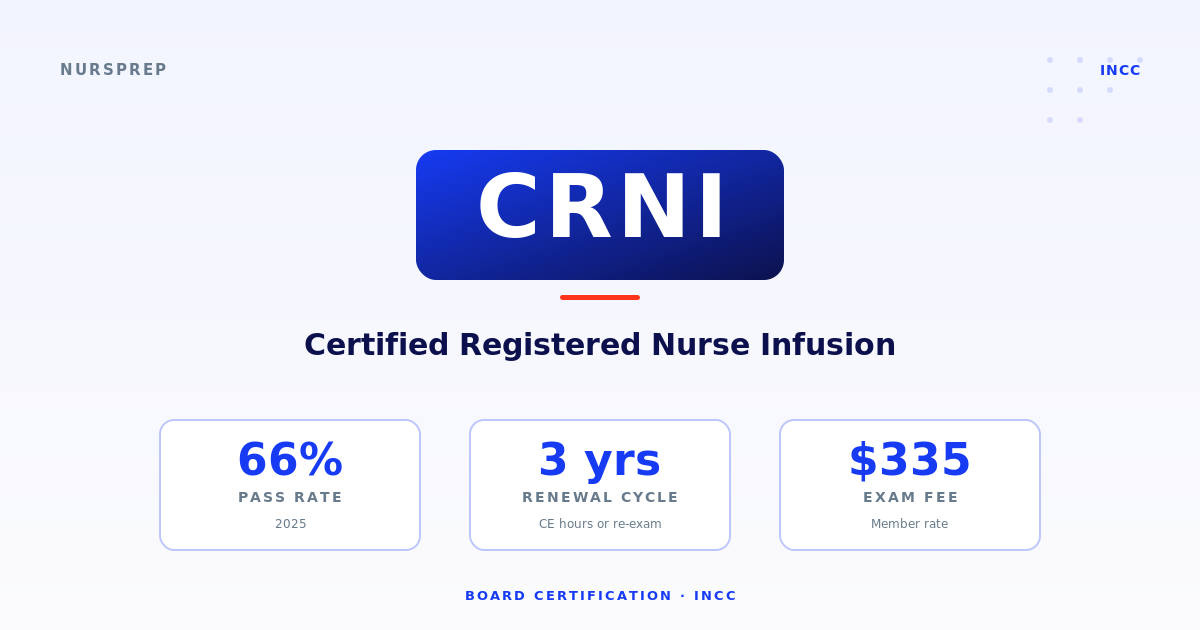
CRNI certification is a specialty board certification for registered nurses who practice infusion therapy, granted by the Infusion Nurses Certification Corporation (INCC). CRNI stands for Certified Registered Nurse Infusion. INCC describes it as the only nationally recognized, accredited specialty certification built specifically for infusion nurses.
The credential is accredited twice over: by the Accreditation Board for Specialty Nursing Certification (ABSNC) and by the National Commission for Certifying Agencies (NCCA). INCC reports 2,378 CRNIs, which makes this a small credential relative to how routinely patients receive infusions.
CRNI is a certification, not a course and not a scope-of-practice permit. Passing the exam does not authorize a procedure your license, state rules, or facility policy do not already allow.
Am I eligible for the CRNI exam?
You are eligible if you hold an active, unrestricted RN license in the United States or Canada and have logged at least 1,600 hours of infusion therapy experience as an RN within the past two years. Both conditions are hard requirements, not recommendations.
CRNI is RN-only. There is no LPN, LVN, technician, or non-nursing pathway, and no advanced-practice variant.
The 1,600 hours do not have to be bedside hours. INCC counts infusion-specialty time spent in nursing education, administration, research, or clinical practice. INCC frames the requirement as roughly 15 hours a week, or about 42% of a 36-hour week, spent on infusion therapy.
Expect the hours to be checked. The application asks for your supervisor's contact details, and INCC states it may contact your employer to verify the experience you claim.
You are a strong candidate if…
- You hold an active, unrestricted RN license in the US or Canada and can document 1,600 infusion therapy hours inside the last two years.
- Your practice spans all three core content areas, not just one — the principles behind safe therapy, the access devices, and the infusates that run through them.
- You work with the full device range the exam covers: short and long peripheral catheters, midlines, PICCs, tunneled and non-tunneled central catheters, implanted ports, subcutaneous access, and intraosseous access.
- You routinely handle the therapy classes the exam weights most heavily — anti-infectives, antineoplastics, biologics, blood products, parenteral nutrition, and fluid and electrolyte replacement.
- You practice outside the US or Canada but hold an active, unrestricted RN license where you work, can supply a credentials evaluation, and accept that the exam tests United States practice and regulation. A $140 international site fee applies.
What does the CRNI exam cover?
The CRNI exam covers three core content areas: Principles of Practice (35 scored items, 29%), Access Devices (39 items, 33%), and Infusion Therapies (46 items, 38%). The counts sum to the 120 scored items; the other 20 items on your form are unscored pretest questions you cannot identify.
- Principles of Practice (35 scored items) 29%
- Access Devices (39 scored items) 33%
- Infusion Therapies (46 scored items) 38%
Infusion Therapies is the heaviest area and the one candidates most often under-study. It covers pain management, cardiovascular and anti-infective therapy, antineoplastics, biologics, blood products, fluid and electrolyte balance, parenteral nutrition, and therapy-related complications including adverse reactions and hazardous drug exposure.
Access Devices spans device technology, the devices themselves, care and maintenance, special populations such as older adults and pediatric and oncology patients, and device-related complications like infiltration, extravasation, and occlusion. Principles of Practice covers anatomy and physiology, infection prevention and control, and phlebotomy.
Items are written at two cognitive levels. Recall items ask "what is X?" Application items give you a clinical picture and ask what follows from it. The application items are where experience helps and rote memorisation does not.
How much does CRNI certification cost?
CRNI certification costs $335 for INS members and $475 for non-members at the early-bird deadline, rising to $385 and $525 in the regular window and $435 and $575 after the late deadline. INS membership is worth exactly $140 off at every tier.
INCC runs two exam windows a year: the month of March and the month of September (excluding Labor Day). For the March exam, the early-bird deadline is November 10, the regular window runs November 11 to January 10, and anything after January 10 is late. For September, the dates are June 10, June 11 to July 10, and after July 10.
INCC emails a receipt and mails a confirmation letter within 7 to 14 days of processing your application. That letter carries the unique PSI code you need to book a seat. PSI invites candidates to schedule roughly three weeks before the window opens, at hundreds of PSI test centers across the US and Canada plus more than 570 international sites.
| Fee item | Cost (USD) |
|---|---|
| Early-bird application — INS member | $335 · non-member $475 |
| Regular application — INS member | $385 · non-member $525 |
| Late application — INS member | $435 · non-member $575 |
| International site fee | +$140 |
| Retake discount (previously unsuccessful candidates) | −$50 |
| Application received after a published deadline | May incur a $50 late fee |
| Cancellation before the regular deadline | Refund less a $75 processing fee |
| Transfer to the next exam window | $75 · offered once, non-refundable |
| Recertification — INS member | $200 · non-member $325 |
| CRNI Exam Study Guide and Practice Questions | $40 member · $50 non-member |
| Duplicate score report (from PSI) | $25 |
Renewal
CRNI certification is valid for three years. The credential takes effect on April 1 for March passers and October 1 for September passers, and expires on that date three years later. Validity depends on continuous RN licensure throughout.
Pathway 1 — recertification by continuing education: earn 40 CRNI Recertification Units (RUs) within the cycle, of which at least 30 must come from national INS meetings or INS Virtual Education Conferences. RUs are not the same thing as contact hours or CEs, which is the single most common recertification mistake. You must also document 1,000 hours of infusion therapy clinical experience within the previous three years and a current, unrestricted RN license.
Pathway 2 — recertification by exam: pass the current CRNI exam during the final year of your cycle. Choosing this route forfeits the CE option for that cycle.
Deadlines are March 31 for March-cycle CRNIs and September 30 for September-cycle CRNIs; late applications may be accepted with a $50 fee. Miss the deadline and INCC revokes the credential — there is no grace period, and the only way back is to sit and pass the exam again.
How hard is the CRNI exam?
The CRNI exam is failed by about a third of the people who sit it. INCC reported 323 of 487 candidates passed in 2025, a 66% pass rate, following 63% in 2024 and 67% in 2023. That is a meaningfully tougher result than the 84% VACC reports for the adjacent VA-BC exam.
The eligibility rule explains part of it. Every candidate already has 1,600 infusion hours behind them, so this is not a pass rate softened by novices dropping out — it is a specialist cohort, and a third of them still miss.
INCC publishes no numeric passing score. The cut score is set by the Angoff method, in which expert judges estimate the probability that a minimally competent nurse answers each item correctly, and is carried across forms by pre-equating. Your score report shows pass or fail plus raw scores by content area, so a failed attempt tells you exactly which of the three core areas to rebuild.
A 10-week CRNI study plan
Ten weeks maps cleanly onto INCC's calendar: the regular application deadline falls about eight weeks before the window opens, so you can start the week you apply and finish before your PSI appointment. Weight your weeks to the blueprint — Infusion Therapies is 38% of scored items, Access Devices 33%, Principles of Practice 29%.
Start with INCC's Detailed Content Outline and run a self-assessment against it before you read anything else. INCC explicitly recommends this, and it is the only way to find out which of the three core areas your daily practice has left thin.
-
1 WeekRead the CRNI Exam Handbook and Detailed Content Outline; self-assess against all three core areas
-
2 WeekPrinciples of Practice — anatomy and physiology, vessel and site selection, body positioning
-
3 WeekPrinciples of Practice — infection prevention, chain of infection, bloodstream infection, phlebotomy and blood cultures
-
4 WeekAccess Devices — solution containers, administration sets, filters, add-on devices, pumps, vein location and tip-locating technology
-
5 WeekAccess Devices — peripheral, midline, PICC, tunneled, non-tunneled, implanted port, subcutaneous and intraosseous access
-
6 WeekAccess Devices — care and maintenance, special populations, infiltration, extravasation and occlusion
-
7 WeekInfusion Therapies — anti-infectives, cardiovascular, pain management, biologics and immunologics
-
8 WeekInfusion Therapies — antineoplastics, blood products, fluid and electrolyte balance
-
9 WeekInfusion Therapies — parenteral nutrition and therapy-related complications; full-length timed 140-item set
-
10 WeekRebuild the weakest core area from your error log, review approved abbreviations, confirm PSI appointment and ID
How CRNI candidates trip up — and how to avoid it
Sample CRNI exam question
This item mirrors INCC's application level: a short clinical picture and four options that all describe things nurses really do, where only one is correct. Answer it before you read the rationale.
The findings describe extravasation of a vesicant. The first action is to stop the infusion and leave the catheter in place while attempting to aspirate residual drug, because the catheter is the route for aspiration and, for some agents, for antidote administration. Flushing pushes more vesicant into the tissue. Restarting the infusion continues the injury, and a warm compress is the wrong thermal treatment for an anthracycline, which calls for dry cold. Removing the catheter first discards the aspiration and antidote route before it has been used.
Key CRNI terms every candidate should know
These terms carry the exam's application items. Most stems turn on recognising which definition applies — vesicant versus irritant, infiltration versus extravasation, thrombotic versus non-thrombotic occlusion — before any nursing action is chosen.
| Term | Definition | Domain |
|---|---|---|
| Vesicant | A solution or medication that causes tissue blistering or necrosis if it escapes the vein. Vesicant status, not drug class, drives device selection and the extravasation response. | Infusion Therapies |
| Irritant | A solution that causes pain, aching, or inflammation along the vein without causing tissue necrosis on escape. | Infusion Therapies |
| Infiltration vs. extravasation | Infiltration is leakage of a non-vesicant solution into surrounding tissue. Extravasation is leakage of a vesicant, which can cause necrosis and may require an antidote. | Access Devices |
| Osmolarity | Solute concentration of an infusate in mOsm/L. Together with pH it determines whether a solution can run through a peripheral catheter or needs central access. | Infusion Therapies |
| Midline catheter | A peripheral catheter with the tip at or below the axilla. It is not central access and is inappropriate for continuous vesicants and parenteral nutrition. | Access Devices |
| PICC | Peripherally Inserted Central Catheter — a central catheter inserted through an upper-arm vein with the tip in the lower superior vena cava or cavoatrial junction. | Access Devices |
| Implanted port | A central device with a subcutaneous reservoir accessed through the skin with a non-coring needle; suited to intermittent long-term therapy. | Access Devices |
| Thrombotic vs. non-thrombotic occlusion | Fibrin or clot occlusion responds to a thrombolytic. Occlusion from drug precipitate or lipid residue needs a different clearing agent, so identifying the cause comes before treating it. | Access Devices |
| CLABSI | Central Line-Associated Bloodstream Infection — the surveillance-defined infection that infusion maintenance bundles are built to prevent. | Principles of Practice |
| Chain of infection | The six-link model — agent, reservoir, portal of exit, mode of transmission, portal of entry, susceptible host — that infection prevention items are written against. | Principles of Practice |
| Phlebitis | Inflammation of the vein wall, classified as mechanical, chemical, or bacterial; the cause determines whether the fix is the device, the infusate, or technique. | Access Devices |
| Parenteral nutrition | Intravenous delivery of nutrients. Exam items focus on solution composition and on infectious, metabolic, and mechanical complications, including refeeding risk and filtration requirements. | Infusion Therapies |
| Hazardous drug exposure | Occupational risk from antineoplastic and other hazardous agents, governed by OSHA and NIOSH guidance on handling, personal protective equipment, and waste disposal. | Infusion Therapies |
| Infusion Therapy Standards of Practice | The INS evidence-based standards, now in their 9th edition, that underpin much of the exam's content and appear on INCC's approved reference list. | Principles of Practice |
| Angoff method | The criterion-referenced standard-setting method INCC uses to fix the CRNI passing score. Expert judges estimate each item's passing probability, and pre-equating carries that standard to later forms. | Scoring |
| Recertification Unit (RU) | INCC's own renewal currency. 40 RUs are required per three-year cycle, at least 30 from national INS meetings or INS Virtual Education Conferences. RUs are not contact hours or CEs. | Recertification |
CRNI vs. VA-BC: which infusion credential should an RN take?
CRNI and VA-BC are the two credentials in this space that clinicians most often confuse, and the difference is scope plus who may sit. CRNI is RN-only and covers infusion therapy end to end — the principles, the access devices, and the drugs, blood products, and nutrition running through them. VA-BC is multidisciplinary and vascular-access-specific: the Vascular Access Certification Corporation (VACC) certifies LPNs, physicians, PAs, NPs, respiratory and radiologic therapists, paramedics, and pharmacists alongside RNs, and the exam stops at the device, the vessel, and the complications.
The entry rules differ just as sharply. CRNI requires 1,600 hours of infusion therapy as an RN within two years, a number INCC audits against your supervisor. VACC sets no numeric hour threshold — one year of professional experience plus current vascular access practice. If you have seen the 1,600-hour rule quoted for VA-BC, it has been borrowed from CRNI. Our VA-BC certification guide covers that exam's eight-domain blueprint in full.
The exams themselves are close in shape and different in emphasis. CRNI is 140 items with 120 scored in 2.5 hours across three content areas; VA-BC is 150 items with 125 scored in 2.5 hours across eight domains. Nurses who both manage devices and run complex infusions sometimes hold both.
| Credential | Body | Scope | Best fit |
|---|---|---|---|
| CRNI | INCC | Infusion therapy nursing end to end — principles, access devices, and infusates | RNs only, with 1,600 infusion hours in 2 years |
| VA-BC | VACC | Vascular access device selection, insertion, maintenance, and complications | RNs, LPNs, MDs, PAs, NPs, RTs, paramedics, pharmacists; 1 year experience, no hour count |
| LPN/LVN IV therapy certification | State boards of nursing | Authorisation to perform IV therapy within the LPN/LVN scope | LPNs and LVNs; a scope permission, not a board certification |
| PICC or ultrasound-guided PIV insertion course | Varies by vendor | Procedural training in one insertion skill | Clinicians building a technique, not a credential |
| INS membership | INS | Professional society membership, standards, and education | Anyone in infusion practice; cuts $140 off every CRNI fee tier |
Take CRNI if you are an RN, you meet the 1,600-hour rule, and the therapies matter to your practice as much as the devices. Take VA-BC instead — or as well — if your specialty is the vascular access device itself, or if your team includes clinicians who are not RNs and you want one shared standard across it. Insertion courses and LPN IV certification belong on your training record, but neither goes after your name.
Frequently asked questions about CRNI certification
CRNI stands for Certified Registered Nurse Infusion. The credential is awarded by the Infusion Nurses Certification Corporation (INCC) and is accredited by both ABSNC and the NCCA.
You need a current, active, unrestricted RN license in the United States or Canada, plus a minimum of 1,600 hours of infusion therapy experience as an RN within the past two years. Direct bedside hours are not required — education, administration, research, and clinical practice within the infusion specialty all count.
Confirm you meet the RN license and 1,600-hour requirements, apply to INCC before the deadline for the March or September window, wait 7 to 14 days for the confirmation letter carrying your PSI code, schedule your seat with PSI, and pass the 140-item exam. The credential takes effect on April 1 for March passers and October 1 for September passers.
No. CRNI is RN-only. LPNs and LVNs who administer IV therapy do so under state-level IV therapy certification, which is a scope-of-practice authorisation from their board of nursing rather than a national board certification.
The exam has 140 four-option multiple-choice items, of which 120 are scored and 20 are unscored pretest questions. You have 2.5 hours, and an untimed on-screen practice exam comes first.
About a third of candidates fail. INCC reported a 66% pass rate in 2025 (323 of 487 candidates), 63% in 2024, and 67% in 2023 — and every one of those candidates already had 1,600 infusion hours behind them.
INCC does not publish a numeric passing score. The cut score is set by the Angoff method on a base form and carried to later forms by pre-equating, so the required number of correct answers shifts slightly with form difficulty. Score reports show pass or fail plus raw scores by content area.
The exam is $335 for INS members and $475 for non-members at the early-bird deadline, $385 and $525 in the regular window, and $435 and $575 after the late deadline. International candidates add a $140 site fee, and previously unsuccessful candidates get $50 off a retake.
INCC offers the exam in two windows a year: the month of March and the month of September, excluding Labor Day. Applications close on November 10 (early bird) and January 10 (regular) for March, and June 10 and July 10 for September.
Plan on several months end to end. Applications close six to eight weeks before the window opens, most candidates study for eight to twelve weeks, and the credential takes effect on the April 1 or October 1 following the exam.
CRNI lasts three years. Recertify by earning 40 CRNI Recertification Units, at least 30 of them from national INS meetings or INS Virtual Education Conferences, or by passing the exam again in your final year. Either route also requires 1,000 hours of infusion therapy experience in the previous three years and a current RN license.
It is revoked, with no grace period. Missing your March 31 or September 30 recertification deadline means you must reapply, pay the full exam fee, and pass the CRNI exam again to regain the credential.
No. CRNI is RN-only and covers infusion therapy as a whole, including the infusates; VA-BC comes from VACC, is open to LPNs, physicians, PAs, NPs, allied health clinicians and paramedics as well as RNs, and is limited to vascular access devices. The 1,600-hour requirement belongs to CRNI, not VA-BC.
INCC's own resources are CRNI Academy, its online prep platform, and the CRNI Exam Study Guide and Practice Questions, which holds 125 items with rationales for $40 (member) or $50. The approved reference list is led by the INS Infusion Therapy Standards of Practice, 9th edition, and the Core Curriculum for Infusion Nursing, 5th edition. INCC endorses no third-party review course.
Trusted sources
Every figure on this page traces to the INCC and INS sources below. Fees, deadlines, content-outline weights, and recertification rules change on INCC's revision cycle, so confirm numbers against the current CRNI Exam Handbook before you apply.
- INCC — CRNI Exam Overview: eligibility, the three core content areas with item counts and percentages, ABSNC and NCCA accreditation (https://www.ins1.org/crni/exam/overview/)
- INCC — CRNI Exam Handbook, revised January 2026 (PDF): eligibility, fee and deadline tables, PSI scheduling, scoring method, content outline effective September 2025, recertification rules (https://www.ins1.org/wp-content/uploads/2026/01/CRNI-Handbook-Revised-1-2026-1.pdf)
- INCC — Exam Score and Data: Angoff standard setting, 2023–2025 pass rates, recertification rates, total CRNIs (https://www.ins1.org/crni/exam/score-and-data/)
- INCC — CRNI Exam Preparation: CRNI Academy, the CRNI Exam Study Guide and Practice Questions, approved reference and abbreviation lists (https://www.ins1.org/crni/exam/prepare/)
- INCC — CRNI Exam Registration: registration criteria, confirmation letter, PSI code, scheduling windows (https://www.ins1.org/crni/exam/register/)
- INCC — 2025 CRNI Exam Content Outline, PDF (https://www.ins1.org/wp-content/uploads/2025/11/2025-INCC-CRNI-Exam-Content-Outline.pdf)
- INCC — Job Analysis Executive Summary, PDF (https://www.ins1.org/wp-content/uploads/2025/12/JA-Executive-Summary.pdf)
- INCC — Recertification overview and Recertification Unit (RU) options (https://www.ins1.org/crni/recertification/)
- Infusion Nurses Society (INS) — Infusion Therapy Standards of Practice, 9th edition (https://www.ins1.org/publications/infusion-therapy-standards-of-practice/)
- VACC — VA-BC eligibility and exam structure, used for the CRNI vs. VA-BC comparison (https://www.vacert.org/eligibility/)
Ready to practice CRNI-style items?
Work through a 25-question diagnostic mapped to INCC's three core content areas. Free to start — no card required.