PCCN certification at a glance
PCCN — Progressive Care Certified Nurse — recognizes RNs who deliver direct bedside care to acutely ill adult patients in progressive care settings. The credential is issued by the AACN Certification Corporation, the certification arm of the American Association of Critical-Care Nurses, which launched the PCCN program in 2004. More than 30,000 nurses currently hold the active credential.
Progressive care sits between general medical-surgical nursing and intensive care. Patients are stable enough to leave the ICU yet still require close monitoring, continuous cardiac telemetry, and complex interventions. If you work in a PCU, step-down, IMCU, telemetry, DOU, or post-ICU recovery unit, PCCN matches your scope of practice.
Am I eligible for the PCCN exam?
You need an active, unencumbered US RN or APRN license plus documented bedside practice hours. AACN offers two clinical-hour pathways for the Direct Care route — pick the one that fits your recent work history.
Hours worked as a charge nurse, educator, or administrator do not count toward the Direct Care pathway. If your role influences progressive care but does not include direct bedside care, consider the PCCN-K (Knowledge Professional) variant instead.
You are a strong candidate if…
- You have logged 1,750 bedside hours in the past 2 years, with at least 875 hours in the most recent year — or 2,000 hours in the past 5 years with at least 144 in the most recent year.
- Your direct bedside care covers acutely ill adult patients who are closely monitored, moderately unstable, and at risk of rapid decline.
- Your unit fits the recognized PCCN setting list: progressive care (PCU), step-down (SDU), intermediate medical care (IMCU), telemetry, direct observation (DOU), transitional care, heart failure clinic, or post-ICU recovery floor.
- You are comfortable with rhythm strip interpretation, ABG reading, titratable vasoactive drips, and the primary assessment priorities for a deteriorating adult.
PCCN exam blueprint — five content areas (effective 2024-02-06)
The PCCN test plan is built on the AACN Synergy Model. Content is grouped into body-system clusters plus a professional practice domain. Cardiovascular content carries roughly a third of the exam — most of your study time should live there.
- Cardiovascular 33%
- Pulmonary 14%
- Endocrine, Hematology, Neurology, GI, Renal 27%
- Musculoskeletal, Multisystem, Psychosocial 20%
- Professional Caring and Ethical Practice 6%
Do not neglect Professional Caring and Ethical Practice. Advocacy, patient education, interprofessional collaboration, and ethical decision making feel abstract at the bedside but reliably appear on the exam. Candidates who rely only on workplace experience tend to bleed points in the multisystem and psychosocial sub-areas.
Cost, scheduling, and membership savings
AACN delivers PCCN through PSI test centers and also offers live-remote online proctoring for candidates who prefer to test from a private location. After AACN approves your application, you receive a scheduling window of 90 days to book your seat — reschedule is allowed up to 7 days before your exam date for a small fee.
Members pay roughly 30 percent less on every fee line. AACN individual membership costs about $99 per year, so if you plan to renew by CERPs, becoming a member often pays for itself by the second year.
| Fee item | Cost (USD) |
|---|---|
| PCCN exam fee — AACN member | $255 |
| PCCN exam fee — non-member | $370 |
| Retake fee — member | $180 |
| Retake fee — non-member | $260 |
| Renewal by CERPs — member | $150 |
| Renewal by CERPs — non-member | $230 |
| AACN individual membership (reduces all fees) | ~$99 / year |
Renewal
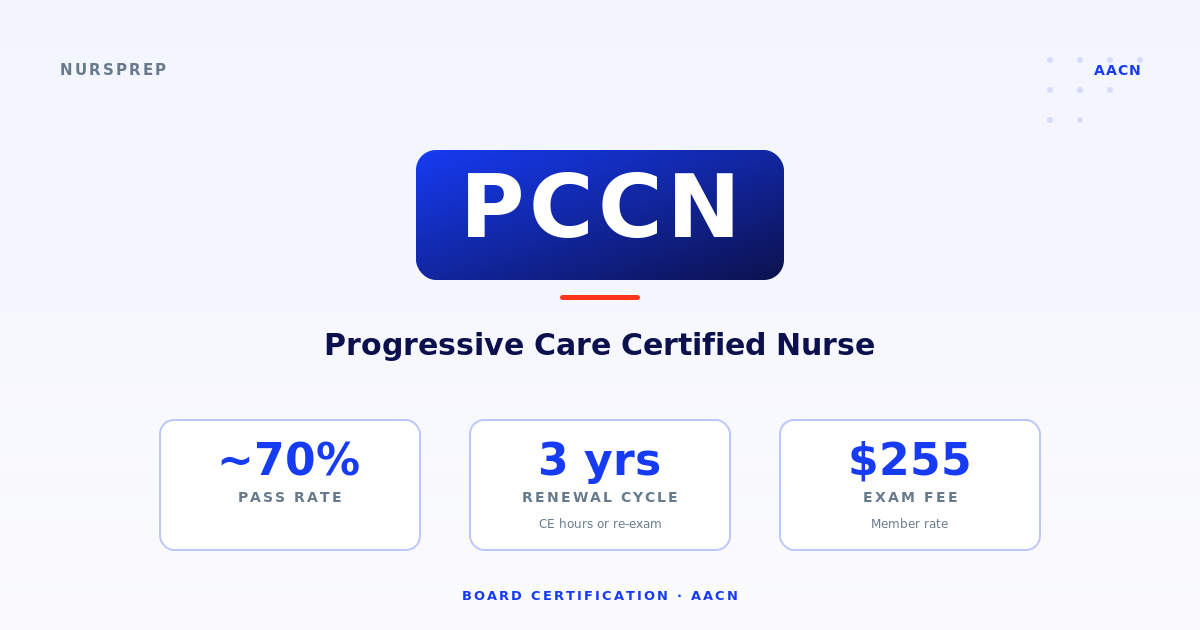
PCCN certification is valid for three years. AACN offers two renewal pathways. Pathway 1 — Renewal by Synergy CERPs: complete 432 practice hours in direct care of acutely ill adult patients during the 3-year cycle, with at least 144 hours in the 12 months before your renewal date, plus 100 total Synergy CERPs broken into categories: 60 Category A (clinical judgment), 10 Category B (professional caring/ethics), 10 Category C (clinical inquiry), and the remaining 20 in any category.
Pathway 2 — Renewal by Exam: re-sit the full PCCN exam instead of logging CERPs. This path is useful if your CE tracking has fallen behind. Synergy CERPs are AACN-approved learning credits mapped to the Synergy Model categories of patient care, professional practice, and clinical inquiry.
How hard is the PCCN exam?
The first-time pass rate has hovered between 68 and 74 percent in recent cycles. In 2023, 3,477 candidates sat the PCCN exam with a reported pass rate near 70%. Most candidates rate the PCCN as slightly easier than the CCRN because the scope is narrower — progressive care rather than full ICU complexity — while the blueprint and exam format are otherwise similar.
Candidates who follow a structured 6 to 8-week plan and complete at least one full-length timed practice exam pass at meaningfully higher rates than those relying on work experience alone. The February 2024 blueprint refresh introduced small shifts in content weights, so expect minor year-over-year movement while the revised standard beds in.
A 6-week PCCN study plan
A focused 6-week plan works for most candidates — roughly 50 to 80 total study hours across the five blueprint areas. Build study blocks around the heaviest domains, not the content you already know. Candidates returning from a long study break often need closer to 8–10 weeks.
-
1 WeekBlueprint review + diagnostic practice test
-
2 WeekCardiovascular deep dive — ACS, HF, dysrhythmias, vasoactives
-
3 WeekPulmonary + Renal — respiratory failure, ABGs, AKI, weaning
-
4 WeekEndocrine, GI, Hematology, Integumentary — DKA, GI bleed, sepsis
-
5 WeekNeurology, MSK, Multisystem, Psychosocial — stroke, delirium, EOL
-
6 WeekProfessional Caring + full-length timed practice + weak-area review
Why candidates fail the PCCN exam — and how to avoid it
Sample PCCN question
This item mirrors AACN's scenario format: a short clinical stem, an adult in a progressive care setting, and four plausibly-correct options where only one is best. Try it before you read the rationale.
The presentation suggests non-ST elevation acute coronary syndrome. Priority actions are oxygen if SpO2 is under 94%, continuous cardiac monitoring to detect evolving ischemia or arrhythmia, and rapid provider notification. Options A, C, and D delay time-sensitive ischemic care.
Key PCCN terms every candidate should know
These terms show up in vignettes throughout the exam. Review them until the definitions feel automatic — scenario-based stems often hinge on recognizing which framework or setting the question refers to.
| Term | Definition | Domain |
|---|---|---|
| PCU (Progressive Care Unit) | A hospital unit for patients who are stable but need close monitoring outside the ICU. | Setting |
| SDU (Step-Down Unit) | A transitional unit for patients stepping down from ICU before floor transfer. | Setting |
| Telemetry | Continuous remote cardiac monitoring via a portable ECG transmitter. | Cardiovascular |
| ACS | Acute Coronary Syndrome — umbrella term for unstable angina, NSTEMI, and STEMI. | Cardiovascular |
| Hemodynamic monitoring | Measurement of blood pressure and cardiac output using invasive or non-invasive tools. | Cardiovascular |
| Synergy Model | AACN framework that matches patient needs with nurse competencies. | Professional |
| CERP | Continuing Education Recognition Point — the currency AACN uses for renewal. | Professional |
| Clinical Judgment | The nurse's ability to recognize, interpret, and respond to patient cues. | Professional |
| Weaning readiness | Criteria indicating a patient can be liberated from mechanical ventilation. | Pulmonary |
| Delirium | Acute, fluctuating disturbance in attention and cognition common in hospitalized adults. | Neurology |
| DKA | Diabetic Ketoacidosis — hyperglycemic emergency marked by anion-gap acidosis and ketonemia. | Endocrine |
| PSI | The testing vendor that delivers the PCCN exam at its centers and via online proctoring. | Logistics |
| PCCN-K | Knowledge professional variant for nurses who influence but do not deliver direct care. | Credential |
| Non-invasive ventilation | CPAP or BiPAP delivered via mask to support respiratory failure without intubation. | Pulmonary |
| AKI | Acute Kidney Injury — rapid decline in renal function, staged by creatinine rise and urine output. | Renal |
PCCN vs. CCRN: what is the difference?
PCCN and CCRN are both AACN Certification Corporation credentials, but they recognize different patient populations. Choose the one that matches your unit. If you split time between ICU and step-down, pick the credential that matches where you spend the majority of your direct care hours.
| Credential | Body | Scope | Best fit |
|---|---|---|---|
| PCCN | AACN | Acutely ill adults in progressive care | PCU, step-down, telemetry, IMCU, DOU RNs |
| CCRN (Adult) | AACN | Critically ill adults in ICU | ICU, CVICU, MICU, SICU, TICU RNs |
| PCCN-K | AACN | Progressive care knowledge professional | Educators, managers, directors, faculty |
| CCRN-K | AACN | Critical care knowledge professional | ICU educators, managers, directors |
| TCRN | BCEN | Trauma nursing across the full continuum | Trauma-touching RNs |
| CMC (subspecialty) | AACN | Cardiac medicine subspecialty | Cardiac PCCN or CCRN holders |
Take PCCN if your direct care hours live in progressive care, step-down, telemetry, or IMCU. Take CCRN if you work in a true ICU. Nurses who later move to ICU can sit the CCRN once they meet its hour requirement — PCCN is a clean stepping stone because the Synergy Model, exam format, and fee structure are identical. Add CMC as a subspecialty if your unit focuses on cardiac medicine.
Frequently asked questions about PCCN certification
Most candidates rate the PCCN as slightly easier than the CCRN. The scope is narrower because PCCN focuses on progressive care rather than full ICU complexity. The blueprint and exam format are otherwise similar.
Plan for 6 to 8 weeks of focused preparation, or roughly 50 to 80 total study hours. Candidates returning from a long study break often need closer to 10 weeks.
The first-time pass rate has hovered between 68 and 74 percent in recent years. In 2023, 3,477 candidates took the PCCN exam with a reported pass rate near 70 percent.
Yes. AACN offers live-remote online proctoring through PSI. You need a quiet, private room, a webcam, a reliable internet connection, and a valid photo ID.
You can retake the exam after a 45-day waiting period. You pay a retake fee of $180 for AACN members or $260 for non-members. Most candidates focus their re-study on the body systems where they scored below target.
For most bedside nurses, yes. The $255–$370 exam fee is typically recouped within a year through clinical ladder bonuses or certification differentials, plus the credential strengthens your application for cardiac stepdown, IMCU, and ICU-track positions.
You need a current, unencumbered US RN or APRN license plus 1,750 bedside hours in the last 2 years (875 in the most recent year), or 2,000 hours in the last 5 years (144 in the most recent year).
PCCN certification is valid for 3 years. You renew through 100 Synergy CERPs plus 432 practice hours, or by retaking the full PCCN exam.
PCCN is for nurses who deliver direct bedside care to acutely ill adult patients. PCCN-K (Knowledge Professional) is for nurses who influence progressive care but do not provide direct bedside care — educators, unit managers, directors, academic faculty, and nursing administrators.
The PCCN does not directly count toward the CCRN, but it shares the Synergy Model foundation. Many progressive care nurses use the PCCN as a stepping stone and sit for the CCRN once they accumulate the required ICU hours.
Trusted sources
All figures on this page are verified against the following primary sources. Fees, blueprint weights, and recertification rules shift on AACN's revision cycle — always verify numeric facts against the current PCCN Exam Handbook before relying on them for application decisions.
- AACN Certification Corporation — PCCN Exam Handbook (April 2026) and Feb 6, 2024 revised content outline
- AACN Newsroom — Revised PCCN Exam Launch announcement (2024-02-06)
- American Association of Critical-Care Nurses — Synergy Model, practice standards, CERP category guidelines
- PSI Test Centers (psionline.com) — exam scheduling, test-day policy, online proctoring requirements
- AACN Core Curriculum for Progressive Care Nursing and AACN Review Manual for Progressive Care Nursing
- US Bureau of Labor Statistics (BLS) — Occupational Employment and Wage Statistics, Registered Nurses (May 2024): $93,600 median RN wage
Ready to practice PCCN-style items?
Work through a 25-question diagnostic mapped to the February 2024 blueprint. Free to start — no card required.