AMB-BC certification at a glance
AMB-BC — Ambulatory Care Nurse Board Certified — is the RN-level board credential for nurses practicing across the ambulatory care continuum: primary care, specialty clinics, outpatient infusion, ambulatory surgery, telehealth triage, occupational health, college health, and federally qualified health centers (FQHCs). The credential is issued by the American Nurses Credentialing Center (ANCC), the credentialing arm of the American Nurses Association (ANA), and was developed with the American Academy of Ambulatory Care Nursing (AAACN). The first ANCC Ambulatory Care Nursing exam was administered in October 1999 with 92 nurses in the inaugural cohort.
AMB-BC was previously known as RN-BC. ANCC's Commission on Board Certification updated specialty acronyms to better distinguish each specialty practice, so the credential now appears as AMB-BC — the exam, eligibility, and renewal rules carried over unchanged. As of December 31, 2025, 7,956 nurses held the AMB-BC credential, with 1,209 first-time passers and 618 renewals in 2025 (ANCC 2025 Certification Data).
Am I eligible for the AMB-BC exam?
Yes — if you hold an active RN license in the United States, a US territory, or the professional legally recognized equivalent in another country, and you meet ANCC's three additional rules. Unlike credentials where hours are recommended but not enforced, ANCC enforces these as hard application gates — applicants who fall short must accumulate the hours and CE before applying.
The four eligibility rules are: (1) active RN license, (2) the equivalent of 2 years full-time RN practice, (3) a minimum of 2,000 hours of clinical practice in ambulatory care nursing within the last 3 years, and (4) 30 hours of continuing education in ambulatory care nursing within the last 3 years. ANCC accepts educators, administrators, and other non-bedside roles if the role aligns with the Test Content Outline — if your role fits the TCO, apply and let ANCC evaluate your documentation.
You are a strong candidate if…
- You staff an outpatient primary-care or specialty clinic and own the full visit — rooming, assessment, point-of-care testing, patient education, telephone triage, and care-plan follow-up.
- You work in a federally qualified health center (FQHC), community clinic, college health, occupational health, or rural health clinic where ambulatory RN practice spans triage, teaching, and care coordination.
- Your role includes telephone or video triage, secure-message triage, or ambulatory care coordination — AMB-BC's blueprint folds telehealth into the Assess and Evaluate domain.
- You provide ambulatory infusion, ambulatory surgical preop/postop care, or outpatient procedural nursing where day-of-visit assessment, education, and clinical-tasks competence drive your day.
- Your last three years of timesheets show at least 2,000 ambulatory practice hours and your CE transcript holds 30 hours of ambulatory care, telehealth, or care-coordination content — clinical inpatient med-surg CE does not count toward this gate.
AMB-BC exam blueprint — four domains (current TCO)
ANCC's current Test Content Outline splits 100% of scored content across four domains. Assess and Evaluate is the heaviest domain at 40% — half of the 125 scored items live in assessment, triage (in-person, virtual, telehealth), medication management, and clinical data interpretation. Professional Role carries 22%, Education 19%, and Plan and Implement 18%. Together that footprint rewards bedside ambulatory experience plus comfort with scope-of-practice, fiscal-health, and patient-education content.
- Assess and Evaluate (assessment, triage, medication management, clinical data interpretation) 40%
- Plan and Implement (care coordination, disease-specific interventions, clinical tasks) 18%
- Professional Role (scope and standards, professional development, fiscal health, advocacy, leadership, safety) 22%
- Education (modes of delivery, diverse populations, communication barriers, professional communication) 19%
Effective September 11, 2026 ANCC publishes a new TCO. The new outline keeps the 150-item / 125-scored / 25-pretest structure and the four-domain footprint, but renames the domains (Assessment and Diagnosis · Planning and Implementation · Evaluation and Modification · Patient and Community Education) and shifts weights: Assess and Evaluate to 41%, Plan and Implement to 16%, Professional Role to 24%, Education unchanged at 19%. Candidates testing on or after September 11, 2026 should study against the new TCO; candidates testing on or before August 27, 2026 should use the current outline. ANCC suspends scheduling Aug 28 – Sep 10, 2026 to swap the exam.
Cost, scheduling, and the 2026 TCO change
ANCC delivers AMB-BC through Prometric computer-based testing centers year-round, with a 120-day window to schedule after ANCC issues your Authorization to Test. Apply online through the ANCC certification portal, then schedule directly with Prometric using your certification number. The exam is 3 hours for 150 items (125 scored + 25 pretest), and ANCC reports pass/fail with diagnostic feedback for each content area; third-party prep vendors describe a scaled score of 350 on a 0–500 scale as the passing mark.
| Fee item | Cost (USD) |
|---|---|
| Initial certification — ANA member | $295 |
| Initial certification — AAACN member | $295 |
| Initial certification — non-member | $395 |
| Retake fee (no discounts apply) | $270 |
| Renewal — ANA member | as low as $250 |
| Renewal — AAACN member | $295 |
| Renewal — non-member | $350 |
| Test format | 150 items, 3-hour Prometric session |
Renewal
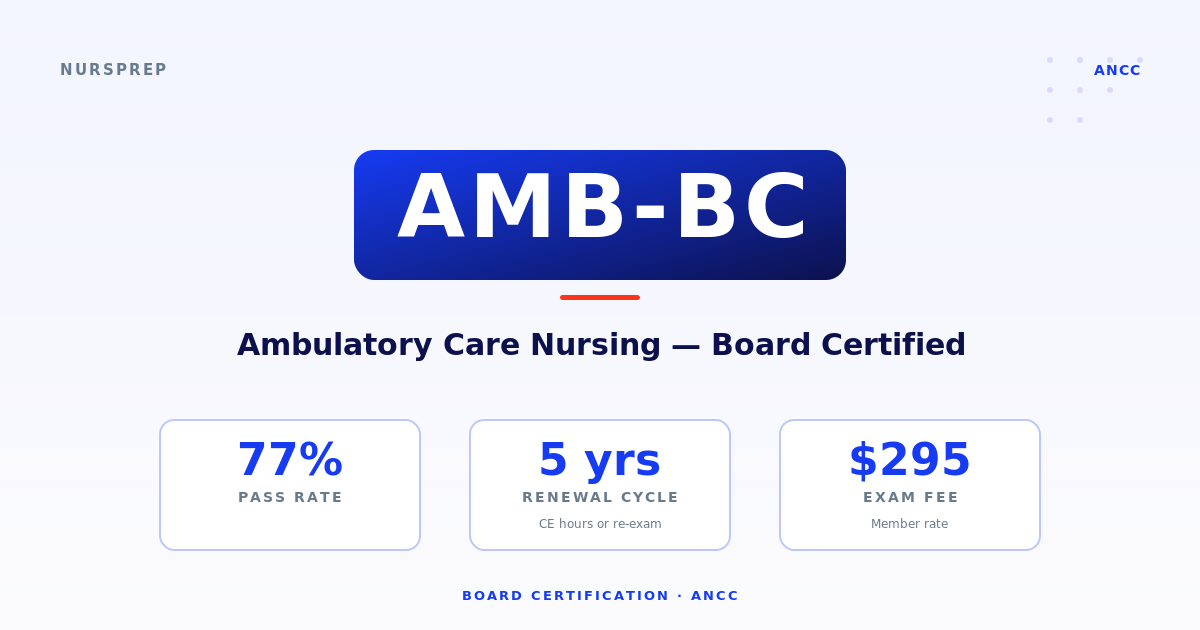
AMB-BC certification is valid for five years. ANCC offers two renewal pathways. Option A — Professional Development plus Practice Hours: hold a current active RN license + current ANCC certification, complete the certification specialty's professional development requirements within the 5-year cycle, document 1,000 practice hours in the certification role and specialty within the 5-year cycle, and pay the renewal fee. Option B — Professional Development plus Testing: same prerequisites minus the practice-hours requirement, but the candidate must pass the current AMB-BC exam.
Renewal applications may be submitted up to 12 months prior to the certification expiration date. Failing the renewal exam under Option B invalidates the certification. Track professional development through the ANCC online account before starting the renewal application — stored activities transfer directly to the online renewal form.
How hard is the AMB-BC exam?
ANCC reported that 1,209 of 1,562 first-time test takers passed the AMB-BC exam in 2025 — a 77% pass rate (ANCC 2025 Certification Data, page 2). That is consistent with the credential's historical pattern: AAACN's published fact sheet reported a 76% pass rate in 2016, when 3,268 nurses held the credential. By the end of 2025 the active certificant base had grown to 7,956 — a steady, mid-single-digit annual growth pattern reflecting ambulatory care's expanding share of US nursing practice.
Candidates who fall short of 77% most often do so by under-studying Professional Role (22%) and Education (19%) — domains that feel administrative compared with hands-on assessment but together carry over 40% of the scored items. ANCC reports pass/fail with diagnostic feedback by content area; if you fail, the diagnostic report tells you which domain to rebuild before retesting after the mandatory 60-day wait.
A 10-week AMB-BC study plan
A structured 10-week plan suits most working ambulatory RNs — about 80 to 110 total study hours across the four blueprint domains. Practice-question volume ramps through weeks 2–8 and peaks in week 9 with a full-length timed 150-item exam under real conditions; week 10 is for targeted review of weak domains, logistics, and a rest day. Aim for 400 to 700 practice items total before test day, anchored on the AAACN Core Curriculum, the ANCC Sample Test Questions, and the AAACN Review Course materials.
-
1 WeekRead ANCC's current AMB-BC Test Content Outline + Reference List + baseline diagnostic exam
-
2 WeekAssess and Evaluate I — disease process, medication management, preventative care, expected outcomes
-
3 WeekAssess and Evaluate II — triage (in-person, virtual, telehealth), physical/psychosocial assessment, clinical data interpretation
-
4 WeekPlan and Implement — care coordination, disease-specific interventions, clinical tasks (POCT, wound care, procedures)
-
5 WeekProfessional Role I — ANA + AAACN Scope and Standards, scope-of-practice, professional development
-
6 WeekProfessional Role II — fiscal health (reimbursement, billable services, prior auth), leadership, safety and security
-
7 WeekEducation — modes of delivery, diverse populations, health literacy, communication barriers, teach-back
-
8 WeekTelehealth deep dive + AAACN Core Curriculum review chapters + targeted weak-domain drills
-
9 WeekFull-length timed practice exam (150 items in 3 hours) + error-log review
-
10 WeekTargeted review of weak domains, rest day, logistics, test day
How AMB-BC candidates actually fail — and how to avoid it
Sample AMB-BC question
This item mirrors the ANCC AMB-BC format: a short ambulatory clinical stem with four plausibly-correct options where only one is best. Telephone triage sits inside the Assess and Evaluate domain — the largest scored block on the test — so triage-style stems are high-yield practice.
The presentation — pressure-like chest discomfort lasting more than 30 minutes, unresolved with rest, in a 58-year-old with diabetes and hypertension — meets the ambulatory triage red-flag criteria for acute coronary syndrome. The RN's correct action is to activate EMS (911), keep the caller on the line, and instruct the patient to chew an adult-strength aspirin if no contraindication. Driving the patient or routing him to clinic delays definitive care and exposes him to arrest in transit. Borrowing a family member's nitroglycerin is not safe practice. The AMB-BC blueprint places telephone triage inside domain I (Assess and Evaluate) — items frequently test the difference between a same-day clinic appointment and a 911 activation.
Key AMB-BC terms every candidate should know
These terms surface in most AMB-BC exam items. Review them until the definitions feel automatic — scenario stems hinge on whether the candidate can name which framework applies (telephone triage red flags, motivational interviewing, teach-back, scope-of-practice delegation rules, population health management).
| Term | Definition | Domain |
|---|---|---|
| Ambulatory care nursing | RN practice in outpatient settings — primary care, specialty clinics, ambulatory surgery, outpatient infusion, urgent care, FQHCs, occupational health, college health, and telehealth — characterized by brief visits, high patient volume, and a focus on prevention, education, and care coordination. | Foundations |
| Telephone triage | Structured nursing decision-making conducted by phone (or virtual platform) to determine the urgency of a patient's complaint and the appropriate disposition: 911, ED, same-day clinic, scheduled appointment, or self-care advice. Sits inside domain I (Assess and Evaluate). | Assess and Evaluate |
| Care coordination | Deliberate organization of patient-care activities across providers, settings, and time to facilitate appropriate delivery of health-care services — including referrals, prior authorization, transitions of care, and population-management workflows. Sits inside domain II (Plan and Implement). | Plan and Implement |
| Motivational interviewing | Patient-centered counseling technique that elicits the patient's own reasons for behavior change — used in ambulatory smoking cessation, weight management, medication adherence, and chronic-disease self-management coaching. | Education |
| Teach-back method | Patient-education technique in which the RN asks the patient to repeat instructions in their own words to confirm understanding — closes the loop on health-literacy gaps without making the patient feel tested. | Education |
| ANA + AAACN Scope and Standards | Two foundational documents that define ambulatory care RN scope and standards of practice. ANA's Scope and Standards sets the profession-wide baseline; AAACN's Scope and Standards adds ambulatory-specific competencies. Both are core ANCC reference texts. | Professional Role |
| Population health management | Proactive, data-driven approach to managing the health outcomes of a defined panel of patients — registry-based outreach, gap-closure campaigns, chronic-disease cohort monitoring, and quality-metric tracking (HEDIS, CMS Star Ratings). | Plan and Implement |
| Prior authorization | Payer requirement that a clinical service, medication, or imaging study receive insurer approval before the service is rendered or reimbursed. Ambulatory RNs frequently coordinate PAs, which sits inside Professional Role > fiscal health. | Professional Role |
| Patient-generated health data (PGHD) | Health data created, recorded, or gathered by patients (or their caregivers) — including home blood pressures, glucose logs, wearable data, and patient-reported outcomes — surfaced into the EHR for ambulatory clinical decision-making. Named in the 2026 TCO. | Assess and Evaluate |
| Patient-Centered Medical Home (PCMH) | Care-delivery model in which a primary-care team coordinates a patient's care across the health system; NCQA-recognized PCMH practices employ ambulatory RNs in care-coordination, transitions, and population-management roles. | Plan and Implement |
AMB-BC vs. RN-BC, CCTM, MEDSURG-BC, Telehealth, FNP-BC
AMB-BC sits inside ANCC's RN specialty credential family. Several adjacent credentials confuse candidates, especially the legacy RN-BC acronym and the CCTM care-coordination credential. The distinction matters before paying the application fee.
| Credential | Body | Scope | Best fit |
|---|---|---|---|
| AMB-BC | ANCC | Ambulatory care nursing across outpatient settings — primary care, specialty clinics, telehealth, FQHCs | RNs with 2 yrs experience + 2,000 ambulatory hours + 30 ambulatory CE in last 3 yrs |
| RN-BC (Ambulatory Care) | ANCC | Same credential as AMB-BC — legacy acronym before ANCC's 2018 specialty-acronym update | Older holders; new candidates earn the AMB-BC acronym |
| CCTM (Care Coordination & Transition Management) | ANCC (renewal only) | Care-coordination and transitions specialty — adjacent to AMB-BC but narrower in scope | Renewal only — no new candidates can sit the exam |
| Telehealth Nursing Certification | NCC (AAACN-aligned) | Telephone triage and telehealth nursing | RNs focused exclusively on telehealth; AMB-BC covers telehealth within a broader scope |
| MEDSURG-BC | ANCC | Inpatient medical-surgical nursing — the broadest US nursing specialty | Acute-care inpatient RNs; the inpatient counterpart of AMB-BC's outpatient focus |
| FNP-BC | ANCC | Family Nurse Practitioner — APRN level with prescriptive authority | Master's-prepared APRNs, not RN-level staff nurses |
Take AMB-BC if you practice across ambulatory settings — primary care, specialty clinics, telehealth triage, ambulatory infusion, ambulatory surgery, FQHCs, occupational or college health — and you can document 2,000 ambulatory practice hours in the last 3 years. Take Telehealth Nursing Certification instead if 100% of your role is phone or video triage. CCTM is closed to new candidates. MEDSURG-BC is the inpatient credential for hospital med-surg units. FNP-BC is the APRN credential — a separate, master's-level career step. Older nurses holding RN-BC (Ambulatory Care) already hold the same credential under its legacy acronym.
Frequently asked questions about AMB-BC certification
AMB-BC stands for Ambulatory Care Nurse — Board Certified. The credential is issued by the American Nurses Credentialing Center (ANCC) in partnership with the American Academy of Ambulatory Care Nursing (AAACN) and validates RN-level expertise in ambulatory care nursing practice across outpatient clinic, primary care, specialty, telehealth, and FQHC settings.
Yes. AMB-BC and the legacy RN-BC (Ambulatory Care) acronym refer to the same ANCC credential. ANCC's Commission on Board Certification updated specialty acronyms to better distinguish each specialty, so the credential is now called AMB-BC. Older holders may still display RN-BC on legacy materials; new candidates earn the AMB-BC acronym. Eligibility, the exam, fees, and the 5-year renewal cycle did not change.
ANCC — the American Nurses Credentialing Center — issues the AMB-BC credential. ANCC is the credentialing affiliate of the American Nurses Association (ANA). The credential was developed in partnership with the American Academy of Ambulatory Care Nursing (AAACN) and was first administered in October 1999. AMB-BC is accredited by the Accreditation Board for Specialty Nursing Certification (ABSNC).
Candidates need a current active RN license in a US state, US territory, or the legally recognized equivalent in another country; the equivalent of 2 years full-time RN practice; a minimum of 2,000 hours of clinical practice in ambulatory care nursing within the last 3 years; and 30 hours of continuing education in ambulatory care nursing within the last 3 years. Educators and administrators whose roles align with the Test Content Outline are also eligible.
ANCC charges $295 for ANA members, $295 for AAACN members, and $395 for non-members. The retake fee is $270 flat (no discounts apply). Renewal fees are $250 (ANA member, as low as), $295 (AAACN member), and $350 (non-member). All initial-application prices include a $140 non-refundable administrative fee.
The current ANCC Test Content Outline specifies 150 multiple-choice items in a 3-hour Prometric session: 125 scored items plus 25 pretest items that ANCC is evaluating for future use. Candidates cannot distinguish pretest from scored items, so it is important to answer every question. (Note: the legacy 2017 outline used a 175-item / 150-scored format that some older study guides still reference — both the current TCO and the new TCO effective September 11, 2026 use the 150-item format.)
ANCC's 2025 Certification Data PDF reports a 77% first-time pass rate — 1,209 of 1,562 candidates passed the AMB-BC exam in 2025. AAACN's earlier fact sheet reported a 76% pass rate in 2016 with 3,268 certificants then; by the end of 2025 the active certificant base had grown to 7,956.
ANCC offers year-round testing through Prometric. After ANCC approves your application, you receive an Authorization to Test and have a 120-day window to schedule your seat. Effective September 11, 2026 ANCC publishes a new Test Content Outline and suspends scheduling for 7 business days (August 28 – September 10, 2026) to swap the exam — you can test BEFORE August 28, 2026 or AFTER September 10, 2026, but not in between.
Yes. AMB-BC certification is valid for 5 years. ANCC offers two renewal pathways. Option A combines professional development requirements with 1,000 practice hours in the certification role within the 5-year cycle. Option B combines professional development requirements with successful retesting on the current AMB-BC exam. Renewal applications may be submitted up to 12 months prior to expiration.
You may retest after a mandatory 60 calendar-day wait from your last test date, and may not test more than three times in any 12-month period. The retake fee is $270 flat. ANCC reports pass/fail with a diagnostic content-area feedback report — use the diagnostic to identify which of the four domains to rebuild before retesting.
Trusted sources
All figures on this page are verified against the following primary sources. Fees, blueprint weights, and renewal rules shift on ANCC's revision cycle, and the AMB-BC Test Content Outline is scheduled for an update on September 11, 2026. Always verify numeric facts against the current ANCC AMB-BC product page and the active Test Content Outline before relying on them for application decisions.
- ANCC — Ambulatory Care Nursing Certification (AMB-BC) product page: eligibility, fees, Prometric scheduling, renewal options — nursingworld.org/our-certifications/ambulatory-care-nursing
- ANCC — Ambulatory Care Nursing Test Content Outline (current, effective 2021-05-01, last updated 2025-09-03): four-domain blueprint with section-level detail — nursingworld.org/globalassets/acn-tco-09032025.pdf
- ANCC — Ambulatory Care Nursing Test Content Outline (new, effective 2026-09-11): renamed domains and shifted weights — nursingworld.org/globalassets/certification/certification-specialty-pages/resources/test-content-outlines/amb-tco_08292025-for-webposting.pdf
- ANCC — 2025 Certification Data PDF: AMB-BC first-time pass rate (1,209 of 1,562 = 77%), 618 renewals, 7,956 total certified as of 12/31/2025 — nursingworld.org/globalassets/docs/ancc/ancc-cert-data-website.pdf
- ANCC — Test Score Reports & Retest Application Procedures: 60-day retest wait, 3-per-12-month cap — nursingworld.org/certification/certification-policies/scores-retest-application
- AAACN — Updated Ambulatory Care Nursing Certification Credential (RN-BC to AMB-BC rename announcement) — aaacn.org/updated-ambulatory-care-nursing-certification-credential
- AAACN — Ambulatory Care Nursing Certification Fact Sheet (PDF, includes the historical 2017 outline and the $270 retake fee) — aaacn.org/sites/default/files/Ambulatory_TCO.pdf
- ANCC — Certification General Testing and Renewal Handbook (PDF) — nursingworld.org/globalassets/certification/renewals/ancc-generaltestingrenewalrequirements.pdf
- ANCC — All Certifications catalog — nursingworld.org/our-certifications/
- US Bureau of Labor Statistics — Occupational Employment and Wage Statistics, Registered Nurses (OEWS, May 2024): national mean RN wage $98,430, median $93,600; ambulatory-care RN sub-aggregate roughly $94,480/yr — bls.gov/oes/current/oes291141.htm
Ready to practice AMB-BC-style items?
Work through a diagnostic mapped to the current four-domain ANCC blueprint, including telephone triage, care coordination, and patient-education items. Free to start — no card required.