What is CRNFA certification?
CRNFA certification is the credential that validates a registered nurse's practice in the RN first assistant role. It is awarded by the National Assistant at Surgery Certification (NASC) and is accredited by the Accreditation Board for Specialty Nursing Certification (ABSNC), which granted accreditation on 16 October 2024.
Two facts trip up most candidates. First, NASC — not CCI — owns the credential. The transfer took effect on 1 January 2019, so guidance written before then is out of date. Second, there is no CRNFA exam. NASC retired the exam at the end of 2020 and opened the CRNFA Professional Portfolio in February 2021.
RNFA and CRNFA are not the same thing. RNFA is a role; AORN defines it as a perioperative RN, or an APRN, functioning as a first assistant, and the role is recognised in the nurse practice acts of all 50 states. CRNFA is the certification that documents achievement in that role.
Am I eligible for CRNFA certification?
You are eligible if you hold a bachelor's degree or higher, current CNOR certification, an unrestricted RN licence, a certificate from an acceptable RNFA programme, and 2,000 documented hours of RNFA practice. That is the RN pathway, and every item is a hard gate.
APRNs follow a second pathway. A clinical nurse specialist, nurse practitioner, certified nurse midwife or certified registered nurse anesthetist needs a master's, doctoral or post-master's advanced-practice qualification plus national APRN certification — CNOR is not required on the APRN path — along with the same RNFA programme certificate and the same 2,000 hours.
Definition — acceptable RNFA programme: a formal RN first assistant programme that meets the AORN Standards for RN First Assistant Education Programs. AORN sets the floor at the equivalent of six semester credit hours of post-basic RN education — three didactic and three clinical — with at least 120 intraoperative first-assisting hours in the clinical component and full coverage of the Core Curriculum for the RN First Assistant, 6th edition. NASC lists 16 acceptable programmes across 13 states; if yours is not listed, contact NASC before you apply.
The hours rule has four parts that candidates routinely miss. All 2,000 hours must fall in the five years immediately before you apply. At least 500 must fall in the last two years. At least 1,000 must be first assisting during the intraoperative period. And while you are first assisting you cannot be filling any other perioperative role, so scrub time does not count.
You are a strong candidate if…
- You hold a bachelor's degree or higher in any field — the subject does not matter, but the degree does.
- Your CNOR is current, or you are nationally certified as an APRN and taking the advanced-practice route.
- You graduated from an RNFA programme on the NASC acceptable list and still have your certificate of completion.
- Your practice-hour log already carries 2,000 hours, with 500 in the last two years and 1,000 of intraoperative first assisting.
- Each log line records the date, the procedure type, the pre-, intra- and postoperative split, and the initials of the surgeon you assisted — NASC may contact your supervisor to verify it.
- You can name one complete surgical patient — preoperative through Phase 1 recovery — that you can write up in depth for the Clinical Case Study.
What does the CRNFA Professional Portfolio cover?
The portfolio is weighted across seven CRNFA Job Analysis domains, and Intraoperative Patient Care Interventions alone carries 35%. Professional Practice is second at 15%. Together with Infection Prevention and Perioperative Workplace Safety at 13% each, those four domains account for three-quarters of your score.
- Intraoperative Patient Care Interventions 35%
- Professional Practice 15%
- Infection Prevention 13%
- Perioperative Workplace Safety 13%
- Preoperative Patient Assessment 10%
- Emergency Situations 9%
- Postoperative Patient Care Interventions 5%
Those seven domains are delivered through three studies and 109 activities. The Clinical Case Study is the bulk of the work: 29 preoperative activities (27% of the portfolio), 35 intraoperative (32%) and 12 postoperative (11%). The Workplace Safety Study adds 15 activities (14%) and the Professional Practice Study adds 18 (16%).
The domain structure rests on the CRNFA Job Analysis — 104 task statements and 97 knowledge statements — first conducted by task force in September 2019 and repeated by survey in 2024. NASC has not yet published a revised domain table from the 2024 analysis, so the weights above are the current published figures. Verify them against the NASC handbook before you plan your time.
What does the CRNFA portfolio cost, and how do you renew it?
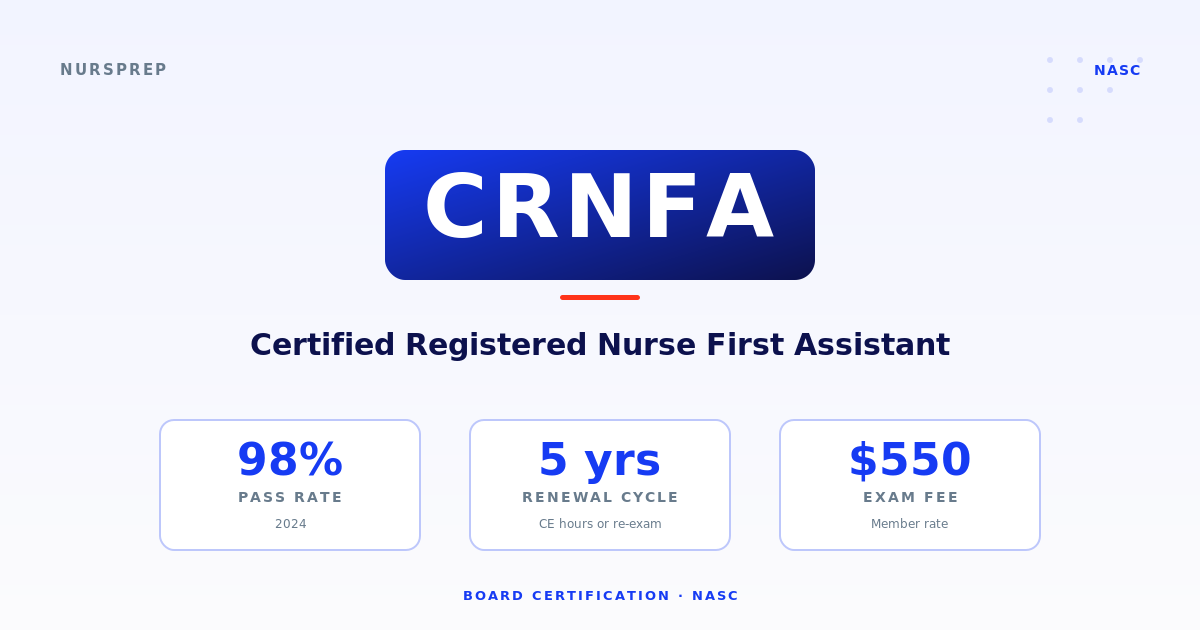
CRNFA certification costs $550 for new applicants and $275 if you currently hold NASC's RNAS-C credential. There is no member or non-member rate — NASC is not a membership body, so the only discount is the RNAS-C one.
Once NASC approves your application you pick a start date, and the clock is strict. You must start within two months of approval and submit within three months of your start date. Miss either deadline without contacting NASC and your entire fee is forfeited. A one-month extension costs $100 and you may take at most three.
Results arrive within about a month of submission. If you fail, you get one revise-and-resubmit, due within 60 days for a $100 fee, reviewed by the same evaluators. Fail the revision and you reapply, pay again, and build a new portfolio around a different patient.
| Fee item | Cost (USD) |
|---|---|
| CRNFA Professional Portfolio — new applicant | $550 |
| CRNFA Professional Portfolio — current RNAS-C certificant | $275 |
| One-month portfolio extension (max. 3) | $100 each |
| Revise and resubmit a failed portfolio | $100 |
| Recertification — early (1 Jan – 1 Jul) | $450 |
| Recertification — standard (2 Jul – 31 Dec) | $500 |
| One-year recertification extension | $100 |
| CRNFA Emeritus status (one-time) | $125 |
Renewal
CRNFA is conferred for five years. You choose one of two renewal methods, and the requirement scales with how much you practised during the five-year accrual period — not with your seniority.
Method 1 — contact hours. With 1,000 or more RNFA clinical practice hours you need 200 contact hours, of which 150 must be RNFA or perioperative related. With 500 to 1,000 practice hours the bar rises to 300 contact hours, 225 of them RNFA or perioperative related. Hours must come from accredited providers and each certificate needs an accreditation statement or provider number.
Method 2 — professional activity points. With 1,000 or more practice hours you need 400 points; with 500 to 1,000 practice hours you need 500 points. Points come from continuing education, academic study, precepting, mentoring, board and committee service, volunteering, publication and other perioperative certifications.
Two safety valves exist. A one-year extension ($100) keeps the credential active while you finish accruing, available once every 10 years. CRNFA Emeritus — CRNFA (E) ($125, one-time) is for nurses leaving the RNFA role; retiring the credential is permanent, and returning would mean a fresh portfolio.
How hard is the CRNFA portfolio to pass?
The published pass rate has climbed every year since the portfolio launched: 84% in 2021 (101 of 121), 82% in 2022 (47 of 57), 93% in 2023 (51 of 55) and 98% in 2024 (46 of 47). Only one candidate failed in 2024.
Read those numbers with the eligibility gates in mind. A CRNFA candidate has already cleared a bachelor's degree, CNOR, an AORN-standard RNFA programme and 2,000 documented hours. The screening happens before the portfolio, not during it — so the pass rate measures a pre-filtered group, and cohorts are small.
The portfolio is scored by two evaluators from a panel of active and emeritus CRNFAs, working from a detailed rubric. A third evaluator reviews if the first two disagree. The process is double-blind: evaluators do not see your identity and you do not see theirs. NASC does not publish a numeric cut score — the passing standard was set by a standard-setting committee working with a psychometrician.
A 12-week plan for the CRNFA Professional Portfolio
NASC gives you three months from your chosen start date, so plan in weeks, not months. The schedule below drafts all 109 activities in eleven weeks and leaves week 12 for a rubric-led read-through, reference checks and submission.
Front-load the Clinical Case Study. It is 76 of the 109 activities and 70% of the portfolio, and it depends on one patient you must choose early — pick a case with genuine preoperative, intraoperative and postoperative complexity, because a routine case gives you little to write about.
Work in Microsoft Word throughout. NASC supplies the templates as Word documents and requires Word files back, so drafting in Pages or Google Docs adds a conversion step at the deadline.
-
1 WeekRead the NASC handbook; confirm eligibility; gather Core Curriculum 6th ed. and AORN Guidelines
-
2 WeekSelect and de-identify the Clinical Case Study patient; map the case to the seven domains
-
3 WeekCase Study preoperative — focused assessment, history and physical, plan of care
-
4 WeekCase Study preoperative — patient education, Universal Protocol, team communication
-
5 WeekCase Study preoperative — finish and self-score all 29 preoperative activities
-
6 WeekCase Study intraoperative — exposure, tissue handling, cutting, hemostasis, suturing
-
7 WeekCase Study intraoperative — instruments and devices, wound management, positioning
-
8 WeekCase Study intraoperative — emergency situations and infection prevention within the case
-
9 WeekCase Study postoperative — PACU handover, postoperative orders, drains, discharge planning
-
10 WeekWorkplace Safety Study — sharps, smoke evacuation, radiation, ergonomics, hazardous agents
-
11 WeekProfessional Practice Study — scope, ethics, evidence-based practice, advocacy, accountability
-
12 WeekFull read-through against the rubric; verify every citation; Word formatting; submit
Where CRNFA candidates lose ground — and how to avoid it
What does CRNFA-level clinical reasoning look like?
CRNFA has no exam, so NASC publishes no official items. The self-check below was written by NursPrep to mirror the intraoperative judgement the Clinical Case Study asks you to justify in writing — the kind of decision you will have to defend with a cited rationale, not just make at the field.
Try it, then read the rationale and notice its structure: the action, the reason the alternatives are inferior, and the standard behind the choice. That is the shape a portfolio answer needs.
Hemostasis starts with visualisation. Clearing the pooled blood lets you find the source and apply pressure or a clamp to that specific vessel, which stops the loss without injuring surrounding tissue. Blind lap-sponge packing may slow the bleeding but leaves the source unidentified and can resume the moment pressure comes off. Sweeping electrosurgical activation across an obscured, wet field is unreliable and risks thermal injury to bowel and mesenteric vessels. The surgical count is a patient-safety process for preventing retained surgical items; it is not suspended for a bleed you can control, and any interruption to it must be documented.
Key CRNFA and RNFA terms every candidate should know
These terms appear across the NASC handbook, the AORN education standards and the portfolio itself. Several are routinely confused with one another — RNFA against CRNFA, and CRNFA against RNAS-C most of all.
| Term | Definition | Domain |
|---|---|---|
| RNFA | Registered Nurse First Assistant — a role, not a credential. A perioperative RN, or an APRN, functioning as first assistant during operative and invasive procedures. Recognised in the nurse practice acts of all 50 states. | Role |
| CRNFA | Certified Registered Nurse First Assistant — the NASC certification that documents professional achievement in the RNFA role. Earned by portfolio, not by exam. | Credential |
| NASC | National Assistant at Surgery Certification — the body that has awarded CRNFA since 1 January 2019, when the credential transferred from CCI. Also awards RNAS-C. | Credential |
| RNAS-C | Registered Nurse Assistant at Surgery — Certified. NASC's exam-based first-assisting credential: 150 items in 3 hours, 70% to pass, 120 intraoperative hours, no degree requirement. | Credential |
| CNOR | Certified Perioperative Nurse, awarded by CCI. A prerequisite for CRNFA on the RN pathway and an admission requirement for AORN-standard RNFA programmes. | Credential |
| ABSNC | Accreditation Board for Specialty Nursing Certification — the accrediting body for nursing certification programmes and the only one that accredits portfolio-based credentials. Accredited CRNFA in October 2024. | Credential |
| CRNFA Professional Portfolio | The assessment that replaced the CRNFA exam. 109 activities across three studies, submitted in Microsoft Word within three months of your chosen start date. | Portfolio |
| Clinical Case Study | The largest of the three portfolio studies — 76 activities and 70% of the portfolio — built around one surgical patient followed from preoperative assessment through Phase 1 recovery. | Portfolio |
| Intraoperative first-assisting hours | AORN defines these as the time from incision until the dressing is applied. At least 1,000 of your 2,000 CRNFA hours must be first assisting in the intraoperative period. | Eligibility |
| Acceptable RNFA programme | A formal RNFA programme meeting AORN standards — six semester credit hours minimum, at least 120 intraoperative first-assisting hours, full Core Curriculum coverage. NASC lists 16 across 13 states. | Eligibility |
| Core Curriculum for the RN First Assistant | The AORN text, now in its 6th edition (2025), that every RNFA education programme must cover and that NASC recommends as a portfolio reference. | Eligibility |
| Accrual period | The five-year window in which you must earn your recertification contact hours or points and your practice hours. It ends the year before your recertification year. | Renewal |
| Recertification year | The calendar year your certification expires, during which you may submit your recertification application at any point. Applying by 1 July saves $50. | Renewal |
| Professional activity points | The alternative to contact hours for renewal — 400 points with 1,000+ practice hours, 500 points below that. Earned through CE, academic study, precepting, service, volunteering and publication. | Renewal |
| CRNFA Emeritus — CRNFA (E) | A permanent retired designation ($125 one-time) for CRNFAs leaving the RNFA role. It cannot be reactivated; returning would require a new portfolio. | Renewal |
CRNFA vs. RNAS-C, CNOR and the other CCI credentials
CRNFA is the senior first-assisting credential for nurses, but it is not the only route and it is not the right first step for everyone. The closest comparison is NASC's own RNAS-C, which covers the same role with a lower entry bar and an exam instead of a portfolio.
The rest of the table is CCI's perioperative ladder. CNOR is the prerequisite that connects the two organisations — you cannot take the CRNFA RN pathway without it.
| Credential | Body | Scope | Best fit |
|---|---|---|---|
| CRNFA | NASC | RN first assisting — portfolio-assessed, 2,000 hours | Experienced RNFAs with a bachelor's degree and current CNOR |
| RNAS-C | NASC | RN first assisting — 150-item exam, 120 intraoperative hours | RNFAs earlier in the role, or without a bachelor's degree |
| CNOR | CCI | Perioperative RN practice across the surgical journey | OR staff RNs — and anyone heading for CRNFA |
| CFPN | CCI | Foundational entry-level perioperative practice | New OR RNs who do not yet meet CNOR's experience bar |
| CNAMB | CCI | Ambulatory perioperative practice — ASC-specific | RNs working exclusively in ambulatory surgery centres |
| CSSL | CCI | Surgical services leadership (formerly CSSM) | OR managers and directors moving into formal leadership |
The usual ladder is CFPN → CNOR → RNAS-C → CRNFA. Take RNAS-C first if you are newer to first assisting, have 120 intraoperative hours rather than 2,000, or do not hold a bachelor's degree — and note that holding RNAS-C later cuts the CRNFA fee from $550 to $275. Go straight to CRNFA if you already have the degree, the CNOR and the hours. Choose CSSL instead if your next move is management rather than the field.
Frequently asked questions about CRNFA certification
NASC, the National Assistant at Surgery Certification, awards CRNFA. The credential transferred from the Competency & Credentialing Institute (CCI) on 1 January 2019, so any guidance naming CCI as the awarding body is out of date.
No. NASC discontinued the CRNFA exam at the end of 2020. Certification is earned by completing the CRNFA Professional Portfolio, which opened for applications in February 2021.
RNFA is the role — a perioperative RN or APRN who first assists at surgery. CRNFA is the certification that validates practice in that role. You work as an RNFA first, then certify as a CRNFA.
On the RN pathway, yes — current CNOR certification is required. APRNs follow a separate pathway that requires national APRN certification instead of CNOR.
2,000 documented RNFA hours. All must fall within the five years before you apply, at least 500 within the last two years, and at least 1,000 must be first assisting during the intraoperative period.
$550 for new applicants, or $275 if you currently hold NASC's RNAS-C credential. There is no member or non-member pricing. Recertification costs $450 before 1 July and $500 after.
NASC reported a 98% pass rate in 2024 (46 of 47 candidates), up from 93% in 2023, 82% in 2022 and 84% in 2021. Cohorts are small, and candidates are already filtered by strict eligibility gates.
You must select a start date within two months of your application being approved, then submit within three months of that start date. One-month extensions cost $100 each, up to three.
You get one chance to revise and resubmit within 60 days for a $100 fee, reviewed by the same evaluators. If the revision does not pass, you reapply, pay the full fee again, and build a new portfolio around a different patient.
Five years. Renew by contact hours (200 or 300, depending on your practice hours) or by professional activity points (400 or 500). A one-year extension is available once every 10 years for $100.
No. CCI stopped honouring dual CNOR/CRNFA certification on 18 September 2023. You now meet and submit each credential's requirements separately and pay both CCI and NASC.
Take RNAS-C if you have 120 intraoperative first-assisting hours, no bachelor's degree, or prefer an exam — it costs $425 and is 150 items over 3 hours. Take CRNFA once you have the degree, CNOR and 2,000 hours. Holding RNAS-C reduces the CRNFA fee to $275.
Trusted sources for CRNFA requirements
Every figure on this page comes from the primary sources below. Fees, portfolio structure and recertification rules change on NASC's revision cycle, and the current candidate handbook carries no visible revision date — verify numeric facts against NASC directly before you apply or pay.
- NASC — CRNFA Application and Candidate Handbook (RN and APRN eligibility, fees, practice-hour rules): https://nascertification.com/crnfa/application-and-candidate-handbook/
- NASC — CRNFA Certification/Recertification Candidate Handbook (PDF; job-analysis domains, portfolio content outline, deadlines, evaluation, failure pathway): https://nascertification.com/wp-content/uploads/2022/03/CRNFA-Certification_Recertification-Candidate-Handbook.pdf
- NASC — About the CRNFA Professional Portfolio (three studies, development, double-blind evaluation): https://nascertification.com/crnfa/about-the-crnfa-professional-portfolio/
- NASC — CRNFA Statistics (2021–2024 pass rates and certificant counts): https://nascertification.com/crnfa/crnfa-statistics/
- NASC — CRNFA Recertification (five-year cycle, contact hours and points, fees, extension, emeritus, 10% audit): https://nascertification.com/crnfa/recertification/
- NASC — FAQs (CRNFA exam discontinued end of 2020; CNOR/CRNFA dual certification ended 18 September 2023): https://nascertification.com/resources/faqs/
- NASC — Acceptable RNFA Programs (16 programmes across 13 states): https://nascertification.com/resources/acceptable-rnfa-programs/
- NASC — CRNFA Achieves ABSNC Accreditation, 16 October 2024: https://nascertification.com/news/crnfa-achieves-absnc-accreditation/
- NASC — About the RNAS-C Exam (150 items, 3 hours, 70% pass, Prolydian): https://nascertification.com/rnas-c/about-the-rnas-c-exam/
- AORN — RN First Assistant Resources (CCI-to-NASC transfer effective 1 January 2019; RNFA role definition): https://www.aorn.org/guidelines-resources/clinical-resources/rn-first-assistant-resources
- AORN — Standards for RN First Assistant Education Programs 2025–2026 (PDF; six semester credit hours, 120 intraoperative first-assisting hours, CNOR admission requirement): https://www.aorn.org/docs/default-source/guidelines-resources/rnfa-education-standards_2025-2026.pdf
- CCI — CNOR certification (the prerequisite credential): https://www.cc-institute.org/certify/cnor/
- CCI — Credential Statistics (confirms CRNFA is no longer a CCI credential; CNOR 2025 first-time pass rate 68.0%): https://www.cc-institute.org/credentials/credential-statistics/
Ready to plan your CRNFA portfolio?
Start with a 25-question diagnostic mapped to the seven CRNFA job-analysis domains — heaviest on intraoperative interventions, professional practice and infection prevention. Free to start, no card required.