NI-BC certification at a glance
NI-BC — Nursing Informatics-Board Certified — is the nursing-side benchmark for informatics practice across the health-IT lifecycle. The credential is issued by the American Nurses Credentialing Center (ANCC), the certification arm of the American Nurses Association. ANCC first offered an informatics nursing certification in 1995; by the end of 2025, 3,536 nurses held the active credential.
The single most common point of confusion: this credential was renamed. Until 2023 it carried the designation RN-BC (Registered Nurse-Board Certified). ANCC updated it to NI-BC in 2023 to distinguish nursing informatics from other RN-BC specialties — so RN-BC informatics holders carry the same credential under the old name. NI-BC is a board certification, not a course.
Am I eligible for the NI-BC exam?
NI-BC has a real eligibility gate — unlike some board certifications, ANCC enforces both an education floor and a practice-hour requirement. You must hold an active, unrestricted RN license in a US state or territory (or the legally recognized equivalent abroad), a bachelor's or higher degree in nursing, the equivalent of two years full-time RN practice, and 30 hours of continuing education in informatics nursing within the last three years.
On top of that, you must satisfy one of three practice-hour options. Most candidates qualify through Option 1 — logged informatics hours on the job. The graduate-coursework and graduate-practicum routes exist for nurses moving into informatics through formal education rather than accumulated work hours.
You meet the eligibility gate if…
- You hold an active RN license and a BSN (or higher nursing degree), with at least two years of full-time-equivalent RN practice behind you.
- You have completed 30 contact hours of informatics-nursing continuing education within the last three years.
- Option 1: you have practiced a minimum of 2,000 hours in informatics nursing within the last three years.
- Option 2: you have practiced a minimum of 1,000 informatics hours in the last three years AND completed 12 semester hours of graduate-level informatics nursing coursework.
- Option 3: you have completed a graduate program in informatics nursing that included at least 200 hours of faculty-supervised informatics practicum.
NI-BC exam blueprint — three domains (effective 2023-05-03)
The NI-BC blueprint is three weighted domains across 125 scored items. Foundations of Practice and System Design Lifecycle together carry about 71% of the exam — most of your study time should live there.
- Foundations of Practice 36%
- System Design Lifecycle 35%
- Data Management and Healthcare Technology 29%
Do not assume your day-job tooling covers the blueprint. Candidates who work deep in one EHR module tend to under-prepare for the standards, regulations (HIPAA, HITECH, 21st Century Cures), and full system-development-lifecycle content that the exam tests broadly.
Cost, scheduling, and membership discounts
ANCC delivers the NI-BC exam year-round through Prometric test centers. After ANCC approves your application, you receive an Authorization to Test and schedule within a 120-day testing window — book your Prometric seat early. All fees below include a $140 non-refundable administrative fee.
| Fee item | Cost (USD) |
|---|---|
| Initial application — non-member | $395 |
| Initial application — ANA member | $295 |
| Initial application — ANIA member | $340 |
| Renewal — non-member | $350 |
| Renewal — ANA member (as low as) | $250 |
| Renewal — ANIA member | $295 |
| Non-refundable administrative fee (included above) | $140 |
| ANA annual membership (reduces exam fee) | Varies by state |
Renewal
NI-BC certification is valid for five years. You renew by maintaining your RN license and completing ANCC's professional-development requirements during the certification period, then reporting them on the renewal application. ANCC accepts renewal applications up to one year before your expiration date.
ANCC's renewal categories combine continuing education with options such as academic credit, presentations, publications, preceptorship, and professional service. Track every activity in your ANCC account as you complete it — the online renewal pulls directly from those stored records, which is far easier than reconstructing five years of CE at the deadline.
How hard is the NI-BC exam?
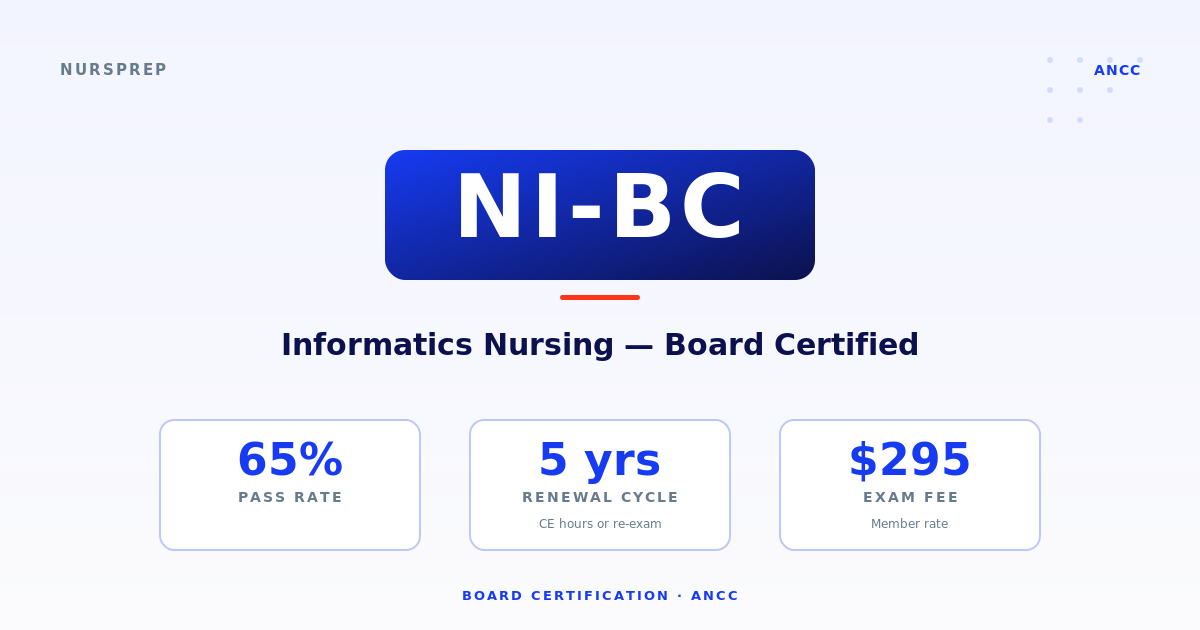
ANCC reported 229 of 352 first-time NI-BC candidates passed in 2025 — a 65% pass rate. That sits in the middle of ANCC's specialty exams, lower than headline NP pass rates partly because the blueprint spans practice foundations, system design, and data management rather than a single clinical domain.
To pass you need a scaled score of about 350 out of 500. Candidates who study the full blueprint — not just the EHR they use daily — and complete at least one full-length timed practice exam pass at meaningfully higher rates than those relying on work experience alone.
An 8-week NI-BC study plan
A structured 8-week plan is enough for most informatics RNs who already meet the practice-hour gate — roughly 80 to 120 total study hours across the three blueprint domains. Practice-question volume ramps through weeks 2–7 and peaks in week 7 with a full-length timed exam; week 8 is for targeted review and logistics.
-
1 WeekRead the ANCC Test Content Outline + baseline diagnostic exam
-
2 WeekFoundations: scope & standards, ethics, regulations (HIPAA, HITECH, Cures Act)
-
3 WeekFoundations: theories (DIKW), change management, interprofessional collaboration
-
4 WeekSystem Design Lifecycle: planning, analysis, design and build
-
5 WeekSystem Design Lifecycle: testing, training, implementation, maintenance
-
6 WeekData management: standards (SNOMED, LOINC, HL7, FHIR), warehousing, analytics
-
7 WeekFull-length timed practice exam + error-log review
-
8 WeekTargeted review of weak domains, rest, test day
How NI-BC candidates actually fail — and how to avoid it
Sample NI-BC question
This item mirrors the ANCC single-best-answer format: a short scenario and four plausible options where only one is best. Try it before you read the rationale.
Semantic interoperability — the ability of systems to exchange data with shared meaning — depends on standardized terminologies such as SNOMED CT and LOINC, which give clinical concepts consistent codes across systems and organizations. SSO addresses access, backups address data integrity, and help-desk staffing addresses support — all important, but none deliver semantic interoperability.
Key NI-BC terms every candidate should know
These terms surface across the three NI-BC domains. Review them until the definitions feel automatic — scenario items often hinge on recognizing which standard, framework, or lifecycle phase applies.
| Term | Definition | Domain |
|---|---|---|
| DIKW | Data-Information-Knowledge-Wisdom — the foundational metastructure describing how raw data is transformed into actionable wisdom in nursing informatics. | Foundations |
| Nursing informatics | The specialty that integrates nursing science with information science, computer science, and analytical sciences to manage data and support decision-making. | Foundations |
| HIPAA | Health Insurance Portability and Accountability Act — the federal statute governing the privacy and security of protected health information. | Foundations |
| HITECH Act | Health Information Technology for Economic and Clinical Health Act — promotes adoption and meaningful use of health IT and strengthens HIPAA enforcement. | Foundations |
| 21st Century Cures Act | Federal law advancing interoperability and prohibiting information blocking, including patient access to electronic health information. | Foundations |
| SDLC | System Development Life Cycle — the structured phases of planning, analysis, design, build, testing, implementation, and maintenance for clinical systems. | System Design |
| Clinical decision support (CDS) | Tools that deliver patient-specific, evidence-based guidance to clinicians at the point of care, often built into the EHR. | System Design |
| User acceptance testing | Non-functional testing in which end-users verify a system meets requirements before go-live. | System Design |
| Backout plan | A predefined procedure to revert to the prior system state if an implementation or upgrade fails. | System Design |
| SNOMED CT | A comprehensive, multidisciplinary clinical terminology used to code clinical findings, procedures, and concepts for interoperability. | Data Management |
| LOINC | Logical Observation Identifiers Names and Codes — a standard for identifying laboratory and clinical observations. | Data Management |
| HL7 / FHIR | Health Level Seven standards for health-data exchange; FHIR (Fast Healthcare Interoperability Resources) is the modern API-based standard. | Data Management |
| NMDS | Nursing Minimum Data Set — a standardized set of essential nursing data elements for comparison across settings. | Data Management |
| Interoperability | The ability of systems to exchange data and use it; semantic interoperability adds shared meaning via standardized terminologies. | Data Management |
| Data warehouse | A central repository that integrates data from multiple sources to support reporting, analytics, and decision-making. | Data Management |
NI-BC vs. RN-BC, CAHIMS, and CPHIMS
NI-BC sits alongside a few related credentials that informatics nurses sometimes consider — or confuse it with. The most important distinction is simply that RN-BC (informatics) is the former name of NI-BC, not a separate certification.
| Credential | Body | Scope | Best fit |
|---|---|---|---|
| NI-BC | ANCC | Nursing informatics across foundations, system design, data management | BSN-prepared RNs in informatics roles |
| RN-BC (informatics) | ANCC | Same credential — pre-2023 designation | Nurses certified before the 2023 rename |
| CAHIMS | HIMSS | Associate-level health IT and management systems | Early-career health-IT staff; open to non-nurses |
| CPHIMS | HIMSS | Professional-level health information and management systems | Experienced health-IT professionals, any discipline |
Take NI-BC if you are an RN validating nursing-specific informatics expertise. If you already hold RN-BC in informatics, you hold this credential under its old name. Consider CAHIMS or CPHIMS instead — or in addition — if your role is broader health IT rather than nursing-anchored informatics.
Frequently asked questions about NI-BC certification
NI-BC stands for Nursing Informatics-Board Certified. The credential is issued by the American Nurses Credentialing Center (ANCC).
Yes. RN-BC (informatics) was the designation for this credential until 2023, when ANCC renamed it NI-BC. Nurses certified before the change may still display RN-BC; it is the same credential.
Yes. ANCC requires a bachelor's or higher degree in nursing, an active RN license, two years of full-time-equivalent RN practice, 30 informatics CE hours within three years, and one of three informatics practice-hour options.
One of three options: 2,000 informatics hours in three years; or 1,000 hours plus 12 graduate semester hours of informatics coursework; or a graduate informatics program with at least 200 hours of supervised practicum.
The NI-BC exam is moderately difficult. The 2025 first-time pass rate was 65% (229 of 352 candidates). Candidates who study the full three-domain blueprint rather than only their daily EHR tend to do better.
The initial application is $395 for non-members, $295 for ANA members, and $340 for ANIA members. All fees include a $140 non-refundable administrative fee.
NI-BC certification is valid for five years. You renew by maintaining your RN license and completing ANCC's professional-development requirements during the certification period.
It is a computer-based test delivered year-round at Prometric test centers. You have three hours to answer 150 questions (125 scored plus 25 unscored pretest items).
You may retest under ANCC's retest policy, which requires a new application and fee and a waiting period before retaking the exam.
For BSN-prepared RNs in informatics roles, NI-BC is a recognized, ABSNC- and NCCA-accredited credential that signals validated expertise to employers and supports Magnet program goals.
Trusted sources
All figures on this page are verified against the following primary sources. Fees, blueprint weights, and renewal rules shift on ANCC's revision cycle — always verify numeric facts against the current ANCC NI-BC page and candidate handbook before relying on them for application decisions.
- American Nurses Credentialing Center (ANCC) — Informatics Nursing Certification (NI-BC) official page: eligibility, fees, exam format, and renewal
- ANCC — Informatics Nursing Test Content Outline (effective 2023-05-03): three-domain blueprint, 125 scored of 150 items
- ANCC — 2025 Certification Data report: 65% first-time pass rate (229 of 352), 3,536 active certificants as of 12/31/2025
- Alliance for Nursing Informatics — Nursing Informatics Credential From RN-BC to NI-BC: credential history and 2023 designation change
- HIMSS — coverage of the ANCC RN-BC to NI-BC designation change
- US Bureau of Labor Statistics (BLS) — Occupational Employment and Wage Statistics (May 2024) as salary context; BLS does not track nursing informaticists as a discrete occupation
Ready to practice NI-BC-style items?
Work through a 25-question diagnostic mapped to the ANCC three-domain blueprint. Free to start — no card required.