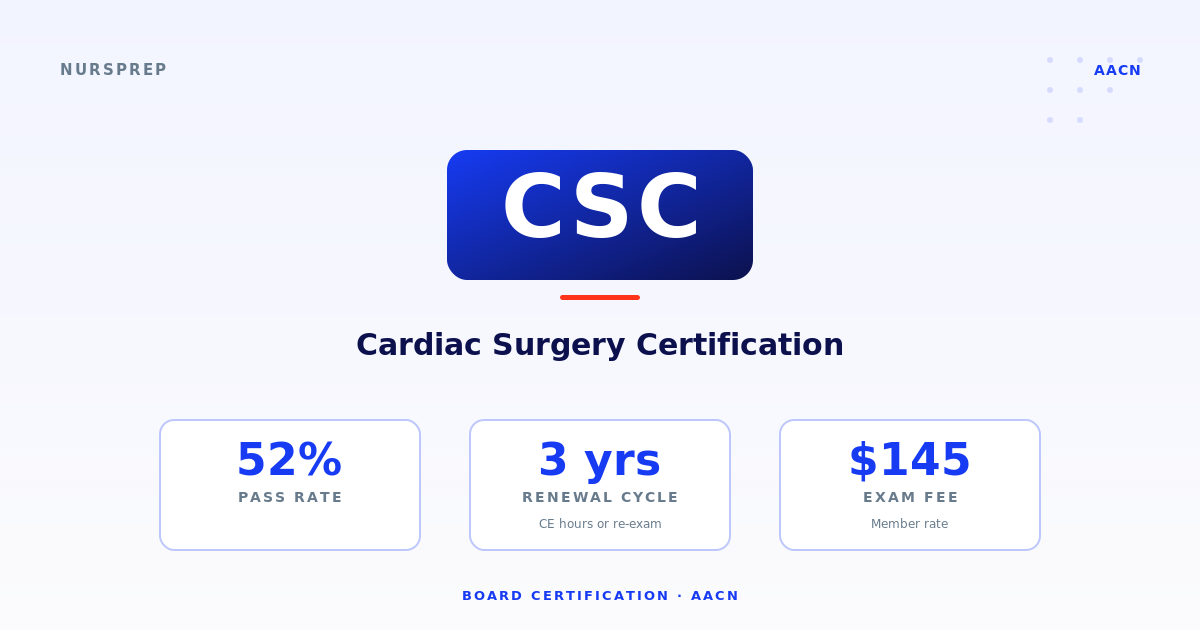
CSC certification at a glance
CSC — Cardiac Surgery Certification — recognizes RNs who deliver direct care to acutely/critically ill adult cardiac surgery patients in the first 48 hours postoperatively. The credential is issued by the AACN Certification Corporation, the certification arm of the American Association of Critical-Care Nurses. CSC is a subspecialty: it attaches to an existing nationally accredited clinical specialty certification — typically CCRN or PCCN — so it cannot be a candidate's first certification.
The CSC scope is post-op cardiac surgery care — coronary artery bypass grafting (CABG), valve repair and replacement, the MAZE procedure, and related vascular surgery, plus the bleeding, hemodynamic, pulmonary, and renal complications that follow. If your unit is a cardiothoracic surgery ICU, cardiovascular surgical ICU, open-heart recovery, or a PACU receiving fresh post-op hearts, CSC matches your day-to-day practice. CMC, the sibling subspecialty, covers acutely ill adult cardiac patients in cardiac medicine rather than the surgical first 48 hours.
Am I eligible for the CSC exam?
Yes — if you hold an active, unencumbered U.S. RN or APRN license, a current nationally accredited clinical nursing specialty certification (the CSC attaches to it), and you meet one of two clinical-practice-hour options.
AACN sets the hours specifically around adult cardiac surgery patients within the first 48 hours postoperatively. Hours must be completed in a U.S.- or Canada-based facility (or a comparable acute/critical-care setting) and must be verifiable by your clinical supervisor or a professional colleague if you are selected for audit.
You are eligible if…
- You hold an active, unencumbered U.S. RN or APRN license.
- You already hold a current nationally accredited clinical specialty certification (such as CCRN or PCCN) for the CSC to attach to.
- Two-Year Option: 1,750 hours of direct care of acutely/critically ill adult patients over the previous two years (875 in the most recent year), of which 875 hours were in adult cardiac surgery patients within the first 48 hours postoperatively.
- Five-Year Option: at least 2,000 hours over the previous five years (144 in the most recent year), of which 1,000 hours were in adult cardiac surgery patients within the first 48 hours postoperatively.
CSC exam blueprint — four domains
The CSC blueprint is four domains. Therapeutic Interventions (36%) and Complications (31%) together carry about two-thirds of the exam — most of your study time should live there. Procedures (19%) and Monitoring and Diagnostics (15%) round out the form.
- Therapeutic Interventions (chest tubes, drips, pacing, ventilation, glycemic, pain) 36%
- Complications (CV, pulmonary, endocrine, heme/immuno, neuro, GI, renal, multisystem) 31%
- Procedures (CABG, MAZE, valve repair/replacement, vascular surgery) 19%
- Monitoring and Diagnostics (CVP, capnography, pulse oximetry, ABGs, coag labs, ECG) 15%
The weighting reflects the bedside reality of the first 48 post-op hours: managing chest tubes, vasoactive drips, temporary pacing, ventilation, and tight glycemic control (interventions), then recognizing and responding to bleeding, tamponade, low cardiac output, dysrhythmias, and renal or pulmonary decline (complications). Candidates who know the surgical procedures but underprepare for complication recognition tend to lose the most points.
Cost, scheduling, and renewal fees
AACN delivers the CSC exam through its testing service, PSI, at PSI test centers, with a paper option also available. After AACN approves your application, you receive scheduling instructions — book your seat promptly to stay inside the testing window. Computer-based candidates receive a pass/fail score report at the end of the exam.
| Fee item | Cost (USD) |
|---|---|
| Initial exam — AACN member | $145 |
| Initial exam — non-member | $235 |
| Renewal by exam — member | $120 |
| Renewal by exam — non-member | $165 |
| Renewal by Synergy CERPs — member | $75 |
| Renewal by Synergy CERPs — non-member | $130 |
| AACN annual membership (reduces exam fee) | Varies by tier |
Renewal
CSC certification is valid for three years, beginning the first day of the month you passed the exam. Pathway 1 — Renewal by Synergy CERPs: earn 25 Category A Clinical Judgment CERPs within the three-year cycle and maintain continued clinical practice (432 hours of direct care of adult postoperative cardiac patients, with 144 hours in the most recent 12 months).
Pathway 2 — Renewal by Examination: retake and pass the current CSC exam. Because CSC attaches to an underlying CCRN or PCCN, most nurses sync the CSC renewal with that base credential. A lapsed CSC must be earned again by exam — there is no grace period.
How hard is the CSC exam?
The CSC passing standard is a cut score of 55 correct out of 75 scored items, in effect since 2022-01-31. The passing score is a raw number, not a percentage, set through the modified-Angoff method with PSI psychometricians. The 15 unscored pretest items do not count toward your result.
AACN reported a 52.2% first-time pass rate in 2025 (1,184 candidates tested), down from 51.3% in 2024 and 69.7% in 2023. The sharp drop from the high-60s to the low-50s likely reflects content updates following AACN's 2020 National Practice Analysis of Cardiac Surgery Nurses. The CSC is now one of AACN's harder subspecialty exams — structured, complication-focused preparation matters.
An 8-week CSC study plan
Eight weeks is enough for most cardiac surgery RNs who already hold CCRN or PCCN — roughly 60 to 100 total study hours across the four blueprint domains. Weight your time toward Therapeutic Interventions and Complications (about two-thirds of the exam), and finish with a full-length timed practice run plus a targeted review of weak areas.
-
1 WeekRead the AACN CSC test plan + baseline diagnostic exam
-
2 WeekTherapeutic interventions I — chest tubes, temporary pacing, vasoactive/inotrope drips
-
3 WeekTherapeutic interventions II — ventilation/weaning, glycemic control, pain management
-
4 WeekComplications I — bleeding, tamponade, low cardiac output syndrome
-
5 WeekComplications II — post-op dysrhythmias, renal, pulmonary, neuro events
-
6 WeekProcedures — CABG, valve repair/replacement, MAZE, vascular surgery
-
7 WeekMonitoring and diagnostics — CVP/PA pressures, capnography, ABGs, coag labs, ECG
-
8 WeekFull-length timed practice exam + error log; targeted review and rest
How CSC candidates actually fail — and how to avoid it
Sample CSC question
This item mirrors AACN's scenario format for the post-op cardiac surgery patient: a short clinical stem and four plausible options where only one is best. Try it before reading the rationale.
Equalizing/rising filling pressures (rising CVP) with a falling cardiac index, plus a sudden drop in chest-tube drainage and muffling heart sounds, point to blood accumulating in the pericardial space (tamponade) rather than draining out. Tachycardia and hypotension occur in both tamponade and hemorrhage, so they do not distinguish the two. The clotted, suddenly slowing chest tube paired with the hemodynamic picture is the key — it warrants urgent surgical notification and preparation for re-exploration.
Key CSC terms every candidate should know
These terms surface across CSC exam items. Review them until the definitions feel automatic — scenario stems often hinge on recognizing which post-op syndrome or intervention applies.
| Term | Definition | Domain |
|---|---|---|
| Low cardiac output syndrome (LCOS) | Post-op state of inadequate cardiac index (often <2.0 L/min/m²) despite adequate filling, managed with inotropes, afterload reduction, and sometimes mechanical support. | Complications |
| Cardiac tamponade | Blood accumulating in the pericardial space compressing the heart; signs include rising/equalizing filling pressures, falling cardiac output, muffled heart sounds, and an abruptly slowing chest tube. | Complications |
| Mediastinal chest tube | Drain placed after cardiac surgery to evacuate blood from the pericardial and mediastinal space; sustained high output or sudden cessation are both red flags. | Interventions |
| Temporary epicardial pacing | Pacing wires placed on the heart during surgery used post-op to manage bradycardia, heart block, and low output via atrial, ventricular, or AV-sequential pacing. | Interventions |
| Inotropes | Agents (epinephrine, dobutamine, milrinone) that increase myocardial contractility to support cardiac output after cardiopulmonary bypass. | Interventions |
| Post-op atrial fibrillation | The most common dysrhythmia after cardiac surgery, typically peaking on post-op days 2–3; managed with rate/rhythm control and anticoagulation considerations. | Complications |
| CABG | Coronary Artery Bypass Grafting — revascularization using arterial or venous conduits to bypass coronary stenoses. | Procedures |
| MAZE procedure | Surgical ablation creating scar lines in the atria to interrupt re-entrant circuits and treat atrial fibrillation. | Procedures |
| Cardiac index | Cardiac output normalized to body surface area (L/min/m²); a primary hemodynamic target in the first 48 post-op hours. | Monitoring |
| Mixed venous oxygen saturation (SvO2) | Reflects the balance of oxygen delivery and consumption; a falling SvO2 signals worsening cardiac output or oxygenation post-op. | Monitoring |
CSC vs. CMC, CCRN, PCCN
CSC sits alongside its sibling AACN credentials. The most common mix-up is CSC versus CMC — both are AACN cardiac subspecialty add-ons with the identical 90-item format, but they cover different patients.
| Credential | Body | Scope | Best fit |
|---|---|---|---|
| CSC | AACN | First 48 hours after adult cardiac surgery | CCRN/PCCN-certified post-op cardiac surgery RNs |
| CMC | AACN | Acutely/critically ill adult cardiac patients (medicine) | CCRN/PCCN-certified cardiac medicine RNs |
| CCRN (Adult) | AACN | Broad adult critical care (standalone base cert) | Adult ICU RNs; the most common CSC prerequisite |
| PCCN | AACN | Progressive/intermediate adult care (alt base cert) | Progressive-care RNs; an alternate CSC prerequisite |
Take CSC if most of your shift is fresh post-op cardiac surgery patients in their first 48 hours. Take CMC instead if your cardiac patients are medical rather than surgical. Either way, you must already hold a CCRN, PCCN, or another accredited specialty certification first — CSC and CMC are subspecialty add-ons, not standalone credentials.
Frequently asked questions about the CSC exam
CSC stands for Cardiac Surgery Certification. It is a subspecialty credential issued by the AACN Certification Corporation for RNs caring for adult cardiac surgery patients in the first 48 hours postoperatively.
No. CSC is a subspecialty add-on. You must already hold a current, nationally accredited clinical nursing specialty certification — most commonly CCRN or PCCN — for the CSC credential to attach to.
The CSC exam has 90 multiple-choice items, of which 75 are scored and 15 are unscored pretest items. The passing cut score is 55 correct out of the 75 scored items, in effect since January 31, 2022.
The CSC exam is difficult. The first-time pass rate was 52.2% in 2025 and 51.3% in 2024, down from 69.7% in 2023 after content updates. Bedside experience alone is no longer enough; structured preparation is essential.
The initial CSC exam fee is $145 for AACN members and $235 for non-members. Renewal by exam is $120 (member) or $165 (non-member); renewal by Synergy CERPs is $75 (member) or $130 (non-member).
Both are AACN cardiac subspecialty add-ons with the same 90-item format. CSC covers the first 48 hours after cardiac surgery, while CMC (Cardiac Medicine Certification) covers acutely ill adult cardiac patients in cardiac medicine more broadly.
CSC is valid for three years. You renew by earning 25 Category A Clinical Judgment CERPs plus continued clinical practice, or by retaking the exam. Most nurses sync the CSC renewal with their underlying CCRN or PCCN.
You meet one of two options: 1,750 hours over two years (875 in the most recent year) with 875 in adult cardiac surgery patients within 48 hours post-op; or 2,000 hours over five years (144 in the most recent year) with 1,000 in post-op cardiac surgery patients.
Many cardiac surgery programs and health systems reimburse the CSC fee through an education benefit and offer paid study time. Ask your unit educator or HR before paying out of pocket.
Trusted sources
All figures on this page are verified against the following primary sources. Fees, blueprint weights, cut scores, and renewal rules shift on AACN's revision cycle — always verify numeric facts against the current AACN CSC Exam Handbook before relying on them for application decisions.
- AACN Certification Corporation — CSC (Adult) Get Certified page: eligibility, initial fees ($145 member / $235 non-member)
- AACN — Certification Exam Statistics and Cut Scores: CSC pass rates (2023 69.7%, 2024 51.3%, 2025 52.2%), 90 items / 75 scored, cut score 55 (effective 2022-01-31)
- AACN — CSC (Adult) Certification Renewal page: 3-year cycle, 25 Category A Clinical Judgment CERPs, 432/144 practice hours, renewal-by-exam fees
- AACN — CSC Exam Handbook: test plan, four-domain blueprint (Therapeutic Interventions 36%, Complications 31%, Procedures 19%, Monitoring and Diagnostics 15%), sample questions
- AACN — Frequently Asked Questions About CMC and CSC Certification: CSC vs CMC scope and the subspecialty add-on rule
- AACN — 2020 National Practice Analysis of Cardiac Surgery Nurses (Study of Practice): basis for current exam content
Ready to practice CSC-style items?
Work through a 25-question diagnostic mapped to the AACN CSC four-domain blueprint. Free to start — no card required.